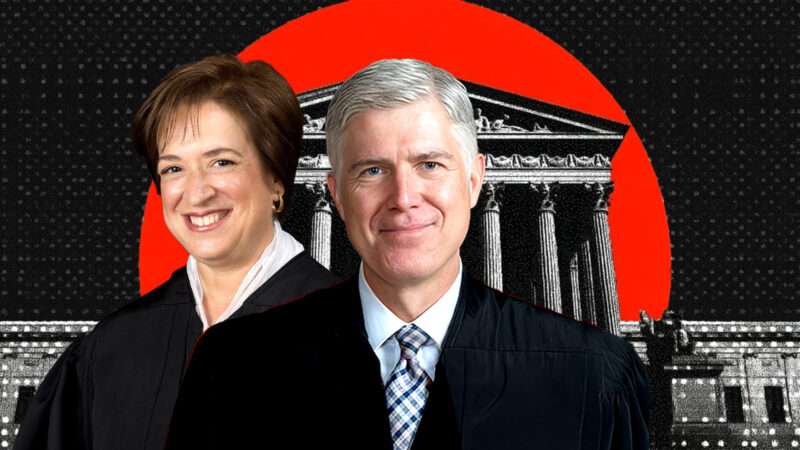
The U.S. Supreme Court heard oral arguments yesterday in a case with huge implications for both presidential power and the future of independent federal agencies. Yet the big question on the mind of the justices was seemingly not whether President Donald Trump should win—since they all seemed to accept that he was going to win, whether they individually liked it or not—but rather, the big question seemed to be just how broad or narrow Trump's legal victory was going to be.
The case is Trump v. Slaughter. At issue is Trump's purported firing of Rebecca Slaughter for purely political reasons from her position as a commissioner of the Federal Trade Commission (FTC). Standing in the way of Trump's actions is a 1935 Supreme Court precedent called Humphrey's Executor v. United States, in which the Court unanimously held that President Franklin Roosevelt exceeded his lawful authority when he tried to fire an FTC commissioner for purely political reasons.
"Humphrey's Executor should be overruled," declared Solicitor General John Sauer, who argued that independent federal agencies such as the FTC are actually a "headless fourth branch" of government that ought to be placed under the control of a unitary executive.
The Supreme Court's six Republican-appointed justices all signaled varying degrees of support for Trump's ability to fire an FTC commissioner at will. Based on what I heard yesterday, Trump is very likely to succeed in his quest to oust Slaughter.
But several of those same six justices also seemed to stop short of endorsing the administration's broader call for overruling Humphrey's Executor. Justice Brett Kavanaugh, for example, brought up the worry that if Trump is able to fire an FTC commissioner at will, he will also be able to fire a top Federal Reserve official at will. "I share those concerns," Kavanaugh said. He seemed to be looking for a way to distinguish the FTC from the Federal Reserve in a manner that would let Trump control the former but not control the latter.
Justice Amy Coney Barrett, meanwhile, explored ways in which the government might win by further narrowing Humphrey's Executor, rather than by overturning it.
Trump's position in this case rests on the idea that because the FTC exercises executive power, the agency must be brought entirely within the confines of the executive branch.
But Justice Elena Kagan challenged that idea by pointing out that the FTC and other such independent federal agencies also exercise significant legislative power, such as when an agency makes federal rules. Which means that if Trump wins and the FTC falls under complete executive control, the president stands to gain all of that legislative power, too.
"Isn't it problematic," Kagan told Sauer, "given what we know about the founders' vision, that what this is going to amount to at the end of the day is putting not only all executive power in the President but an incredible amount of legislative/rulemaking power and judging in the President's hands?"
Justice Neil Gorsuch spoke up a few minutes later to share Kagan's worries. "The one thing our Framers knew is that every political actor seeks to enhance its own power," he told Sauer. "We all know that to be true from our own experiences. And this Court, as part of this bargain, has allowed these agencies to exercise both executive and legislative." However, Gorsuch added, "if they're now going to be controlled by the President, it seems to me all the more imperative to do something about it."
For me, this was one of the most fascinating aspects of the day's arguments. Kagan, the liberal jurist, was in a sort of harmony with Gorsuch, the conservative textualist, about the fact that Congress has relinquished many lawmaking powers to federal agencies.
Yet only Gorsuch seemed interested in taking Congress to task for its role in creating the problem. It was Gorsuch, not Kagan, who pointed out that Congress was guilty of abdicating the lawmaking authority that Congress itself should have been jealously guarding. And it was Gorsuch, not Kagan, who also pointed an accusing finger at the Supreme Court's own permissive brand of judicial review in past delegation cases. "Is the answer," Gorsuch asked, for the Court to "recognize that Congress cannot delegate its legislative authority?"
That is almost certainly not going to be the Supreme Court's answer in this case, although I do look forward to reading a possible Gorsuch concurrence that argues for limiting the power of the executive through the use of the non-delegation doctrine.
Before You Go
Reason's annual webathon is coming to a close today, and I wanted to encourage you one last time to consider making a donation to help support my work and the work of my colleagues. Your generous support makes our endeavors possible. Thank you!
The post SCOTUS Sounds Ready To Let Trump Fire FTC Commissioner Rebecca Slaughter appeared first on Reason.com.