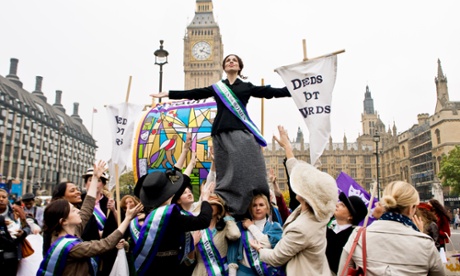
Women remain significantly under-represented amongst candidates chosen to fight Scottish parliamentary seats in this year’s general election, making up just over a quarter of those selected.
A new survey by Fiona Mackay and Meryl Kenny, senior academics who run the gender politics blog hosted by the University of Edinburgh, finds that 29% of the candidates for Scotland’s 59 Commons seats selected by the five main parties (the Conservatives, Labour, Liberal Democrats, Scottish Greens and Scottish National party) are women.
A similar survey by the BBC, based on all the reported candidates so far, puts the figure slightly lower at 28%: its political correspondent Glenn Campbell reported on Sunday that of the 263 candidates it had counted, only 74 were women.
Kenny, a lecturer at the University of Leicester and co-convenor of the Political Studies Association women and politics group, and Mackay, dean of the school of social and political science at the University of Edinburgh, point out even these figures are an improvement on the 2010 general election where just 24% of candidates were women.
Predicting how many of women candidates stand a good chance of being elected is extremely tricky this year: the SNP surge, the Labour slump and the Lib Dem collapse makes it far harder to speculate on which parties will win which seats.
The SNP, after years of refusing to implement positive action programmes to select women candidates – a position which has led it badly lagging in the past, has done surprisingly well this year in its gender balance.
Its candidate list is 36% women, say Kenny and Mackay, in a new blog for the Political Studies Association. That compares to 26% for the Lib Dems (the BBC reports it is 27%); 28% for Labour (the BBC reports it is 26%); the Tories on 18% (the BBC says 17%) and, agree both surveys, 42% for the Scottish Greens, with 13 out of 31 so far selected. That suggests the Greens seem to have breached its policy in other elections of having a full 50/50 share. The UK Independence party has yet to announce its full candidates list for Scotland.
(The variation between the two sets of numbers is because the full, final list of candidates is not yet in place and perhaps because either of the surveys misread a gender neutral name.)
Even though the overall candidates list is slightly better than 2010, Kenny and Mackay say that Scotland’s cohort of MPs elected on 7 May is likely to be very heavily male-dominated – as usual.
While the uncertainties of the 2015 elections have made it difficult for forecasters, there is one outcome that we can predict with a high degree of certainty - the majority of the MPs that Scotland sends to Westminster – as elsewhere in the UK- will still be men.
The SNP’s performance this year, which comes despite having no positive action policies or women only shortlists, could in principle see a net increase in women Scottish MPs elected this year if the polls are correct that it is on the brink of a landslide.
Kenny and Mackay say Nicola Sturgeon’s election as party leader and first minister “has created new momentum for change” with her gender equal cabinet and public support for the cross-party Women 50/50 campaign.
The BBC quotes Sturgeon hinting she plans to introduce further internal selection policies:
We’ve got some fantastic talented women in winnable seats. I am pleased with that progress but it’s not good enough. I want us to do more. I am determined to lead by example, which is why I lead one of the only gender balanced cabinets in the world.
Yet, Sturgeon is still hesitant to commit herself explicitly to asking for quotas, zipping or all women shortlists – the old, pre-referendum SNP was notoriously resistant to equal opportunities policies in candidate selection. But Sturgeon has now said she is interested in pushing the discussion:
My personal view is that we certainly should look at that and not rule that out.
Kenny and Mackay add, however, that an SNP national executive committee rule change to centralise candidate selection could in future allow the leadership “the organizational capacity to implement quotas if it so wished.”
The academics say that historically, the SNP has struggled to portray itself as “women friendly”.
The issue of women’s representation has been less prominent despite the efforts of feminists inside the SNP, and the party has – to date - rejected the use of quota-type measures.
As a result, the Labour party in Scotland has outperformed the SNP in terms of its selection and election of female candidates at Holyrood and Westminster, employing positive action including gender quotas. Currently, women comprise 47% of Labour MSPs compared with only 27% of SNP MSPs.
But they add that the post-referendum surge in SNP membership after the referendum campaign could see party membership and attitudes dramatically change:
The SNP has thus been the beneficiary of widespread mobilization around the Yes Campaign. And 44% of SNP members are women, including many grassroots feminists who saw independence as a means to create a gender-equal social democracy. Indeed, some prominent leaders of the Women for Independence campaign group are standing as candidates for Westminster.
But it has a significant advantage over Labour missed by Kenny and Mackay: Labour’s more deliberate policies on promoting women candidates are hampered by the fact that it has far fewer vacant, open seats to compete for. In theory, Labour is committed to filling vacant seats with many more women candidates.
Since 40 out of Scotland’s 59 MPs are presently Labour and all but 11 of them are male, and since only a small number of male MPs are standing down (Alistair Darling and Gordon Brown amongst them), this makes it far tougher for an incrementalist approach like that to improve the gender balance.
Since the SNP has only six MPs – until 7 May that is – there are 53 seats where the party has vacancies and can therefore have an open contest.
But Kenny and Mackay do make this pointed criticism of Labour: even if it does have a policy of using vacancies to address gender inequalities, it seems to have failed to do so this time around. They report:
Questions can be asked of Labour. Whilst its percentage of female candidates improved slightly from 2010 figures, only two selections used the quota type mechanism of All Women Shortlists (AWS): Glenrothes (a retirement seat where the sitting MP had stepped down) and Argyll and Bute.
This compares to the previous general election, when five of the six new women Scottish Labour MPs elected in 2010 had been selected using AWS. The use of these measures was reflected in the overall results - 11 of the 13 Scottish women MPs elected in 2010 came from the Labour party.
The BBC reports that Scottish Labour’s deputy leader Kezia Dugdale, a founder of Women 50/50, suggests the party will tackle this in future:
We don’t want to leave this to fate or to chance anymore. We want this written into law that political parties should field 50/50 candidates.
The academics conclude:
A political earthquake is forecast for Scotland in the General Election 2015, but despite some positive developments, it doesn’t add up to a genderquake. The SNP seems poised to take over from Labour as leaders on the issue of women’s representation in this election at least, although it is far from clear whether that will translate into support for quotas in the future. But without system-wide statutory quotas, it remains the case that gains in women’s representation are contingent upon party will or individual champions.
13.30 UPDATE: Glenn Campbell adds that the BBC figures include three further Lib Dem candidates whose names were added on Saturday and one Tory female candidate being replaced by a male candidate late last month.