Summary
- A Scottish nurse being treated for Ebola, after becoming the first person to be diagnosed with the virus on UK soil, has been named in news reports as Pauline Cafferkey, an NHS nurse based in Blantyre, South Lanarkshire.
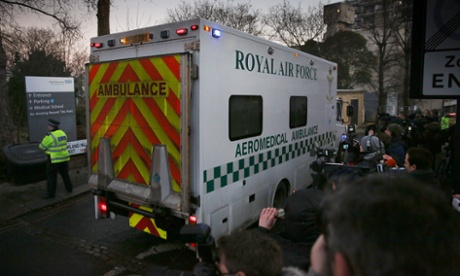
- Scottish first minister Nicola Sturgeon said the patient, who is being treated at the Royal Free hospital in London is doing “as well as can be expected in the circumstances”. Cafferkey was transferred in an RAF Hercules from Gartnavel hospital in Glasgow to the Royal Free, which houses he UK’s main Ebola treatment centre, on Monday morning.
- The Scottish authorities have contacted 63 out of 70 other patients who were on the nurse’s flight from Heathrow to Glasgow, Sturgeon said. She said the 63 had either been spoken to directly or had had messages left for them. Out of the eight patients sat closest to the nurse, five have been spoken to and three have had messages left, she said.
- A doctor who sat next to Cafferkey on a plane returning from Africa accused health officials of jeopardising public safety by allowing at-risk volunteers to use public transport and enter crowded places once they arrive back in the UK. Sturgeon said that “robust procedures” were in place but that they were kept under continual review.
- David Cameron chaired a meeting of the emergency committee Cobra to discuss Ebola. He said the risk to the public was “extremely low”.
- A second Scottish health worker who has returned from West Africa is being tested for Ebola but Sturgeon said that it is “low probability” that it will come back positive. The results of the test are expected this evening. In the meantime the patient is being transferred from the Highlands to Aberdeen as a precaution.
One year into the epidemic, here's how much countries have actually donated to the Ebola fight http://t.co/YcsXX2L1ZJ pic.twitter.com/MnfDXDOfn0
— Vox (@voxdotcom) December 30, 2014
The second Scottish healthcare worker suspected, albeit with a low probability, according to Nicola Sturgeon, of having Ebola, is being transferred to Aberdeen Royal Infirmary for tests. It is believed that she was staying at the Torridon Youth Hostel, in the Highlands.
An NHS Grampian spokeswoman told the Aberdeen Evening Express:
The patient, a female adult, is low risk but became unwell following her return from a country with an Ebola outbreak within the last 21 days.
The patient is stable and is not giving any cause for clinical concern.
Here is the full quote by Scottish first minister Nicola Sturgeon on the condition of the nurse, currently being treated for Ebola at the Royal Free hospital in London:
The latest update we have on the condition of the patient is that she is doing as well as can be expected in the circumstances.
We’re not going to provide a running commentary at this stage on the clinical condition of the patient for reasons I am sure you will understand. If there are any material developments then they will be conveyed to the media as is appropriate.
But I think the most important thing is that the patient and the clinical team caring for her are given the space and the privacy to make sure that she gets the best possible treatment and given the best possible chance of a speedy and full recovery.
I will take the opportunity, I’m sure on behalf of everyone in the country, of wishing her all the best and wishing her that speedy recovery.
NHS Glasgow: Ebola patient has mild symptoms and her prognosis is good
— Gerard Tubb (@TubbSky) December 30, 2014
Sturgeon says she understands the public interest in the story but asks that the privacy of the patient, and that of her family, friends and colleagues is respected.
The patient in question was not displaying any of the symptoms that would have put other people at risk. This is not an airborne disease.
Asked about the claim by Dr Martin Deahl, who was sitting next to the nurse subsequently diagnosed with Ebola on the flight back from Morocco, that the quarantine regulations are “utterly illogical”, Sturgeon says she will not respond to comments that she has not seen but insists that procedures are “robust ...and kept under review”.
We need to learn from cases where cases arise ...We will look at this case and ensure that if there are improvements to be made, lessons to be learned, we will do that.
Coverage of the press conference has ceased.
Updated
The risk to any other person, including other passengers on the same flight as the infected nurse, are “extremely low”, Sturgeon reiterates.
There is no cause for the public to be unduly concerned about the situation we are facing right now.
Syed Ahmed, from Health Protection England, says efforts are ongoing to trace the other seven patients, who were on the Heathrow to Glasgow flight.
In response to a question from my colleague Severin Carrell, Sturgeon says she is aware of the reports naming the nurse but will not comment on her identity due to patient confidentiality.
Sturgeon says 63 out of 70 people who were on the flight from Heathrow to Glasgow alongside the Scottish nurse with Ebola have been contacted. They have either been spoken to directly or a message has been left for them. She does not have the details of the flight from Morocco to Heathrow as that is a matter for the English authorities.
She stresses again that the possible second case in Scotland has a “very low probability” of testing positive for Ebola.
Updated
Ebola patient doing 'as well as could be expected'
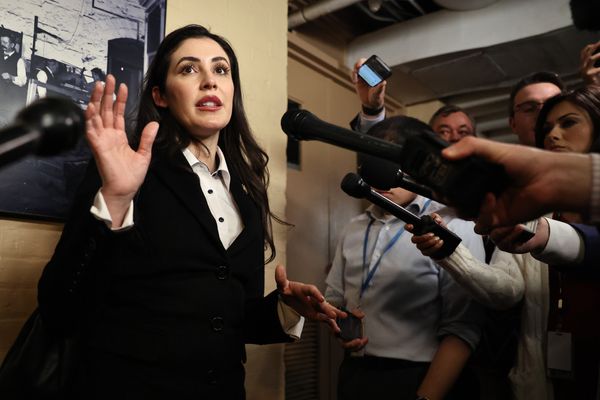
The Scottish first minister Nicola Sturgeon is speaking at a press conference now. She said she attended the meeting of emergency committee Cobra chaired by David Cameron today.
She says the patient is “doing as well as could be expected in the circumstances”. Sturgeon does not name her and says there will not be constant updates on her condition.
Pauline Cafferkey had been volunteering at a newly built hospital at Kerry Town in Sierra Leone run by the charity Save the Children since 23 November.
Between 5 November and Boxing Day, 66 patients at the treatment centre were cured and discharged, according to Save the Children.
Abdullai Jalo, a 27-year-old student from Freetown, was one of six patients discharged on Boxing Day. He said:
I was treated very well here. As soon as I came to Kerrytown, I was put on some drips [to rehydrate], and the doctors advised me that I should try and eat and drink a lot. I started to feel a little better and eating a little as well. I was given food three times a day, and the doctors were kind and encouraged me and others to get better, they talked to us and told us not to worry. Little by little I started to feel strong, and I tried to eat more. And then they tested me to see if I was cured, and today the test came out negative.
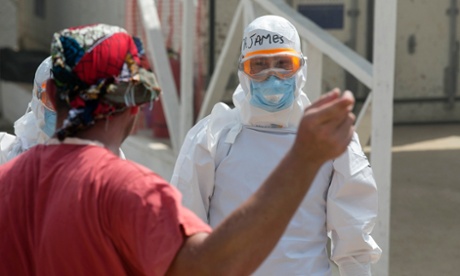
UK nurse with #Ebola, Pauline Cafferkey, told BBC she was "prepared for risks" - interview: http://t.co/rmLcIQBWqf pic.twitter.com/k05cX0OHpl
— BBC News (UK) (@BBCNews) December 30, 2014
Scottish first minister Nicola Sturgeon is due to hold a press conference at 1pm in Glasgow.
I'm about to chair a COBRA on Ebola. Safety measures are working well - and the risk to the public is extremely low.:
— David Cameron (@David_Cameron) December 30, 2014
Ebola patient named as Pauline Cafferkey
The Scottish healthcare worker, who is being treated in London for Ebola, had asked Save the Children, who she was volunteering with in Sierra Leone, not to name her but she is now widely being reported to be Pauline Cafferkey, an NHS nurse based in Blantyre, South Lanarkshire.
My colleague, Severin Carrell, the Guardian’s Scotland correspondent, writes:
A nurse for 16 years and originally from Fife, Cafferkey is one of five Scottish NHS workers who volunteered to work at a Save the Children specialist Ebola hospital in Sierra Leone in November, and wrote a detailed diary about her experiences there.
In her diary, published earlier this week by Scotland on Sunday, she wrote in detail about the health security precautions taken for the 14 volunteers based at the 50-bed Save the Children clinic at Kerry Town. She and her colleagues were kept isolated from the local people.
“The area where the Ebola patients are is classed as the infective Red Zone, and the area surrounding it, the safe Green Zone. Bizarrely we find ourselves saying “good luck” to our colleagues prior to entering the Red Zone, a sobering reminder of what we are doing,” she wrote during her first week.
“I was ill the other day, either from over-hydration as not enough salts in my body or heat exhaustion. It’s very difficult to judge the amount of fluid needed as the quantities we loose are immense. The ORS [oral rehydration salts] which get added to water to help balance out the body’s salt and sugars that are being lost are not the most palatable. I vomited out of the minibus window on the way home – luckily I managed to avoid any splash back and being decapitated.”
Updated
The doctor who sat next to Britain’s second Ebola patient on a plane returning from Africa has accused health officials of risking public safety by allowing at-risk volunteers to use public transport and enter crowded places once they arrive back in the UK, my colleague Josh Halliday writes.
Dr Martin Deahl, who returned from west Africa with the Scottish nurse who was diagnosed on Monday with the virus, told the Guardian that the “utterly illogical” Public Health England rules made “a complete mockery of the quarantine arrangements”.
He described the scenes at Freetown airport, where up to 30 volunteers who had met to travel back to the UK, said goodbye “kissing and hugging” one another – including the nurse. Ebola is not contagious before patients develop symptoms, and the health authorities in Scotland have confirmed that the nurse had none until she arrived home from her journey.
Under current guidelines, health workers who have been in direct contact with Ebola victims are allowed to catch public transport once they arrive at a UK airport to travel home – but once they are at home they are told not to catch buses, trains or planes or enter crowded places.
“The ridiculous thing about this is the advice says once we are home we shouldn’t use public transport or go into crowded places, or if we do it should just be for short journeys of less than an hour, and yet they were quite happy to let us go home disperse from UK airports on the underground, on flights to Glasgow, which just makes a complete mockery of the quarantine arrangements,” said Deahl.
“It just begs the question whether they gave that advice because they didn’t want to spend the money on taking us home.
Important to remember than 500 people a week travel to and from Sierra Leone and this is the first Ebola case since outbreak in May
— lisa o'carroll (@lisaocarroll) December 29, 2014
Ebola maths: Number of patients treated in US, Europe: 19. No of deaths: 5 deaths. Number of cases in Africa? 20,000 +. No of deaths: 7,842
— lisa o'carroll (@lisaocarroll) December 29, 2014
#Ebola doesn’t spread through the air like flu – get more Ebola info from @NHSChoices http://t.co/dOtbVdzodS pic.twitter.com/Z8BIt3ZwBe
— PublicHealthEngland (@PHE_uk) December 30, 2014
1/3 Def Sec: I wish to praise the professionalism of RAF’s C130 aircrew and NHS staff who transported the UK Ebola Virus patient to London.
— Ministry of Defence (@DefenceHQ) December 30, 2014
2/3 Def Sec: This has again demonstrated the benefits and capability that the Armed Forces bring to the UK as a whole.
— Ministry of Defence (@DefenceHQ) December 30, 2014
3/3 Def Sec: Our thoughts remain with the patient and their family at this time.
— Ministry of Defence (@DefenceHQ) December 30, 2014
My colleague Lisa O’Carroll has sent through this useful explainer of the precautions that are taken at the unit where the Scottish nurse will be treated in London:
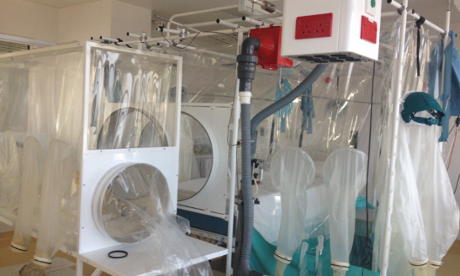
This is the state-of-the-art polythene “patient isolator” unit at the Royal Free Hospital where the nurse who has contracted Ebola will be treated.
There, she will remain isolated from staff in the high-tech tent which comes with inbuilt hats, sleeves and gloves to allow clinical care while protecting staff.
She will only be able to communicate with family and friends by a telephone on a wall in the corridor outside.
The HLIU contains just two beds, three specialist disposal units for biohazardous material, showers, and administration area where the infectious disease consultant will direct treatment.
It is in high contrast to the wards where Ebola patients are treated in Sierra Leone. The tent costs £25,000 alone.
The hospital is on permanent standby for its use and has been on extra high alert for Ebola patients since the outbreak started with extra supplies from Public Health England delivered in September to cater for a multitude of cases.
Nurses and doctors entering the specially sealed bed unit will wear protective clothing and will only access the patient through special sleeves built into the tent to allow clinical care including the taking of bloods and administration of intravenous therapies.
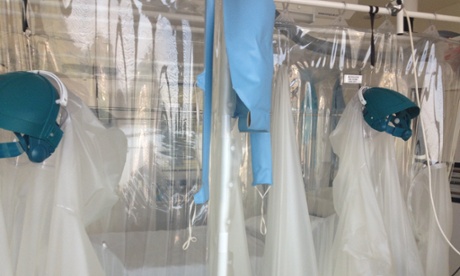
A second tented unit, which bolts onto one end of the tented bed, will be used to pass the patient food and drink, while anything being removed from the unit including plates, cutlery and body waste will be heat sealed by a special device at the other end of the bed. They will then be removed for disposal in an autoclave.
These are not incinerators, but high pressure chambers which will subject needles, waste, clothing, to to high pressure saturated steam at 121 °C before disposal.
Stephen Mepham, the infectious diseases and microbiology consultant who flew to Sierra Leone to accompany Pooley home when he was evacuated by the RAF, took the Guardian on the tour of the unit in September.
He explained that the air is kept its air at negative pressure and that it was systematically replaced because of the possibility of “aerosolisation” of particles through coughing.
The unit will be staffed by dozens of doctors and nurses trained for “category four” infectious diseases. Many of these will volunteer from other London hospitals for the duration of the treatment.
They will operate under strict protocols covering everything from food and drink to removal of materials, and movement of staff through a one-way flow of people through the ward.
Access to the ward is electronically protected, floors are colour-coded for contamination and non-contamination areas and only a handful of doctors and nurses who will be allowed enter the bed unit itself.
Updated
CMO Sally Davies: "important to be reassured that although an #Ebola case has been identified, the risk to the public continues to be low".
— Department of Health (@DHgovuk) December 30, 2014
CMO is short for chief medical officer.
Royal Free 'cannot confirm' if it has again secured rare ZMapp drug used to treat first #Ebola case William Pooley http://t.co/ToCyrTSgAP
— Ham and High (@HamandHigh) December 30, 2014
My colleague Rowena Mason, the Guardian’s political correspondent, sends this update on what Public Health England are saying:
The risk of Ebola spreading from the British nurse who fell ill with the virus in Glasgow is “extremely low” but further checks are being carried out as a precaution, a senior Public Health England official has said.
Professor Paul Cosford, the medical director of Public Health England, said the authorities are confident that the nurse has been successfully isolated and her clinical care is “going as expected”.
However, he said passengers who had sat with her on flights into the UK and from London to Glasgow would want to be reassured by contact with doctors, particularly those who had been in the immediate vicinity. He assessed the risk of transmission as “extremely low” outside of the hospital environment where she is being cared for in London.
Speaking on Radio 4, Cosford said: “What it’s important to understand is the way that Ebola virus is transmitted is through contact with the bodily fluids of someone who is seriously ill - vomit or blood or diarrhoea. This particular individual had symptoms of fever but did not have any of those symptoms that make us very worried about transmission before she was in the isolation facility in Glasgow. We are confident the risk to others is low but obviously, as a precaution we are making contact with [other travellers].”
Asked why the patient had been moved to the Royal Free in London and whether she would receive experimental drugs, Cosford said that was a clinical decision for those now caring for her.
The Ebola of the Glasgow Health worker shows the courage of those serving in S Leone, we owe them thanks and respect, let us pray for her.
— Justin Welby (@JustinWelby) December 29, 2014
Appears health care workers who've been #Ebola nursing volunteers being tested in #Aberdeen and #Truro as Scottish patient arrives in London
— Severin Carrell (@severincarrell) December 30, 2014
Liberia’s government has issued a statement making the point that the diagnosis of the Scottish nurse with Ebola illustrates the importance of tackling the virus in West Africa.
Lewis Brown, the country’s minister of information, said:
The recent case of a Save the Children worker returning to the UK while infected with Ebola clearly shows the ongoing difficulties of containing the disease. We have every faith the UK will effectively isolate this single case. But this event demonstrates that Ebola respects no borders and that the international efforts to combat the disease across West Africa must be maintained - not only to make West Africa Ebola free, but keep countries like the United Kingdom protected as well.
A doctor from Newport has told the Shropshire Star that he was sitting next to the Scottish nurse who has been diagnosed with Ebola on the flight from Casablanca to Heathrow on Sunday night.
Dr Martin Deahl, 58, was also helping to tackle the virus in Sierra Leone, where Ebola has killed more 2,500 people (out of a total of more than 7,500 in West Africa) and infected more than 9,000 (out of a total of almost 20,000 in the region).
He said that said Public Health England had called him twice to ask for his temperature, as anyone with a high reading would be placed into isolation as a precaution, but that he was fine.
Deahl said:
You can only catch Ebola if you come into contact with bodily fluids such as blood, spit or urine, which we were extra careful about not doing.
But I am absolutely fine. I am just so shocked and heartbroken to hear that anyone from our team has had this happen after such a difficult Christmas out there.
In this video clip, Scottish first minister Nicola Sturgeon says the risk to the public of contracting Ebola is extremely low.
Updated
The second person in Scotland who is being tested for Ebola is also a healthcare worker who has returned from West Africa. But Scottish first minister Nicola Sturgeon said there is a “low probability” that they have the disease. She told BBC radio:
Although this is another returning healthcare worker from West Africa, the patient here has had no, as far as we’re aware, direct contact with people infected with Ebola.
This patient over the course of today will be transferred for tests.
Separately, another patient is also being tested for Ebola at the the Royal Cornwall Hospital in Treliske, Truro, where they have been placed in isolation.
It is understood the patient, who attended the hospital this morning, recently returned from a country affected by an outbreak of the virus.
In a joint statement, the hospital and Public Health England said:
A patient has been admitted to Royal Cornwall Hospital and is currently undergoing a series of tests - one of which is for Ebola.
We do not expect the results to be known for at least 24 hours and in the meantime the patient is being looked after in isolation, following nationally agreed guidelines and protocols to protect the health of our staff and other patients.
Royal Cornwall Hospitals NHS Trust has been following national guidance around Ebola and made plans in line with advice from Public Health England and NHS England.
Second patient in Scotland being tested for Ebola
First Minister of Scotland Nicola Sturgeon says a second patient is being tested for #Ebola after returning from West Africa
— Sky News Newsdesk (@SkyNewsBreak) December 30, 2014
Updated
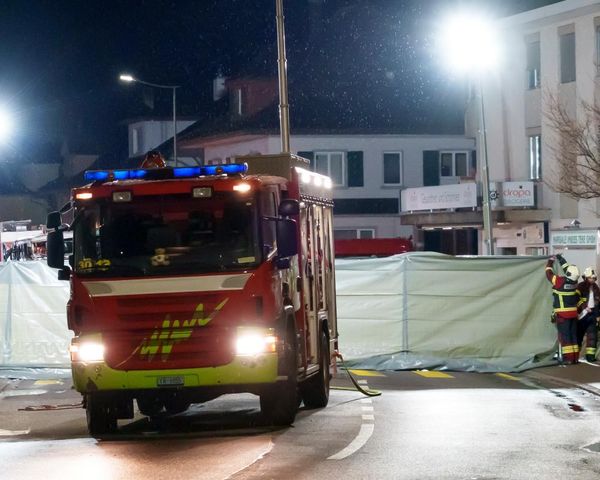
A Scottish nurse, who was the first person to be diagnosed with Ebola, on British soil, has been transferred from Gartnavel hospital in Glasgow to the Royal Free hospital in London.
She was diagnosed hours after arriving home from west Africa via a British Airways flight from Heathrow.
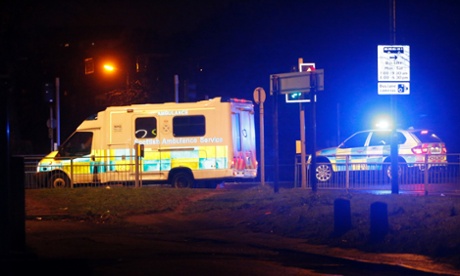
The unnamed nurse, who spent the last month working as a volunteer with Save the Children in Sierra Leone, was later transferred from Glasgow airport on a military-style plane in a quarantine tent surrounded by a group of health workers in full protection suits.
Health experts treating the nurse said she was “quite stable” and showing few signs causing clinical concern, raising hopes she will survive the disease.
Nicola Sturgeon, the Scottish first minister and previously Scottish health secretary, said the risk to other people as a result of the case is “extremely low” and that steps to trace scores of passengers, on the nurse’s Royal Air Maroc flight into the UK from Casablanca in Morocco, and the 71 passengers on her internal British Airways connection – BA 1478 – from Heathrow to Glasgow on Sunday night, were precautionary.
The Ebola virus is transmitted in the bodily fluids of people seriously ill with the virus, who are likely to be vomiting, bleeding or have diarrhoea.
Another British nurse, William Pooley, was successfully treated at the Royal Free, which houses the UK’s main Ebola treatment centre, after contracting the disease in Sierra Leone earlier this year.