It can be said without fear of contradiction that Scotland has never witnessed a year such as this one. The Commonwealth Games and Ryder Cup afforded global sporting status rarely sampled north of the border, with the nation’s referendum on independence thrusting Scotland to the forefront of world news. There has been plenty to make Scots feel good about themselves; the progress of Gordon Strachan’s international football team has contributed in its own way towards such sentiment.
It was in the midst of that referendum lead-up, with the age-old union under threat and politics mobilising the population to an unforeseen extent, that some glanced towards a friendly between Scotland and England with fear. Bitterness, it was assumed, over whatever the result from September could manifest itself in ugly scenes when England take to the field at Celtic Park on Tuesday.
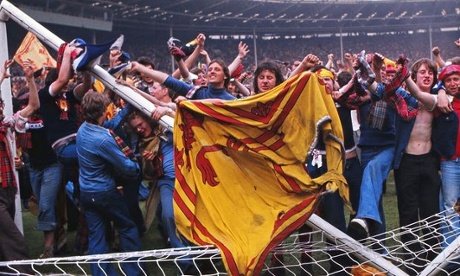
In general terms, followers of the Scotland national team are of more middle age and class than has previously been the case. They pride themselves on partying rather than going on the rampage. In the specific context of a game against England, the alteration of the mindset is obvious with a glance towards fixtures at Wembley in the late 1970s and early 1980s. Modern-day fixtures are tea parties in comparison; exorbitant ticket costs, in their own way, are integral to that.
Scotland’s first minister, Alex Salmond, rather dodged the question from the Guardian of whether the rancour around his ultimately failed campaign for Scottish independence may reshape fan views on a football meeting with the Auld Enemy. “I think the Scotland v England match will be a cracking game and I’m thoroughly looking forward to it,” he said. “The home nations already represent themselves as independent footballing nations and I think the reinventing of this famous contest as a regular fixture is to be welcomed.
“Politics has no place in a match which should simply be regarded for what it is – a fantastic sporting occasion.”
Salmond may then subscribe to the widely held view that football and politics never need mix. It is in many ways a spurious, simplistic theory; wander into any Scottish hostelry on any given night and those two topics will be intensely discussed. It goes without saying that political extremism is acerbic when linked to sport but trying to separate the core issues entirely is in many ways pointless. Politics, by simple definition, concerns the whole of society.
The Labour peer Lord Foulkes was a prominent part of the No campaign during the referendum and, unlike Salmond, attends Scottish football fixtures throughout any given season. “We need to remember that this fixture had a bad history, even before the referendum,” explains Foulkes. “The nature of some of the campaigning will make this one more difficult but we rely on the police and intelligence, as we have done over the years, to make sure everything is OK.
“What I do believe is that Alex Salmond, David Cameron and all leading politicians should make a plea to fans of both sides not to indulge in any threats, violence or taunting at all.”
Foulkes fully accepts that “there are lots of ways in which football and politics will mix” but learned from experience that party campaigning should take place well away from stadia on matchdays. When it happened during the referendum build-up, there was a generally negative reaction.
Still, it was curious that no leading club or body within Scottish football expressed a view for or against independence. This is the national game, after all, and a key part of the country’s fabric. There is an ongoing fear within football, it seems, attached to delving into political matters rather than tackling them where appropriate; and that doesn’t mean in the pursuit of funding.
Hamish Husband, a spokesman for the association of Tartan Army clubs, is among those to dismiss suggestions of extra bite this time on account of political machinations. He has pointed to the level of cheering for English athletes at the Commonwealth Games and is adamant the Scottish support has “moved on” from the time where anti-English sentiment was commonplace. Whether such abuse is for 90-minute effect rather than representative of something with a deep meaning has always been open to debate.
By definition, when 45% of voters were in favour of an independent Scotland there will be a heavy representation of such a group in the international team’s following. Yet the basis for that vote was more mature than basic, outright detestation of England. That much painted Scotland in a positive light.
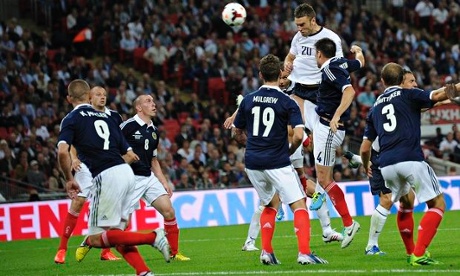
Planned hooliganism still exists to varying extents in Scottish and English domestic scenes week on week. It has a tendency to raise its head again when the countries meet internationally, albeit such instances are rarely publicised. Seven months after Scotland played at Wembley in August 2013, five men were arrested in connection with organised trouble in Covent Garden on that evening.
The last time England played in Glasgow, 15 years ago, 230 people were arrested after the fixture. The city centre was a no-go zone in the hours before and after a 2-0 England success. The return has the highest security rating possible, amid police intelligence reports of pre-arranged trouble. The nature of that, however, cannot be linked to anything political; being blunt, it has always existed. England’s travelling support has never been categorised as angelic.
Stuart Cosgrove co-hosts BBC Scotland’s cult and irreverent football show Off The Ball. He is also head of programmes (nations and regions) at Channel 4, a fanatical St Johnstone follower and someone who perfectly comprehends the blend of football, culture and politics in Scotland. “My own viewpoint is that the game has been stripped of its deep-rooted emotional primacy over the years. That has been gradual, not sudden,” says Cosgrove of Scotland versus England.
“There are a few reasons for that. Firstly, the fixture wasn’t around for so long. Champions League and club football has also taken on such a global dynamic that national fixtures aren’t pursued with the same relish as they once were. I don’t mean to claim people won’t be up for this game, but there is an argument for it not meaning as much as a fixture now. England fans returned some tickets [2,000 was reported], they had to pick them up at a location in Glasgow; the whole thing seemed to feel like a hassle and that speaks volumes.
“For the European Championship play-off games [in 1999] the organisation around potential hooliganism was huge. Like a G14 summit. Now we have England returning tickets.”
Cosgrove believes a wider change in the Scottish mindset, and one not directly linked to football, has to be acknowledged. “The [referendum] debate was about the democracy of Scotland rather than blatant nationalism,” he adds. “A lot of people have adjusted to a different attitude towards England; there isn’t the primal emotion of before. In the 1970s, it would be common to hear people say they ‘fucking hate these English bastards’. You wouldn’t hear that now.”
Except on Tuesday night, when similar is guaranteed. Cut all the nonsense away and this represents another high-profile event in this epic Scottish year. As ever, it promises to be utterly captivating.