It is the world’s oldest international fixture, and the Six Nations’ longest unbeaten home run belongs to it. For all the focus of the modern player on the “next match”, when the Scotland team stride out into the Twickenham arena on Saturday they do so knowing that it is 32 years since their compatriots last emerged victorious from the challenge ahead.
“They do make us aware of it,” concedes Blair Cowan, new to the 144-year‑old rivalry, but fierce enough of countenance to fit right in. By “they” the Scotland flanker presumably means folk on the street, former players at the bar, articles such as this in the media and the braying 80,000 who will fill that harsh arena.
Not that it perturbs him. Quite the contrary. “To be involved in the team that twists those long histories would be an honour,” he says quietly. “We use it massively. You don’t want to dwell on it, but you’ve got to look at it as a challenge, a huge scalp and a chance to set history straight.”
Whenever discussing matches between England and Scotland, the word history is never far from the lips, nor the delicious stereotypes from the mind, thrown up not just since 1871 but throughout the centuries, of the remorseless, powerful English and the wild-eyed Scots, hopelessly outnumbered but trusting in a providence for the passionate.
In the history of the rugby fixture, the early years proved quite propitious for the latter, winning more than they lost, even of the games that were played in England. Until, that is, 1911, when England settled into a permanent home at Twickenham. Since then Scotland have won four times south of the border and drawn five. And since 1983, as no Scot needs reminding, they have not won at all.
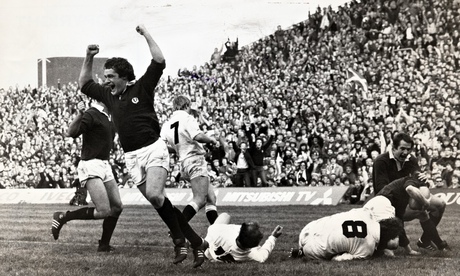
Johnnie Beattie has been playing No8 for Scotland this championship but is on the bench on Saturday. He at least has some kind of connection with winning at Twickenham, insofar as his father, John, played No8 in that last Scottish win, albeit two and a half years before Johnnie was born. Beattie Sr is disarmingly frank about how daunting he found the trip to Twickenham, perhaps in a way he can afford to be as a rare Scot to have won there.
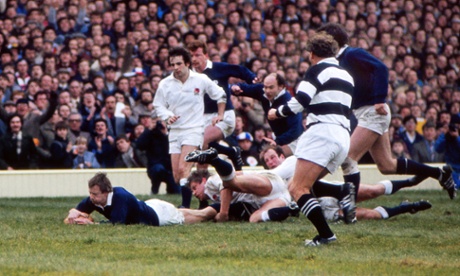
“You’d have to be a liar to go down to Twickenham declaring your confidence,” he says. “Since 1871 we’ve won there four times. But if you go down with a plan, do your best, play your hardest, try and win this bloody game – that’s possible. But, hand on heart, I don’t think I ever went down there confidently, because confidence would be madness.”
Scotland’s win at Twickenham was their only victory of the 1983 championship, but it paved the way for a grand slam the following year, a feat they would repeat, of course, six years later in the 1990 Calcutta Cup match at Murrayfield that needs no further introduction. A bitter irony of the long 32 years since 1983 is that it takes in some of the best sides Scotland have ever produced.
They nearly made the World Cup final in 1991 (denied in a nail-biter at Murrayfield by England), and it is too easy to forget that they had further shots at the grand slam in 1995 and 96, losing to England in their final fixture on both occasions, before they brought the curtain down on the Five Nations in 1999, champions and stars of the most exhilarating championship of all. And what denied them the grand slam that year? A 24-21 defeat at Twickenham in round two, the closest they have come to breaking the hoodoo since the 12-12 draw of 1989.
If George Orwell imagined the future as a boot stamping on a human face for ever, Scotland’s recent rugby history against the English might be viewed as a similarly joyless encounter between the hopeful and their oppressors. It is no secret that professionalism has been hard on Scottish rugby, while marshalling the English to take advantage of their size. Beattie could sense the change when he returned to Twickenham with Scotland in 1987.
“In the 80s, Scotland’s lack of scale was an advantage. We knew the only chance of getting even a sniff of beating England was to put more effort in on the training field. But when it becomes professional and everyone trains the same way that edge is lost.
“In 86 we’d beaten England by a record score [33-6]. It had been a cold winter and we knew they hadn’t trained too much. We were given gym kit to take away, and we were put through these incredible run sessions every Sunday in North Berwick. We smashed them. But it’s funny what revenge will do for you, and in 87 we met the first generation of nasty English rugby player coming through – Brian Moore was winning his first cap, Dean Richards … The World Cup was about to start. There was the first smell of professionalism, the first smell of scary English rugby players.”
History and stereotypes may always feature in discussions of England and Scotland, and, when it comes to rugby, names such as Moore, Richards and Carling are never too far away either. That legendary game at Murrayfield in 1990 was the first – and, it turns out, last – occasion that Scotland put England’s new breed in their place. So traumatic was the defeat to that golden generation that it rendered them truly nasty – and Scotland, for all their success elsewhere, were never to beat them again in the 90s.
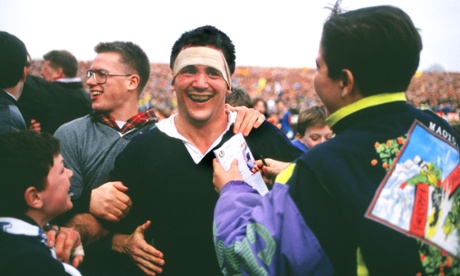
Which means there is a generation of Scottish rugby player who has never tasted victory against the English. And Doddie Weir is probably the greatest of them. “I must have been the poisoned chalice,” he confesses with a weary twinkle in his eye. “I came in just after the grand slam in 1990 and left just before we had some joy in the 2000s. My memories are all disappointing when it comes to the results, but it’s a lovely game to be involved in. There was very little need for motivation in the Five Nations but certainly none against England. You were playing against the likes of Brian Moore and Will Carling. They would do enough off the field to try to wind everyone up. When somebody’s quite arrogant about something you want to show ’em. Mind you, the arrogance was justified, because in my time we never won against them.”
There’s another concept integral to the England-Scotland paradigm – English arrogance. It is a touchy subject, an accusation to rile an Englishman. Confidence might be a more diplomatic way of putting it, a trait born, as Weir acknowledges, from a long history of dominance. Either way, such terms are the emotional colour to the indisputable truth that England is a bigger country than Scotland, that victories for the latter must be secured despite the status quo – and are all the more glorious for that. In rugby-playing terms, the difference in size is greater yet. Scotland’s is the smallest of the British rugby populations – indeed, of the Six Nations – and, in conjunction with her status as co-founder of the international game, her plight in recent times is poignant.
But not without its joy. Underdog status is now a permanent mantle, whether the Calcutta Cup is staged at Twickenham or Murrayfield, with no sign of lifting. Yet the extraordinary derailing in the rain of England’s grand-slam attempt of 2000 was followed by further victories at Murrayfield in 2006 and 2008 and a draw in 2010. And how Scotland failed to win in 2012 remains one of rugby’s finer anomalies.
So much for the even years. It is the odd ones that have caused the pain. Mike Blair was Scotland’s scrum-half for the 06 and 08 results, captain for the latter, but he has had no more luck at Twickenham than any other Scot in the past 32 years. Not that he ever felt the past as a yoke. The rugby team is a constantly regenerating organism, each component of it concerned with his own unfolding narrative.
“Certainly, with me,” he says, “it was never something you thought about, because it wasn’t you that hadn’t won there in 32 years. Maybe if you’d played all 16 of those games, you might be slightly concerned. All the same, when you’re playing at Twickenham you need everything to go your way to stand a chance. But we haven’t been smashed down there in a while. I don’t think the guys on Saturday should be thinking, ‘oh, we’re going to lose again.’ There have been opportunities over the years, and there could be on Saturday.”
The respect for Scottish rugby that was lore in the 80s and 90s has subsided in the Six Nations era into regular, by-nature-patronising expressions of optimism for them on the eve of a championship. Yet third is as high as they have finished in the table. Nevertheless, there is a school of thought that professionalism, for all the punishment it has wrought on a nation short of players and funds, has, 20 years in, finally helped Scotland to regroup. That a new surge may be on its way.
The focus of the domestic scene has shifted from the ferocious culture of Borders rugby and settled at last on the professional teams of Glasgow and Edinburgh, who now show signs of establishing themselves not only as competitive on the field but as viable academies for youngsters. The winning habit is being nurtured at Glasgow in particular, and Beattie believes that the benefits of being able to manage the players across two credible teams will start to tell.
“I’m not the pessimist,” he says. “The current team have done things we never did. They’ve beaten the Springboks, they’ve beaten Australia. If we can organise ourselves so that our smallness counts for us, Scotland can be good. I think we’ve had some real wallies as coaches, but the current one seems to be organised. What’s happening on the pitch is not his design. It’s players panicking. But when you have your best in a couple of teams, you can train them the way you want. That’s what professionalism does for you. But what the numbers game doesn’t do is give you enough alternatives to put pressure on the players in those two teams.”
Twelve professional clubs versus two; around 170,000 adult males versus 12,000; 53 million people versus five million. The numbers will always be skewed against Scotland when it comes to England. But only 15 can take to a field, and from that small mercy greater wonders have been wrought in the history of upsets than a Scotland victory this weekend would represent.
“I would be the happiest guy in the world,” says Beattie. “For goodness’ sake, if we could forget bloody 1983 and win on Saturday, we’d be the happiest bunch in the world.” And the oldest international rugby fixture of them all would be given a new lease of life.