While the form and scores of these sides in the first 10 days of the tournament threw up something of a conundrum, South Africa left Newcastle with considerably more conviction about their progress than did Scotland.
After a blistering first half, the Springboks held firm in the face of a belated Scottish fightback and finished with the demeanour of at least potential finalists. It says much for their composure and maturity that they have been able to regroup so quickly after a disastrous start to their campaign.
Scotland, who put 45 points on Japan, who had beaten South Africa on merit and the goodwill of most everybody else in rugby, arrived at St James’s Park top of Group B, and they move on to a weekend date with Samoa – who were taken apart earlier in the day by Japan – chastened but in reasonable shape.
Beforehand, Jonathan Humphreys, the assistant coach, resisted with some vehemence the suggestion that team changes suggested they were husbanding their resources ahead of the quarter-finals and were resigned to something less than parity with South Africa. He had a point. This is, after all, a game of squads and group effort over the long haul.
Scotland were without the fly-half Finn Russell (ankle), the openside flanker John Hardie (head injury), alongside the rested outside centre Mark Bennett, with the loosehead prop Alasdair Dickinson and the first-choice hooker, Ross Ford, on the bench.
South Africa bore the greater bruises: the absence of their captain, Jean de Villiers, and, less permanently, Victor Matfield.
Their coach, Heyneke Meyer, who regards his counterpart, Vern Cotter, as “an unbelievable coach”, came with no complacency. Indeed, neither team bore the stamp of over-confidence, Scotland going potless in the Six Nations, South Africa drawing a blank in the Rugby Championship. They both had reason to be anxious.
South Africa had lost six of their previous 10 matches and, more pertinently, five of their last seven, including the upset of modern times, against Japan, not to mention a skin‑of‑their-teeth escape against England at Twickenham last November. While that is the sort of form that ought to frighten a coach into panic, Meyer has remained admirably sanguine.
They were wondrously reborn against Samoa and back to near full working order here after the opening shock of Brighton; they surely cannot wait to get their hands on the Americans midweek.
Twice before yesterday, Scotland had scored five tries in the second half, against Japan then the United States, and twice they had won handsomely enough to encourage the view that might at least inconvenience the Springboks. There was little sign of it.
While South Africa had never lost to Scotland south of their border, that line of defence is only 50 miles away. This was as good as a home fixture for the Scots and Cotter knows all about the comfort and value of playing close to home; in his long and productive tenure at Clermont, the team won 76 home matches in a row.
Before the kick-off, Nelson Mandela was inducted into rugby’s hall of fame – a little late, perhaps, but welcome nonetheless – and if the words of South Africa’s World Cup-winning captain, François Pienaar, were tailored for a TV soundbite, they rang true none the less, seeming to lift his compatriots. “Sport has the power to change the world,” he said of a man who was, “an inspiration to modern South Africa” – rarely more so in rugby than on the day they beat New Zealand in the final in 1995, the day Pienaar handed him his No7 shirt to wear with pride he never might have imagined he would have felt during his long incarceration.
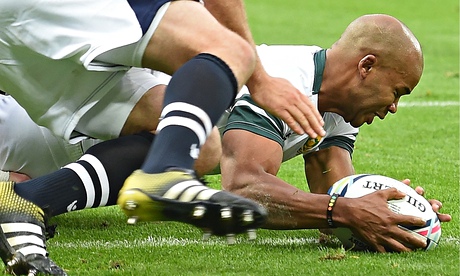
While the earlier Japan-Samoa match was a breathtaking quick-step of darting runs, this was a waltz of a different kind altogether. Working in the dangerous vicinity of nearly 2,000kg of Scottish and South African beef up front, Greig Laidlaw (80kg) pulled off the tackle of the early skirmishes, wrapping his arms around the pumping knees of Damian de Allende – a mere 20kg heavier – on his own 22, but, after fully 10 minutes of grind in front of the line, Burger rose from a ruck under the posts a smiling try scorer. Towards the end of the first half Jannie du Plessis headed grim‑faced for the sin-bin. Mostly, though, they were a happy bunch. The tone had been set.
For nearly 40 minutes, the Scots did not move within sight of the enemy line with ball in hand; when Laidlaw snuck across the opposing 22 just seconds before the whistle, swamped, it was the extent of their first-half ambition. South Africa had enjoyed a monstrous 65% of the territory in that period, and 58% of the ball. They crossed the gain line 39 times to 20, numbers that are tough to overcome even if playing well – which Scotland definitely were not.
Then, upon resumption, a wondrous length-of the field try, finished off by Tommy Seymour after Duncan Weir’s interception almost on the very spot Laidlaw had made his earlier gesture, brought the stadium alive. At last, the match resembled a contest. The gap was reduced to a single score.
Inside the last 20 minutes the margin was 10 points. With a quarter of an hour left, it was 13. Seven minutes from the end, an 18-point differential told the story – the wider puzzle at least partially unravelled.