All six nations have something to play for on the final weekend, even France, les misérables, whose mean defence have kept them in with a chance, however remote, of winning the title. It is likely to last no longer than the opening match of the day in Rome, but for now, even if they do not play rugby for dreamers, they can dream.
There will be two teams in celebratory mood on Saturday night: the one who finish first, even if it is likely to be on points difference and so lack the lustre of the grand slam, and the side, Scotland or Italy, who avoid the wooden spoon. Otherwise, in the last competitive match before the World Cup starts in September, the rest will be left to reflect on what could or should have been.
Scotland start the weekend at the bottom, their mood far darker than it was seven weeks ago when they started with a spring in Paris, buoyed by an autumn campaign that saw them, under Vern Cotter, defeat Argentina and scare New Zealand.
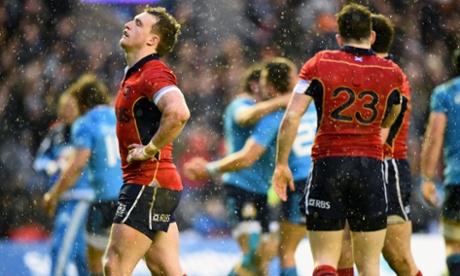
If they lose to Ireland at Murrayfield, they will suffer the indignity of a whitewash, which would be harsh given their performances, overall have been an improvement on last season. They had half-chances to secure at least a draw in Paris, they wasted opportunities against Wales and they failed to hold on to a lead at the end at home to Italy. Last weekend, they led at half-time against England.
In political terms, it would not have taken a massive swing to have turned a poor campaign into a passable one. They look more threatening in possession than they have for some years, Stuart Hogg has recaptured the form that earned him a Lions tour in 2013, Finn Russell has clear potential at fly-half and they have a steady supply of points in Greig Laidlaw, but they lack strength in depth and the belief that comes with winning. They look to have more about them than Italy but in the one game they were expected to take the initiative and control, they failed. Cotter will need the extra time with his squad before the World Cup.
Italy could lose by a record score to Wales and still avoid the wooden spoon. That they are not bottom is an achievement considering their lack of a goal-kicker: their top points scorer is Luca Morisi with 10, made up of his two tries against England at Twickenham. Kelly Haimona’s boot has supplied eight points, and their two penalties compare with the 17 of Ireland, 16 of Wales, 14 of France and 10 of England and Scotland. A side scrapping at the bottom need accuracy from the tee, but only England have scored more tries than Italy.
As they showed against Scotland, they have a pack capable of competing in the set pieces that can drive mauls but many of the forwards are getting on and age seems to tell the longer a campaign goes on. Sergio Parisse, one of the leading players of his generation, remains their inspiration, although the scrum-half Edoardo Gori has arguably been their stand-out player, a sniper with a steady aim.
Italy’s ambition remains avoiding the wooden spoon 16 seasons into their membership of the Six Nations. They are 14th in the world rankings, below Tonga, Fiji and Japan and just ahead of Georgia. If it is not an accurate reflection of their standing given the bulk of their fixtures are against tier-one countries but if they are moving forward the progress is imperceptible.
France are fourth, where they finished last year, an improvement on last place in 2013. If Wales and Ireland lose and France emerge from Twickenham triumphant for the first time in 10 years in the Six Nations, they could be checking in the trophy on their flight back to Paris. However, there is only slightly less chance of pigs orbiting the stadium at the end of the match. There is nothing champion about Philippe Saint-André’s side, although they have conceded the fewest tries of any team, two, which gives them a foundation for the World Cup.
They have beaten the two teams below them and lost to two of the three above with England to come. They have not recorded an away victory over one of the leading trio since before the last World Cup and over the years they have picked at ideas and structures from other countries, even players, and lost much of their identity in the process. The Top 14 is awash with players from elsewhere and a country who had a distinct way of playing are a paler version of their rivals.
France have at least become more difficult to beat and have conceded two tries in their last five Tests. While they were second best to Ireland and Wales, they were only a converted try away from drawing both matches. If England have to improve their points difference to clinch the title, rather than have to simply win, as was the case with Ireland in Paris a year ago, they have to be careful: France have this year scored the bulk of their points after the interval and all of their four tries.
If France could tap what lies within they would at least rival Wales who, although starting the weekend in third place, are worth a flutter for the title. Like England in Rome a year ago, when a 52-11 victory was not enough, they do not know what they have to do other than win and get ahead of England on points difference.
They have rallied since losing to England in Cardiff on the opening night by digging deep and grinding their way to victory, although the difference against Ireland last Saturday proved to be a well worked try scored by Scott Williams. Wales seem to be at their best when they have to produce a performance but winning alone will not be enough in Rome and they will at some point have to play with an abandon not associated with them.
They scored 51 points at home to Scotland on the last day of the 2014 Six Nations, albeit against 14 men for an hour, and they sealed the title on the final day of the two previous tournaments, the second time by moving ahead of England on points difference. They have a core of experience – nine of the side in Rome started the 2012 grand slam match against France – and they played more tactically against Ireland. What they will need to show in Rome, if Italy make their first-up tackles, is a greater creative edge, and that will also apply in the World Cup group stage.
Ireland, the champions, are in a different place to last year when they knew what they had to do, playing last. Wales ended their run of 10 straight victories by taking the initiative from the start and attacking their opponents at their strongest points. Ireland were one-dimensional and they will either have to chase a target set by Wales or impose one on England.
They have not tended to save their best performances for Murrayfield of late – their last victory there by a double-figure margin was in 2005 – and they have averaged one try a match this year. A danger against Scotland will be going open too soon and conceding turnover tries and a doubt about them for the World Cup is their ability to put the ball through hands and create space without kicking. Their closing match provides them with an opportunity.
England, the runners-up for the past three years, know one thing before the kick-off: the title will be in their grasp, unless Wales or Ireland go berserk, but there is a world of difference between having to win a match, as teams have found out this month in football’s Champions League, and having to do so by a specific amount.
England have been the only one of the title contenders prepared to attack this tournament and their try tally is more than double that of their title rivals, 11 to Wales’s five and the four of Ireland and France. Some have advised Stuart Lancaster to load his bench with attacking backs to come on and take the game to France in the final quarter but if only a simple victory is required, he would need players capable of closing out the match.
It is a guessing game. If Wales, Ireland and England all have claims to the title, they also all have faultlines they will need to close up in the summer months. If it has so far been a championship with a lot more thunder than lightning, The final Saturday should provide some flashes.
• This is an extract taken from the Breakdown, the Guardian’s weekly rugby union email. Sign up here.