It is the first game in the age of Vern Cotter that Scotland have to win. There, a little pressure. But it’s true. Up until now there’s been a honeymoon period including a summer tour that would have exhausted supporters following it merely on the map and an autumn series. The first went well, only coming unstuck on its last leg – and on its last legs – in South Africa. And November was negotiated without upsets one way or the other. There was, for example, no embarrassing defeat to the New Zealand B team (a defeat yes; humiliation no).
Nothing much seemed to be expected from those who follow Scotland closely in round one of the Six Nations at the Stade de France, where they have never won. And everybody seemed eminently satisfied with the performance: huge courage in defence and verve in attack. But now comes the one they must win: Wales at Murrayfield.
It may be a bit unfair on Wales, this hardening of the Scottish soul. Meetings between the two are by nature entertaining. But Wales have won the last seven, reason enough in its own right for the Scots to stiffen their resolve. The last time they met – the last game under Scott Johnson – was the worst with Scotland buried by a record margin, 51-3 in Cardiff.
To what extent should Scotland dwell on that game? Is it relevant in any way? Well, Scotland seem happy enough to linger on it, to savour the effect it had on them then and use it to provoke a reaction now. So here’s what happened. Scotland were already trailing 10-3 when Stuart Hogg collided with Dan Biggar late enough to leapfrog yellow and be shown a straight red card. Alasdair Strokosch and Greig Laidlaw have been happy to discuss the impact of that day when, according to the captain, “the jersey was humiliated”. Strokosch said: “It’s a big insult, a big slap in the face, and it’s not something that’s going to happen again.”
To pick over the game is an exercise in self-flagellation with nobody to bear responsibility but themselves. Well, they could have singled out Hogg but they don’t: “You can’t blame Hoggy for anything. You can blame him for doing something stupid, but you can’t hold the result against him,” said Strokosch.Laidlaw said: “One player going off is not an excuse to lose by 50 points. It’s a bit harder playing with 14 but it’s not 50 points harder.”
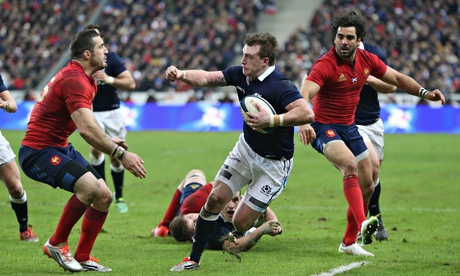
Now comes the conversion of the pain into a positive. Hogg can be singled out because he is an obvious example of a sinner who has moved on. He was elusive and speedy of thought in Paris, the most eye-catching player on the field. Full-back is a hot-spot position at the moment with Rob Kearney, Mike Brown and Scott Spedding prominent as counterattackers in the first round of matches. Hogg outshone them all. The wide-open spaces of Murrayfield and the vastness of the dead-ball zones must appeal to him on Sunday – there is room to move.
Wales, on the other hand, may be reluctant to kick to him. They may prefer to starve him into frustration by keeping the ball in play and in hand as long as possible (by avoiding set pieces wherever possible). It goes against the trend – of kicking and applying pressure in safe, up-field territory – but there is something about this fixture that encourages a sense of almost reckless adventure.
It all depends on whether Warren Gatland has been putting his charges through the World Cup weights again, with an eye on the tournament down the line rather than Sunday. Going to Murrayfield on wobbly legs would be dangerous but a guarantee of a thriller. Perhaps the Wales camp, having lost to England, will have opted to put reality first: thrust and thrust again on fresh legs into midfield, boys, and let’s smash ’em.
To lose an 11-try thriller to Scotland in World Cup year would not trigger demands for coaching heads to roll – well, no more than usual – but Wales may be reluctant to make such a romantic gesture. In that case, it will be Scotland who must force the issue. And not by Hogg alone but by embracing speed and a lung-bursting tempo everywhere.
They’ve tried it before – and lost 17-37 to Italy at Murrayfield in 2007. But they came at that with a frenzy and one-eyed lust to move the ball at all costs and at all times. It was without variation and without an overseer. Finn Russell seems to recognise the caveat: move it, but only when appropriate.
There is enough guile and menace from Mark Bennett and Alex Dunbar in the centre to prevent the entire Wales team lining up the end receivers of a passing game – Tim Visser, Sean Lamont and Hogg – and giving us all more worry about concussion protocols. Contact is there to be avoided, somebody might point out. Perhaps that somebody will have to forget the overwhelming priority for Scotland – that this game must be won.