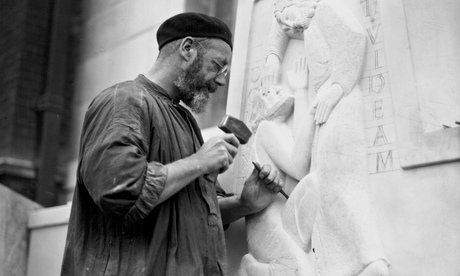
The sculptor and engraver Eric Gill is everywhere in England. The BBC uses one of his typefaces, Gill Sans, which also appears on the classic Penguin book covers. His sculptures can be seen in some of the country’s most famous buildings, including Westminster Cathedral, Broadcasting House and the Midland Hotel.
John Cull, the main character in Rob Magnuson Smith’s Scorper, is not interested in visiting Gill’s more tourist-friendly works. Arriving in the UK from Los Angeles, he goes straight to the tiny Sussex village of Ditchling, where Gill lived between 1907 and 1924, converting to Catholicism and setting up a religious craftsmen’s guild. In Smith’s fictional version, here too lived John Cull’s grandfather and namesake, serving as Gill’s “scorper” and all-round apprentice. (A scorper is both a chisel used for engraving and the name given to the craftsman who wields it.)
John Jr might not recognise a scorper if he saw one, but he dreams of a childhood spent at his grandfather’s side, the two of them companionably scorping wood before a fire. Raised on the US west coast by parents obsessed with their British heritage, wondering how his love of literature has led him to a job copyediting magazine adverts, John hopes that a holiday in Sussex will connect him with his ancestry and the spirit of Gill, enabling him to reinvent himself as an artist in his own right.
Ditchling, entirely alien to John, will seem familiar to a British audience from television murder mysteries and rural detective novels, if not from real life. It’s a place hostile to outsiders, haunted by a strange prophecy (“whoever buries the hand of the stranger rules the rest”) and an ambiguous motto (“Ditchling Is Ruled by God’s Brothers and Sisters”). There’s a sexy young widow whose husband died in mysterious circumstances, and whose new boyfriend is unmistakably bad news. An eccentric couple run a B&B full of dead birds and porcelain dogs, and the village quiz night is the highlight of the local calendar. Everyone knows everyone else’s business, and everyone has something to hide.
As disconcerting as Ditchling is John Cull himself. He is 30 years old and deep in an existential crisis, suffering memory blackouts and hallucinations, swinging between insecurity and wild overconfidence. If he admires rural British life as much as he says he does, why is he so often scornful towards the locals? Is the old man he keeps seeing a descendant of Gill or the ghost of the artist, called into being by John’s desperation? Most of Scorper is told in the second person, so the reader has the uneasy experience of being aligned with the “you” that is John, while having little idea of who John is or what he wants. It’s a clever technique, at once involving and alienating, making the reader as uncomfortable in John’s presence as he is around the villagers he condescendingly labels “Ditchlings”.
It’s never clear whether it is Ditchling or John that is haunted by the village’s past. Neither possibility is wholly convincing. John is certainly delusional, but his delusions can’t account for everything that happens in the novel. On the other hand, much of what goes on in Ditchling is so unlikely that it’s hard to put it down to anything other than the paranoid fantasies of an outsider. Whether this inconclusiveness is unsettling or merely unsatisfying will depend on the reader. Scorper has the trappings of an old-fashioned mystery novel, but these are only so many misleading clues. More rewarding is its funny, disturbing portrayal of a mind at odds with itself.
• To order Scorper for £11.99 go to bookshop.theguardian.com or call 0330 333 6846.