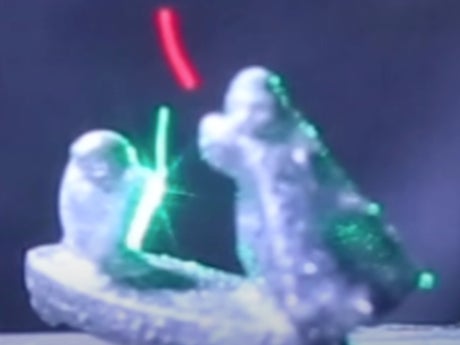
Holograms that move and float in the air have been developed by a university research group – and used to make lightsabers with real luminous beams.
The holograms are called “optical trap displays”, created by trapping a single particle in the air using a laser beam. Researchers from Brigham Young University could then move that particle around, leaving a laser-path that floats in the air behind.
In a video published by the researchers, the holograms could be used to make the “displays of science fiction”. By moving the particle fast enough, the entire image can be seen all at once.
Currently, it is possible to create the effect of a phaser blast or a disrupter charge, which were used to engineer a battle sequence between equally small versions of the Starship Enterprise and a Klingon Battle Cruiser. Yoda and Darth Vader were also shown in battle, using appropriately-coloured lasers for their swords.
The researchers recreated photon torpedoes launching and striking the enemy ship which could be seen with the naked eye – completely absent of computer generated effects.
“What you’re seeing in the scenes we create is real; there is nothing computer generated about them,” said lead researcher Dan Smalley, a professor of electrical engineering at BYU.
“This is not like the movies, where the lightsabers or the photon torpedoes never really existed in physical space. These are real, and if you look at them from any angle, you will see them existing in that space.”
The researchers created virtual stick figures that could walk in the air, and could interact with the virtual images by having a student place a finger in the middle of the display and demonstrate the stick figure walk along it and jump off the end.
“Most 3D displays require you to look at a screen, but our technology allows us to create images floating in space — and they’re physical; not some mirage,” Smalley said. “This technology can make it possible to create vibrant animated content that orbits around or crawls on or explodes out of every day physical objects.”
The researchers detailed this breakthrough in “Simulating virtual images in optical trap displays”, published in Nature Scientific Reports.
It is hypothesised that with some “fancy tricks” using motion parallax, it might be possible to make the illusion appear bigger than it actually is, up to theoretically an infinite size display”.