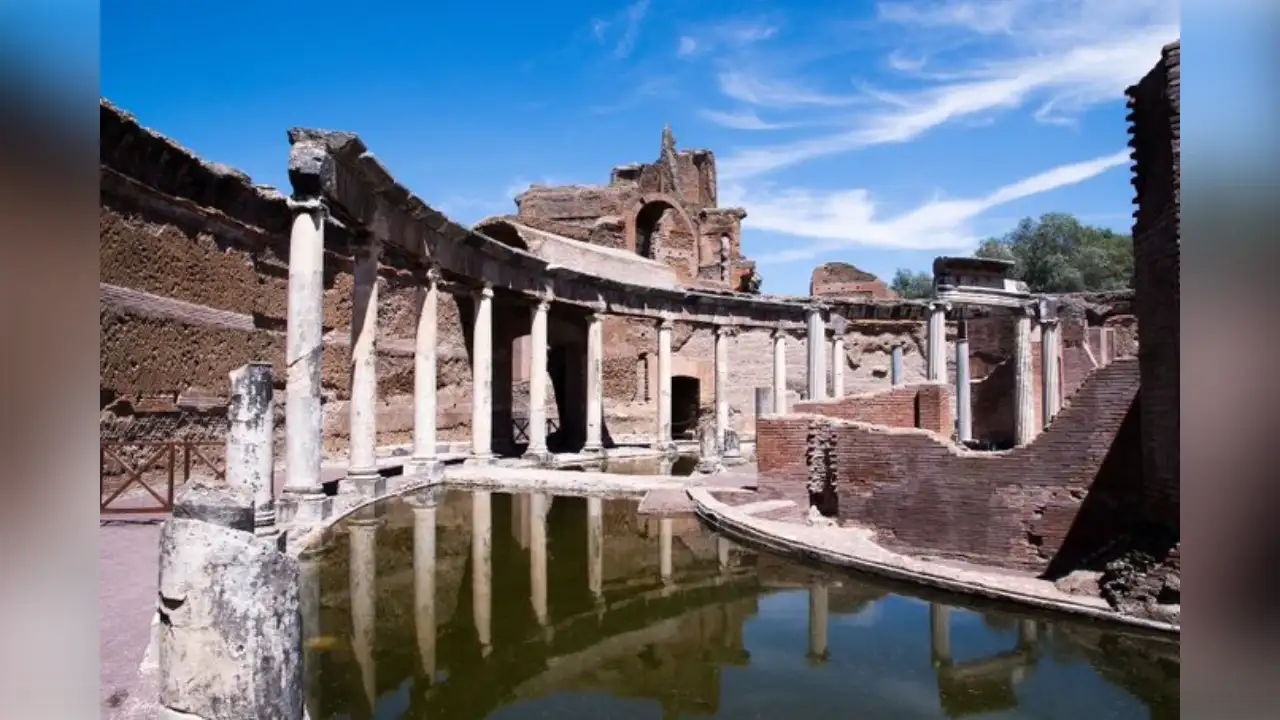
A communal latrine at Hadrian's Villa near Rome is helping researchers understand why some Roman concrete has survived for nearly 2,000 years. A new study suggests the material did more than simply resist decay. Over centuries, calcite gradually formed inside pores and small fractures, helping bind the concrete into a denser and more durable structure.
The findings come from a largely undisturbed section of ancient Roman concrete. By studying the latrine, which had not undergone extensive restoration, researchers gained a rare opportunity to observe how the material naturally changed over almost two millennia, as per a report.
An ancient bathroom preserved the history of Roman concrete
Hadrian's Villa was built in the second century as an imperial residence near Tivoli, about 17 miles east of Rome.
Unlike many famous Roman monuments that have been repaired over the centuries, the communal latrine remained largely untouched. According to Paulo J. M. Monteiro of the University of California, Berkeley, "Nobody restores a latrine," making it an unusually valuable record of how Roman concrete aged on its own, as per an Eco News report.
Researchers led by Xiaohong Zhu of Beijing University of Technology and Monteiro used high-resolution X-ray imaging, electron microscopy and chemical analysis to examine the concrete's internal structure.
Researchers found calcite gradually forming inside the concrete
The team focused on carbonation, a process in which carbon dioxide from the air reacts with calcium-rich compounds inside concrete to form calcite, a hard crystalline mineral.
Their scans showed calcite extending through pores and fractures instead of appearing only as a minor surface byproduct.
Monteiro said, "What is new is that we can now see how it binds," as quoted by Eco News.
According to the researchers, the growing calcite network filled small voids, improved contact between different parts of the concrete and reduced pathways through which water could penetrate.
The study suggests that while the pozzolanic reaction between lime and volcanic ash remained fundamental to Roman concrete, long-term carbonation also helped densify the material and may have closed fine cracks as it aged.
READ ALSO: A rare Greenland shark found in Ireland gave scientists new clues about how it lives for centuries
Roman concrete differs from modern building materials
Scientists have long linked the durability of Roman concrete to its mixture of lime, volcanic ash, water and stone.
Maria Juenger, a concrete materials researcher at the University of Texas at Austin who was not involved in the study, noted that Roman builders relied heavily on volcanic ingredients, whereas modern cement production depends on extremely hot cement kilns, according to the Eco News report.
The findings also build on a 2023 study by researchers from the Massachusetts Institute of Technology (MIT) and other institutions, which suggested that lime clasts could provide calcium when water entered a crack, allowing calcium carbonate to recrystallize and seal part of the opening.
READ ALSO: Psychology researchers reveal how the way you sit could affect your mood and the choices you make
The findings could help shape future construction
The researchers caution that applying the same process to modern concrete is not straightforward because most modern structures contain steel reinforcement, while the Roman concrete examined at Hadrian's Villa did not.
Carbonation gradually lowers the alkalinity that protects reinforcing steel from rust, meaning the same reaction that helped bind ancient Roman concrete could contribute to corrosion in modern reinforced structures.
Instead, the researchers suggest engineers may eventually find ways to control where and how carbonation occurs so it can improve durability without increasing the risk of damage to steel.
The study also highlights the potential environmental benefits of longer-lasting concrete. According to the University of California, Berkeley, producing one ton of clinker, the main ingredient in conventional cement, releases about 0.83 ton of carbon dioxide. Researchers say more durable concrete and lower-clinker binders could help reduce emissions by extending the lifespan of buildings and reducing the need for repairs and replacement.
The study shows that the calcite network developed gradually over centuries, and researchers say more work is needed to determine whether similar benefits can be achieved in modern materials within practical timeframes.
READ ALSO: Researchers in Japan uncover what helps the brain stay motivated when life gets harder