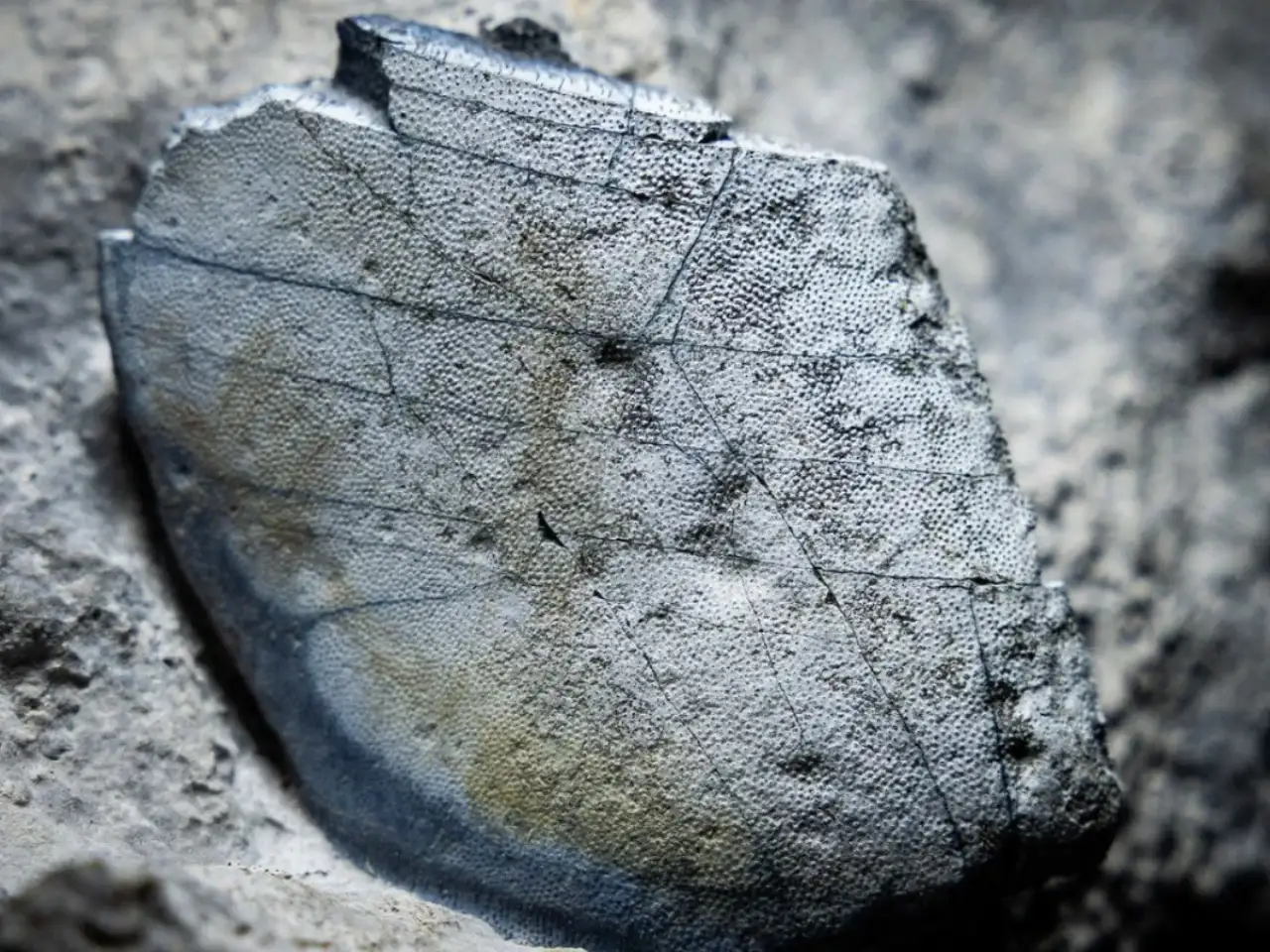
Most of us scroll past shark content online without batting an eye, but two wildlife officers on a routine patrol in western Ireland recently stumbled upon something that stopped scientists in their tracks: fossilized shark teeth, buried in limestone, dating back 330 million years.
That’s older than the dinosaurs. Older than the first flower. Older even than most of the continent we stand on.
The teeth were found in the Burren, a hauntingly beautiful karst landscape on the Atlantic coast of County Clare in Ireland. Phoebe Larkin and Emma Glanville of Ireland’s National Parks and Wildlife Service made the discovery alongside local guide Cormac McGinley. None of them is a professional fossil hunter. They were just being attentive.
So what did they discover?
These were the teeth of an ancient shark species, Psephodus magnus, not the sleek, torpedo-shaped predators we picture today. The teeth of this creature were flat, plate-like structures that were used for crushing hard-shelled prey such as mollusks and shellfish, not for tearing flesh with razor-sharp fangs. It was more of an industrial grinder, less Jaws.
The identification was co-led by Dr. Wayne Itano of the University of Colorado Boulder, who is one of the world’s leading experts on this genus. According to a 2022 study published in the Scottish Journal of Geology, Psephodus existed from the Late Devonian to the Late Mississippian periods. They might have been ancestral to several other holocephalan lineages. This group includes today’s deep-sea ratfish, the closest living relatives of these ancient creatures.
Why the Carboniferous was basically a shark heaven
These fossils date to the middle of the Carboniferous period, an era that was arguably the golden age of early shark diversity. Schnetz et al.'s 2024 study in Paleobiology found that the diversity of chondrichthyans (the class containing all sharks, rays, and ratfish) peaked in the middle Carboniferous before dropping off sharply towards the end of the Permian. The Burren fossils fall squarely within that peak window, a time in evolutionary history when cartilaginous fish were thriving and experimenting with wildly different body forms and feeding strategies.
That is what gives this find its value. This is not your average shark tooth. It’s one data point in a much larger story about how life in the ocean diversified, evolved, and in some cases disappeared altogether.
The citizen science angle that scientists are raving about
What’s really exciting about this discovery, aside from the fossils themselves, is that it wasn’t made by trained paleontologists.
It was a “good example of citizen science,” said Dr. Eamon Doyle, a geologist with the Cliffs of Moher UNESCO Global Geopark, who helped identify the specimens. The people who found these teeth were just doing their everyday thing, tracking wildlife, taking tourists on tours, and had the presence of mind to realize that something unusual was stuck in the rock under their feet.
This is more important than it sounds. There just aren't enough professional paleontologists to be everywhere. Whole stretches of fossil-bearing land in Ireland, the US, and beyond have been unstudied for years because there aren’t enough scientists to cover the ground. When ordinary people know what to look for and who to call, science goes faster.
What that means for any nature lover
You don’t have to be in Ireland to do this kind of discovery. From dinosaur bones in Montana to ancient sea creatures in Kansas, once covered by a shallow inland sea, amateur fossil hunters have been making headlines across the American West for decades.
The simple takeaway from the Burren find is this: leave it where you found it and send a photo to someone who can identify it. In Ireland, it’s info@burrengeopark.ie. In the US, a good place to start is your state geological survey or a nearby natural history museum.
The ocean floor from 330 million years ago is still out there, locked in stone. Sometimes it takes just a curious pair of eyes to bring it to the surface.