
Scientists have successfully restored the vision of old mice by “reversing the clock” on the biological ageing process in a breakthrough study.
The research offers a new approach to reversing age-related decline, using a technique that effectively reprograms cells to be younger.
“It’s a major landmark,” said Juan Carlos Izpisua Belmonte, a developmental biologist at the Salk Institute for Biological Studies in California, who was not involved in the study.
“These results clearly show that tissue regeneration in mammals can be enhanced.”
The study, which was published in the journal Nature on Wednesday, reveals how the scientists targeted what are known as epigenetic changes within a cell, which accumulate as a person ages.
“We set out with a question: if epigenetic changes are a driver of ageing, can you reset the epigenome? Can you reverse the clock” said David Sinclair from Harvard Medical School, who co-authored the study.
The paper proposes that the degenerative process of natural ageing that results in tissue dysfunction and ultimately death is caused by the accumulation of “epigenetic noise” that disrupts a cell’s ability to regenerate.
“These data indicate that mammalian tissues retain a record of youthful epigenetic information that can be accesses to improve tissue function and promote regeneration,” the paper states.
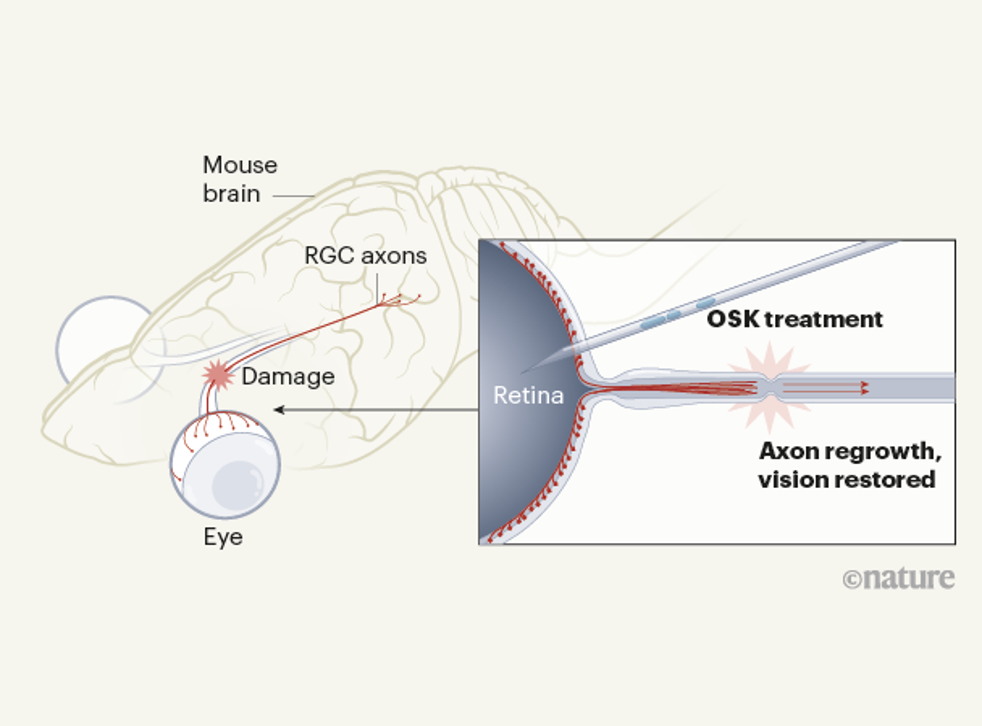
By using a mammalian eye as a model for central nervous system tissue, the scientists demonstrated that the expression of certain genes in mouse retinal ganglion cells could restore youthful DNA, promote regeneration and reverse vision loss.
In order to deliver the age-reversing genes to the appropriate cells, the scientists crammed them into a virus that would activate the genes when the mice drank water spiked with a drug.
The virus was injected into the injured eye cells, prompting them to regenerate. Geneticist Yuancheng Lu described watching the regeneration process as “breathtaking”, saying it looked “like a jellyfish growing out through the injury site."
Further research will need to be carried out to determine whether the approach can be used on humans, or within other tissues and organs affected by ageing.
“There are many labs now who are working on this whole concept of reprogramming,” said Judith Campisi, a biologist at the Buck Institute for Research on Aging in California.
“We should be hopeful but, like everything else, it needs to be repeated and it needs to be extended.”
The technology has been licensed to a company called Life BioSciences, which intends to carry out preclinical safety assessments in order to develop it for use in humans.