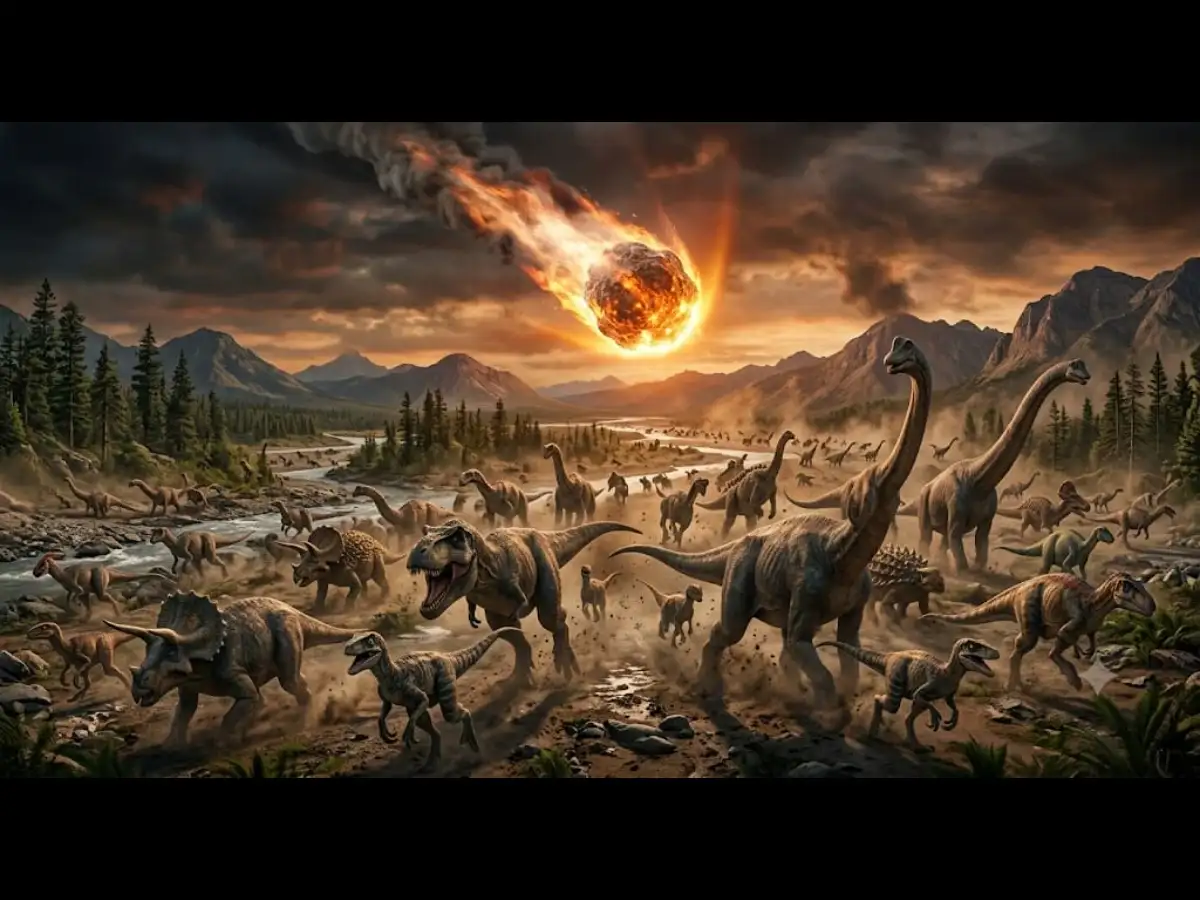
When the giant asteroid that ended the age of dinosaurs struck Earth 66 million years ago, the impact itself may not have been the deadliest part.
A new study suggests that within hours of the collision, Earth was transformed into a giant "broiler" as superheated debris rained back from space, creating temperatures hot enough to kill animals across much of the planet.
Researchers say this devastating heat pulse may explain why so few species survived one of Earth's biggest mass extinction events.
A six-mile-wide asteroid changed Earth forever
The asteroid, about six miles (10 kilometres) wide, crashed into what is now Mexico's Yucatán Peninsula, creating the Chicxulub crater. The impact vaporised more than 1,000 cubic kilometres of rock and soil, according to researchers from Purdue University.
The vaporised material shot far above Earth's atmosphere, forming a massive plume that circled the planet.
As it cooled, some of the material condensed into tiny glass-like droplets called spherules , each measuring only about 250 micrometres across. These particles travelled thousands of kilometres before falling back to Earth.
The sky became an oven
Scientists have long known that these falling spherules generated intense heat as they re-entered Earth's atmosphere.
However, the new research found that another ingredient made the event even deadlier.
Much of the vaporised rock never formed droplets. Instead, it became an ultra-fine dust made of particles about 2.5 micrometres wide—roughly 30 times thinner than a human hair.
According to Purdue University, this fine dust spread across the globe and acted like a giant insulating blanket.
Instead of allowing heat to escape into space, the dust trapped it and reflected it back toward Earth's surface, dramatically increasing temperatures.
Planetary scientist Brandon Johnson said the effect may have created broiler-like conditions that could have killed exposed animals within the first hour or two after the impact.
His co-author, Alexandria Johnson, compared the dust to the tiny particles found in wildfire smoke today, but on a planetary scale.
Why some animals survived
The findings also match what scientists have seen in the fossil record.
Animals that sheltered underground, underwater or in other protected environments had a much better chance of surviving the initial catastrophe. Plants may have endured because their seeds and roots remained buried beneath the surface.
Birds—the only dinosaurs known to survive—may have escaped because of their small size and ability to find shelter in dense vegetation, burrows or near water.
A two-stage extinction
The study, published in the Journal of Geophysical Research: Biogeosciences , suggests the dinosaur extinction may have unfolded in two devastating stages.
First came an intense global heat pulse that rapidly killed many living creatures. That was followed by years of darkness and cooling as dust and soot blocked sunlight, collapsing ecosystems around the world.
Together, these events may have driven one of the largest mass extinctions in Earth's history, showing that the asteroid's impact was only the beginning of the planet's ordeal.