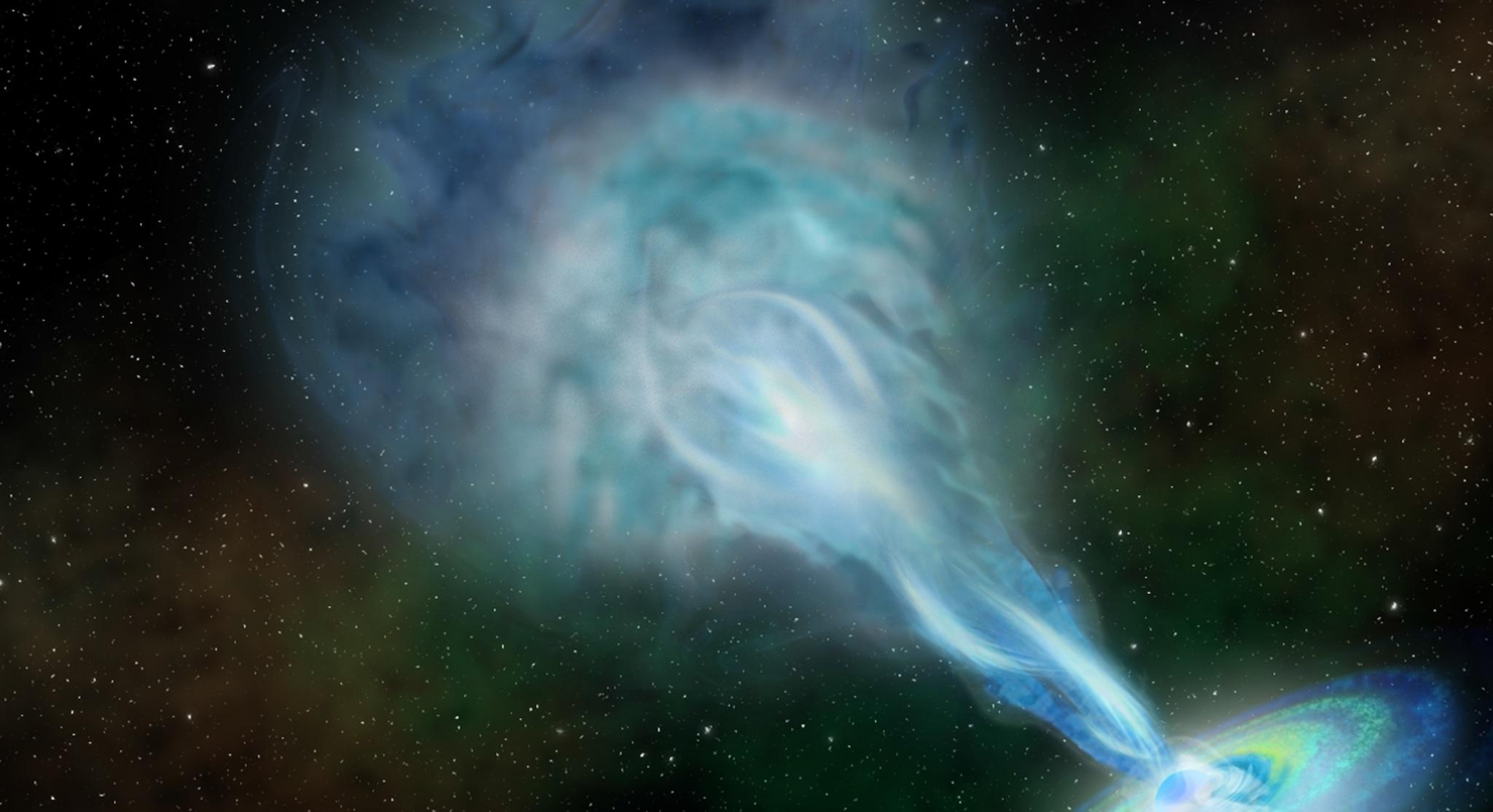
Scientists have found a stunningly bright radio emission coming from deep in the universe.
The quasar is the brightest radio signal ever received from the early universe, and could allow us to understand the beginnings of the cosmos's first galaxies.
Quasars are made up of huge black holes that are swallowing matter at the centre of galaxies. As that happens, a vast amount of radiation is emitted from what are the brightest objects in the universe – that then bursts out across the universe.
It was that radiation that reached Earth as a radio signal, allowing astronomers to see an early quasar in unprecedented detail. It comes from a time when the universe was only a billion years old, and is by some way the strongest signal we have received from that time.
The burst of energy came from a quasar located 13 billion light years away. As such, it began its journey when the universe was relatively young.
"This is the most detailed image yet of such a bright galaxy at this great distance," said Emmanuel Momjian, of the National Radio Astronomy Observatory (NRAO).
Scientists might now be able to examine the emission to understand more about a time when the universe looked vastly different to how it does today.
"We are seeing P352-15 as it was when the Universe was less than a billion years old, or only about 7 percent of its current age," said Chris Carilli, of NRAO. "This is near the end of a period when the first stars and galaxies were re-ionizing the neutral hydrogen atoms that pervaded intergalactic space. Further observations may allow us to use this quasar as a background 'lamp' to measure the amount of neutral hydrogen remaining at that time."
It might finally allow us to understand the beginnings of the earliest galaxies.
"The jet from this quasar could serve as an important calibration tool to help future projects penetrate the dark ages and perhaps reveal how the earliest galaxies came into being," said Bañados.