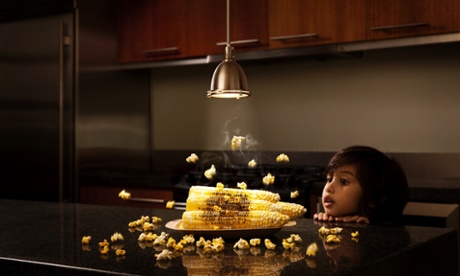
The popping sound made by popcorn is normally viewed as a pleasing cue that your snack is ready to eat, but for scientists the phenomenon represented one of nature’s significant unsolved problems.
Now a French team say they have settled the question of why popcorn pops through a series of high-speed camera observations, sound recordings and the theory of thermodynamics.
Their study concludes that rather than being due to the brittle kernels cracking open or ricocheting around the pan, the distinctive ‘pop’ is due to pressurised water vapour rapidly escaping from the interior. As the vapour is expelled, the cavity inside the kernel acts as an “acoustic resonator” resulting in an audible pop. “Such a scenario has been applied to … the ‘pop’ of a champagne bottle cork,” the authors write.
The team initially developed the high-speed imaging techniques to study plant dynamics, such as how trees break during storms.
“We took advantage of this technique to study ... the mysterious and fascinating jump of popcorn,” said Emmanuel Virot, a PhD student at the CNRS in Paris and the paper’s lead author. “As we started to observe popcorn explosions, it turned out that this phenomenon contains interesting physics.”
Popcorn kernels contain around 14% water, which vaporises at 100C, but is contained by the shell, which acts as a mini-pressure cooker until it reaches breaking point.
The research, published on Wednesday in the Journal of the Royal Society Interface, identifies the critical temperature at which popcorn kernels split as 180C.
When the kernel cracks, the escaping steam causes the starchy interior to expand into puffy white flakes.
Using a high-speed camera, which took 2,900 frames per second, the researchers also show that the kernel is propelled into the air by a “leg” of expanding starch. Previously, scientists had speculated that escaping steam might boost the kernel upwards in a “rocket” effect. But in a freeze-frame analysis, the researchers show the dynamics of a jumping piece of popcorn are similar to an acrobat performing a somersault.