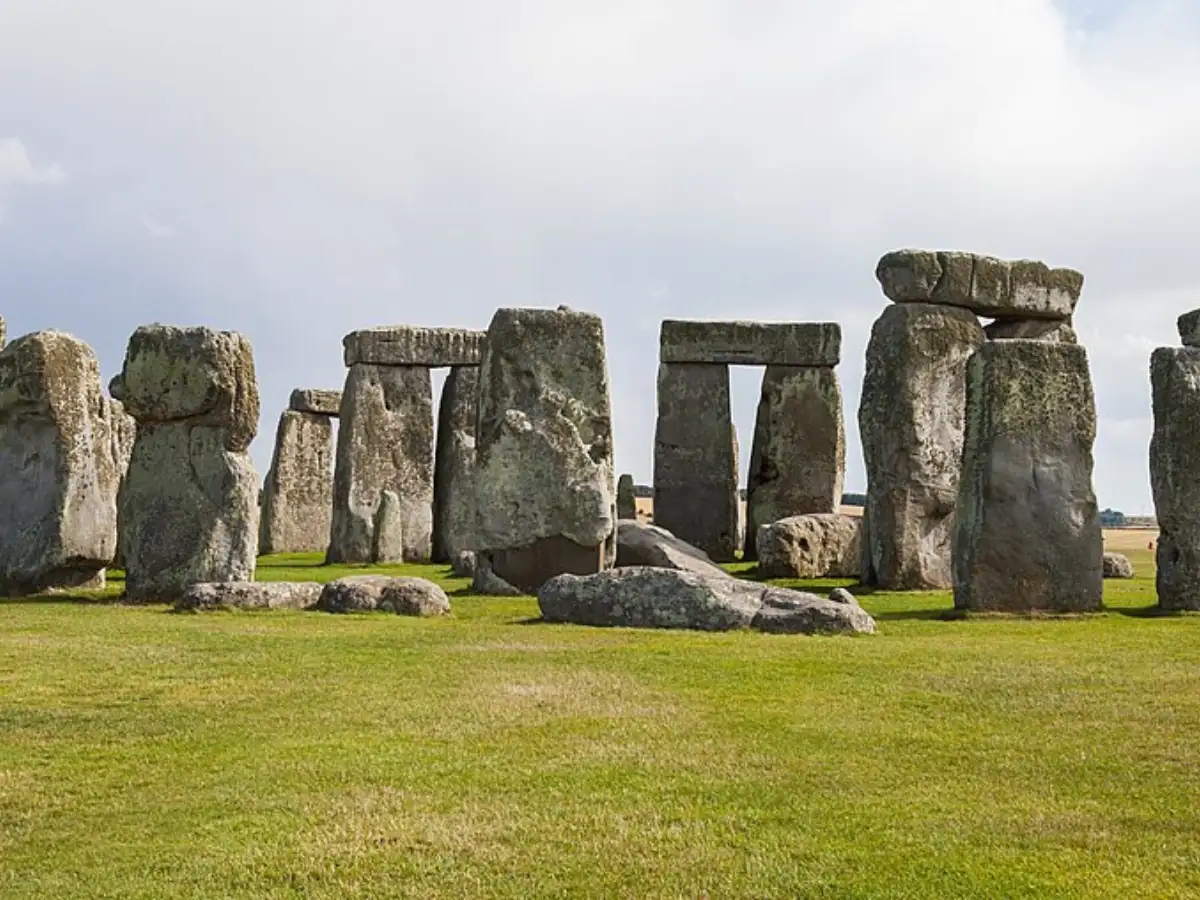
Since time immemorial, there has been a question of logistics associated with Stonehenge: How did prehistoric humans manage to transport stones weighing more than 25 tons throughout southern England thousands of years ago? Clearly, the enormous stones at Stonehenge had been moved intentionally. However, their origins have remained largely mysterious to archaeologists until now, which is why many hypotheses have existed regarding either some long-lost engineering methods or glacial action.
Fortunately, geochemical analysis may give us the answer. As indicated by a study published in Science Advances and cataloged in PubMed, most sarsens at Stonehenge are very probably native to a woodland site known as West Woods, located in Wiltshire, some 25 kilometers north of the monument. It matters since this information allows for concrete conclusions to be made based on chemical analysis of the stones.
Namely, an examination of the geochemistry of Stonehenge's 52 sarsens compared with that of sandstone outcrops in southern Britain revealed that 50 of those 52 stones had identical geochemistry to that of West Woods. Thus, we now know of a definite place where 50 of Stonehenge's sarsens come from.
This revelation has changed how we think about the history of Stonehenge. It is not just true that these rocks come from the nearby fields around the structure. In actuality, the rocks have been collected from a specific location and transported to the destination in an organized manner. There is sufficient evidence from researchers at PubMed and the University of London, who used these studies for their research into the structure. It would be wrong to say that all mysteries revolving around Stonehenge have been cleared. However, they have become clearer in detail.
The newer studies make natural transport far less convincing
One more factor that contributed to the continuity of this debate is the fact that there are scientists who maintain that it might be possible that the stones were transported close to the location prior to the arrival of man, and then were moved using different natural phenomena. One of the most persistent theories suggested to explain the phenomenon of transportation was that of glacial transport.
The theory postulates that huge stones could be brought southward through glaciers to the vicinity of Stonehenge. However, recent scientific evidence seems to refute this theory. According to a report published in Nature Communications Earth & Environment in 2025, glacial transport to the vicinity of Stonehenge does not seem to be a very probable option.
In other words, when the idea of the glacial transportation process becomes less and less feasible, it automatically means that the transport of humans cannot be neglected. In fact, more and more information points to the theory that Neolithic people moved those rocks in a deliberate manner using a combination of ropes, sleds, rollers, muscle power, and familiarity with the terrain.
According to discussions that took place among the UCL archaeology community concerning the stone provenance, it appears that there were transportation channels that followed the same lines of transport routes through Southern England. Such an enterprise remains rather remarkable even in contemporary times. Dragging 25-ton stones using only primitive techniques requires a lot of preparation, cooperation, and hard work.
However, what has become clear to archaeologists is that Stonehenge is evidence of exactly this type of societal organization. Instead of being another accidental heap of rocks that fell in its current location, Stonehenge is an example of a construction project carried out to its full extent. Finally, archaeologists have also learned about the origin of the Altar Stone located at Stonehenge. It comes from Scotland.
Stonehenge increasingly looks like a monument built through planning, not mystery
One reason why the new research matters so much is that it alters the narrative of Stonehenge entirely. Previously, the subject of Stonehenge seemed to be regarded as something of a mystery, far removed from the capabilities of common people. In contrast, the new evidence emphasizes planning, engineering, and organization. Based on the geochemistry studies cited in the source materials, the creators of Stonehenge seem to have chosen particular stones in preference to others that were closer at hand. This indicates some form of planning even prior to the actual construction.
In that light, then, the stone monument becomes even less enigmatic in some ways, but perhaps even more awe-inspiring in others. The clearer the transport clues become, the more skilled the builders seem to have been. Rather than invoking supernatural natural phenomena and fantastic engineering stories, the growing amount of evidence suggests prehistoric communities planning and conducting exceptionally difficult construction operations.
Nevertheless, scientists are wary of drawing too definitive conclusions. It is still not possible to trace every single process of the transportation of the stones at every step along the way. There is no clarity about the timing, the transportation technique, the work organization, or the motivation behind the monument's construction. Yet the research gives much information that significantly narrows down possibilities while not answering all questions.
In particular, it seems now that most of the giant stones of Stonehenge must have been transported from West Woods, located in the county of Wiltshire. It does not seem possible anymore that the stones were delivered there by natural means such as glaciation.