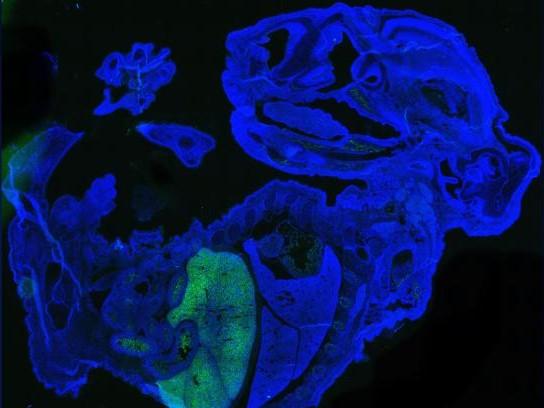
Researchers have created an embryo containing both human and mouse cells in a major advancement of genetically modified organisms.
The hybrid embryo, referred to as a human-animal chimera, was grown by a team at the State University of New York at Buffalo and the Roswell Park Comprehensive Cancer Center.
The mouse embryo contained 4 per cent human cells – a far higher proportion than had ever previously been achieved.
“It has not been possible to generate naïve human [stem cells] that substantially contribute to mouse embryos,” a paper detailing the research states.
“The generation of chimera-competent naïve [stem cells] unifies some common features of naïve [stem cells] in mammals and may enable applications such as human organ generation in animals.”
The experiment involved human blood cells and eye cells, proving that it is possible to generate mature human cells at a much quicker rate than is possible in a human embryo.
This could have significant implications for the treatment of human diseases, including the Covid-19 coronavirus, as it allows for cells, tissues or organs to be grown for research purposes.
The scientists injected human stem cells into the mouse embryo and allowed them to develop for two weeks. When they analysed the embryo, they discovered human cells in the mouse's liver, brain, eyes, heart, blood and bone marrow.
The scientists did not gestate the embryo further, though there have been previous incidents where researchers have produced chimera hybrids beyond the foetus stage.
In 1984, scientists created a sheep-goat hybrid that survived into adulthood. More recently, scientists in China created two monkey-pig chimeras, however they only survived for a few weeks after being born.
The research was published in the journal Science Advances.