There are “vast hidden magma systems” inside of Mars, scientists say – and it could have major implications for the search for alien life.
The new findings indicate that Mars once had enormous systems of magma like those found on Earth, the researcher say, despite the fact that it does not have the plate tectonics that were thought to be required for them.
That in turn could have major implications for other rocky planets, including suggesting that more of them might be habitable than we thought.
Mars has been described as a “stagnant lid”, because unlike our own Earth its surface is not broken up into tectonic plates that move. Those tectonic plates are responsible for the volcanoes and continents on Earth, which led researchers to believe that Mars could not have its own complex crust.
The new study, however, suggests that Mars could in fact have its own highly evolved crust, produced in a different way.
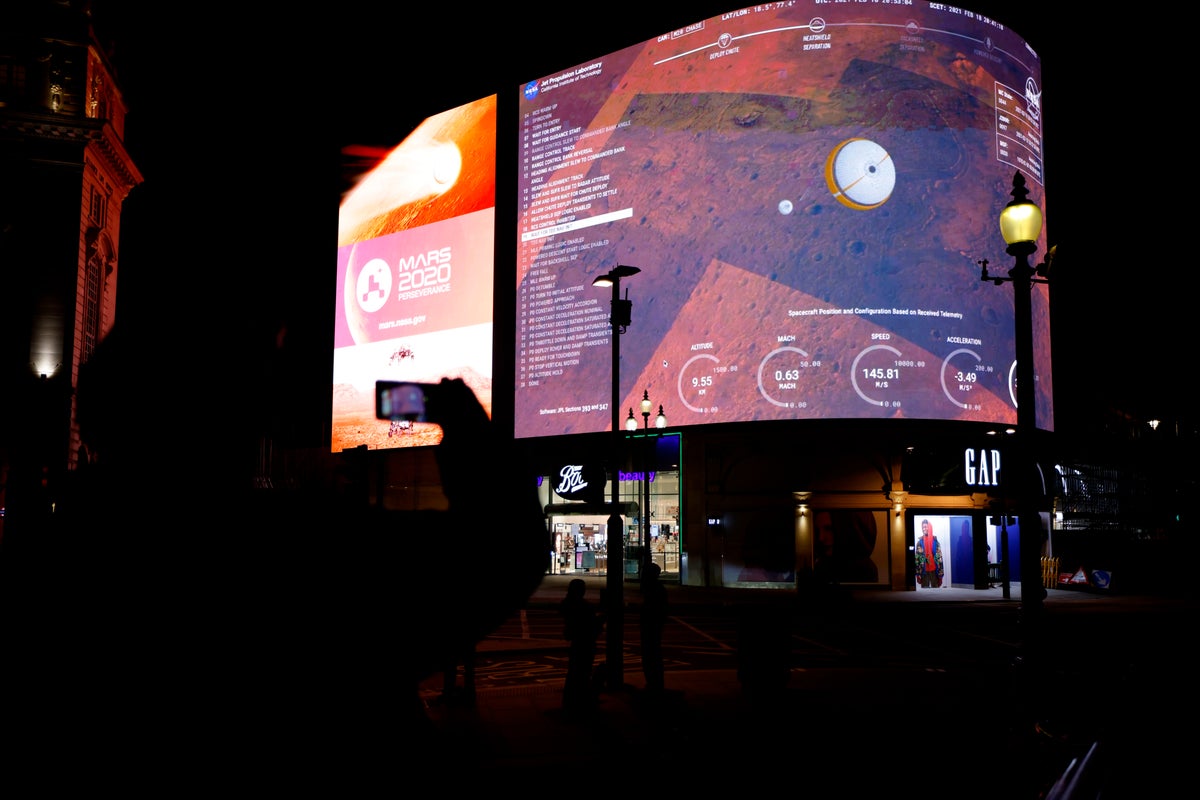
The researchers made the finding based on data from Nasa’s InSight mission, which was built to investigate seismic waves on Mars when it is hit by meteoroids or has “marsquakes”. They used those findings to examine a boundary about 24 kilometres beneath Mars’s surface, which remains mysterious.
The new work looked to understand whether the boundary was a transition between two different kinds of rock. It did so by comparing different rock compositions with the data that was taken from Nasa’s lander.
They found that the rocks from beneath that boundary seemed to be made up of “ultramafic” rocks, which are rich in iron and magnesium. The ones above were “mafic”, which are made of more silica.
“We’ve traditionally assumed that volcanism on Mars was relatively simple compared to that on Earth,” said Tobermory Mackay-Champion, from Oxford University, the lead author on the new work.
“But this discovery suggests Mars could sustain large, long-lived systems where molten rock evolved and reprocessed itself throughout the entire crust. It raises exciting possibilities for how common such systems might be on rocky planets beyond our solar system.”
If Mars has activity of this kind, which was previously thought to be unique to Earth, then it may suggest that other planets could build the conditions to support life.
“One of the big questions in planetary science is whether Earth is unique,” said Jon Wade, also from Oxford, and co-author on the new work. “If Mars could develop this kind of complex crust without plate tectonics, then maybe the conditions needed for habitability can emerge on more planets than we realised, including those previously dismissed based on size or their apparent lack of tectonic activity.”
The work is reported in a new paper, ‘Seismic evidence for a melt-depleted lower crust and transcrustal magmatism on Mars’, published in the journal Nature Astronomy.