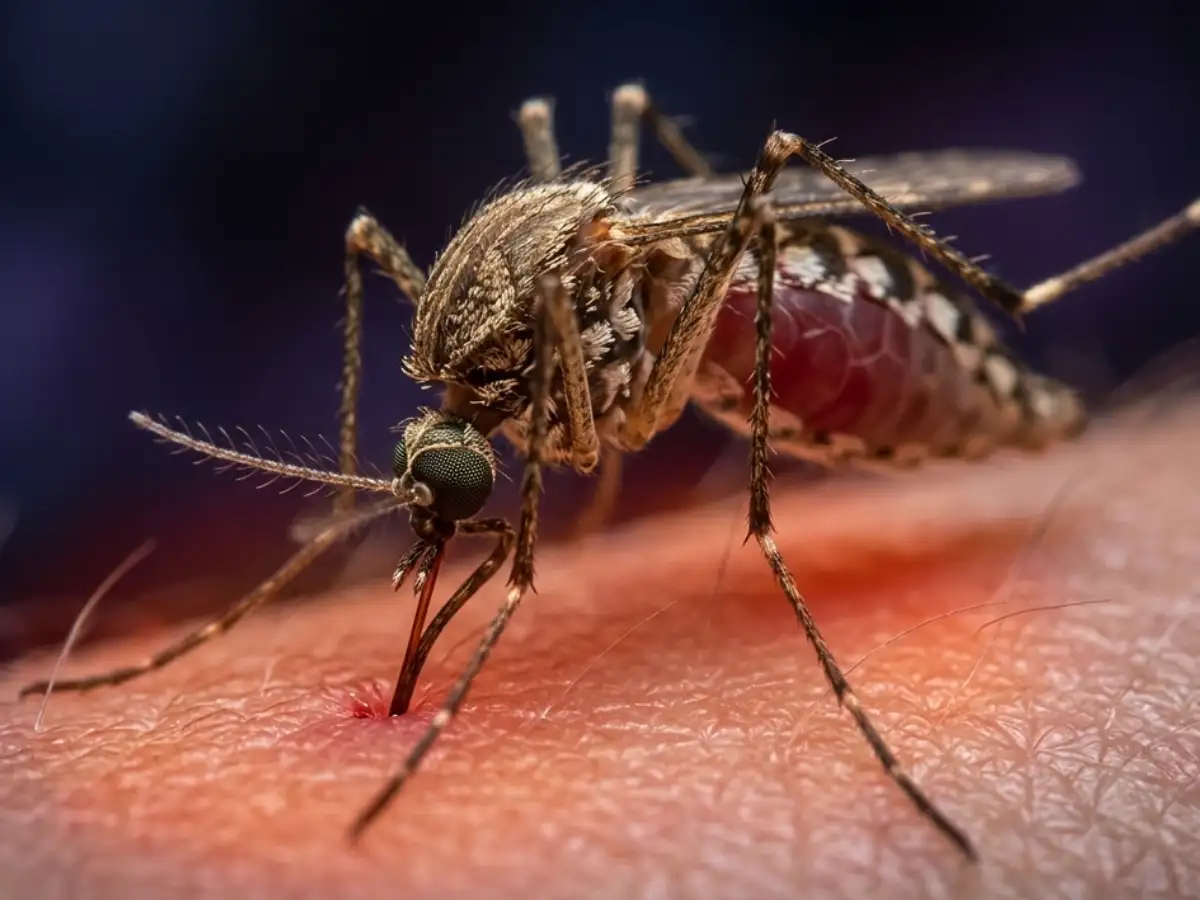
You swat. You spray. You light every citronella candle within a five-mile radius, yet somehow the mosquito finds you. It turns out there is a reason why your efforts feel almost pointless. These bugs aren't just sniffing you out; they've been tracking your body heat all this time.
A team of researchers at UC Santa Barbara has discovered something that sounds like it belongs in a sci-fi thriller: mosquitoes can sense infrared radiation, essentially the heat signature your body constantly radiates, and use it to hone in on you from across the room. Researchers have for the first time documented infrared detection as a mosquito sense, in a finding detailed in the journal Nature.
The bug that has been outsmarting you for centuries
For years, scientists have known that female mosquitoes, the ones doing all the biting, because they need blood to develop eggs, use a cocktail of cues to find their targets. Your exhaled CO2, your unique body odor, humidity, and even visual movement all send signals that draw them in, but there's a catch to each of those cues. Their vision is dreadful. A strong wind will interfere with their ability to track chemical signals.
So the researchers at UCSB began to ask themselves: Is there a more reliable guide? The answer was the same invisible energy that thermal cameras use to see people in the dark.
Heat you can't hide from
In controlled experiments, the team put female mosquitoes in an environment of human odors and CO2, divided into two zones. One zone was also equipped with a thermal infrared source set to 34°C, close to human skin temperature. The result was striking: adding that infrared source doubled the mosquitoes’ host-seeking behavior.
According to the study published in Nature, this sense remains good to about 70 centimeters (more than two feet). "What struck me most about this work was just how strong of a cue IR ended up being," said co-lead author Nicolas DeBeaubien. "Once we got all the parameters just right, the results were undeniably clear."
Crucially, infrared alone did nothing. It only kicked in when it was combined with CO2 and odor, which explains why no one saw it in previous research. Those studies looked at IR alone.
How a mosquito antenna senses your body heat
Mosquitoes are not built to handle infrared the way they see visible light. The energy is too low for that, but scientists found that the tips of a mosquito's antennae have peg-in-pit structures that absorb the radiation and convert it back into heat, activating a temperature-sensitive protein called TRPA1. When the team clipped off those tips from the antennae, mosquitoes lost all ability to sense IR.
It’s a clever biological hack, not a new kind of eye, but a passive thermal receiver built into their body.
Why this really matters if you live in the US
This isn’t just a fun fact of insect biology. It has real consequences for Americans in ways that are becoming harder to ignore.
Both Aedes aegypti and the Asian tiger mosquito are gradually expanding their range as the climate becomes more conducive to them in the Northern Hemisphere. They are the main carriers of diseases like dengue, Zika, chikungunya, and yellow fever. California reported its first locally acquired case of dengue in 2023, and Florida reported 91 locally acquired cases.
Knowing precisely how these mosquitoes locate hosts is key to smarter ways to control them. Researchers at UCSB say that adding thermal IR to mosquito traps would make them much more effective. There’s a handy lesson for your wardrobe too: loose-fitting clothes not only prevent bugs from crawling onto your skin, but they let your body’s infrared radiation escape out into the space between fabric and skin, making you more difficult to spot.
As it turns out, the mosquito has always been playing a smarter game than we knew. Now, at least we know one more rule.