
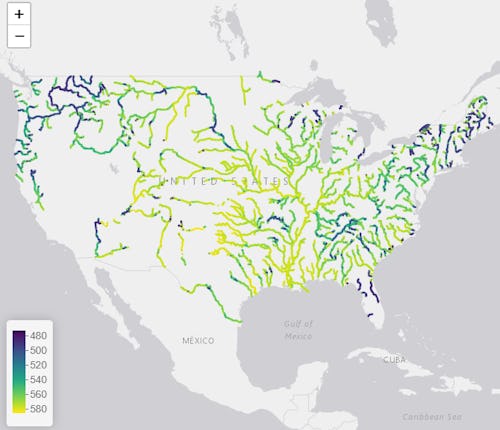
Satellite images of rivers across the U.S. have revealed a troubling color-changing trend: Over the past three decades, one-third of formerly blue rivers have turned a shade of yellow or green. The discovery comes after an analysis of nearly 235,000 images taken from 1984 to 2018. Amongst the rivers that changed color, 56 percent were mostly yellow and 38 percent were mostly green.
The findings, published in the journal Geophysical Research Letters, come from a team of researchers who wanted to try using the color of water to provide insight about the health of a river. It might sound like a simple technique even non-scientists could do, but the scientific community has seemingly avoided observations of color in favor of obtaining actual river samples.
Which would be fine, if samples weren't so scarcely obtained.
"Rivers are among the most imperiled ecosystems globally," wrote the authors, "yet we do not have broad‐scale understanding of their changing ecology because most are rarely sampled."
So the team thought that broad, visual observations of river colors could help when it came to figuring out the health of rivers with little data. Tracking the color could also give researchers a better idea of current trends, patterns, and areas of alarm. And, nowadays, the quality of satellite images is so good that it could make a river checkup a lot easier.
"[River color] is a very simple metric," lead author John Gardner told Live Science. "But it can be used to identify areas that are changing really fast."
The research team also plotted the river colors on an interactive map, which gives a great eye-in-the-sky view of the changes.
But what do the colors of the river mean? Well... scientists aren't completely sure just yet. Sometimes rivers change colors due to sediment flowing down during seasonal snow melts. Sometimes rivers have a period where a bunch of algae temporarily turns it green. Other times, human activity causes a disruption in the environment that alters the water quality and, therefore, the color.
It really depends on what's normal for the river, which is why observing their color can be so important. It's not super abnormal for rivers to be blue, green, yellow, or even brown. But if there's a sudden change, it could be an indication of something going wrong.
"Most of the rivers are changing gradually and not noticeable to the human eye," Gardner explained to Live Science. "But areas that are the fastest changing are more likely to be man-made."
While more research is needed to know precisely what the color changes mean, the authors maintained that tracking "water color can pinpoint rivers undergoing rapid environmental change and work towards continental‐scale understanding of rivers."