
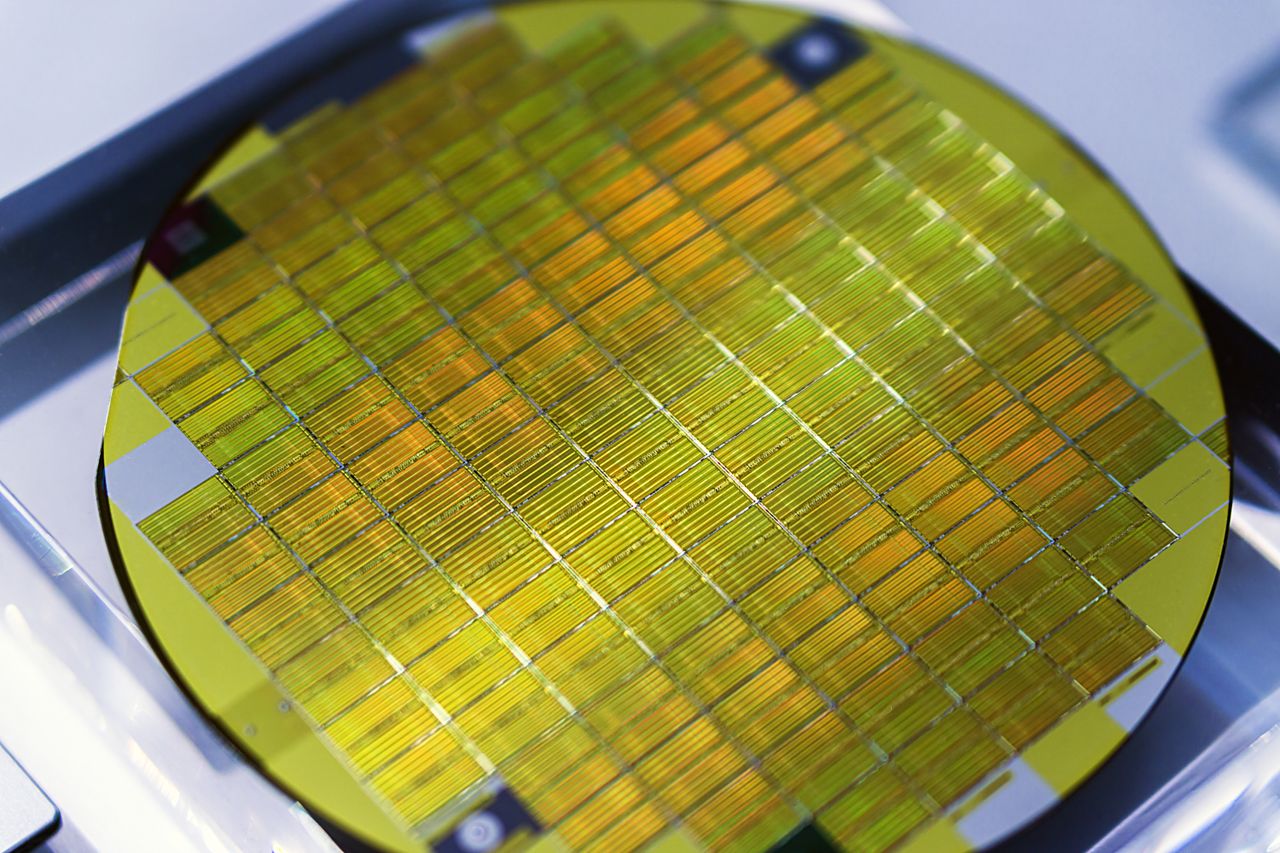
Scientists at the King Abdullah University of Science and Technology (KAUST) in Saudi Arabia have created electronic devices that continue to function perfectly in both extreme cold and extreme heat. In a press release on Monday, the researchers said their devices, made of gallium oxide, can withstand temperatures ranging from near absolute zero to 500°C (932°F).For context, every component in the device you are reading this on would likely fail before 200°C (392°F).
The devices could have far-reaching applications across space applications where extreme temperature swings are the norm.
Most conventional electronic systems, from chips to sensors and circuits, use silicon semiconductors; some powerful and high-frequency devices use gallium nitride and silicon carbide. For these materials to conduct electricity, electrons must have enough energy to move into available conducting bands, where they can travel through the material, generating an electric current.
At extremely low temperatures, electrons lose the thermal energy required to move, becoming trapped — a phenomenon known as freeze-out.
“In practice, most conventional electronics start to fail as you go below about 100 K (−173°C/343.4°F),” explained Vishal Khandelwal, a former Ph.D. student of Xiaohang Li’s and the leader of the research team.
Because conventional electronics behave unpredictability at cryogenic temperatures, systems used in environments such as deep space and quantum computing often require specialized electronics and elaborate thermal management systems, adding cost, bulk, and complexity.
On the other end of the spectrum, as temperatures rise, electrons gain increasing amounts of thermal energy. In conventional semiconductors, this excess energy can excite large numbers of electrons into the conduction band uncontrollably, even when the device is meant to remain in an ‘off’ state. The resulting surge in unwanted charge carriers leads to electrical leakage, unstable switching behavior, overheating, and eventual device failure.

To solve this problem, the researchers turned to the ultrawide-bandgap semiconductor beta-gallium oxide (β-Ga2O3). Its ultra-wide bandgap means electrons are much harder to excite into conductive states, making the semiconductor far more resistant to electrical leakage, high-temperature instability up to 500°C (932°F), and electrical breakdown under extreme operating conditions.
For the extreme cold part of the equation, the researchers turned to doping.
To overcome the carrier freeze-out effects that normally cripple semiconductors at cryogenic temperatures, the researchers heavily doped Beta-gallium oxide with silicon atoms. In semiconductor engineering, doping is the process of intentionally introducing impurity atoms — in this case, silicon — into a material to alter its electrical behavior and provide free charge carriers.
By introducing a high concentration of silicon dopants, the team created conditions in which electrons could move by hopping between closely spaced silicon-related states rather than relying solely on thermal energy to reach the conduction band. This allowed the material to maintain electrical conduction even under extreme cryogenic conditions where conventional semiconductors would suffer severe carrier freeze-out.
The researchers then built two devices based on silicon-seeded beta-gallium: a fin field-effect transistor (FinFET), featuring fin-shaped channels that make it stronger and more stable than conventional field-effect transistors, and a logic component called an inverter (also known as a NOT gate), a fundamental building block of computer circuits.
According to the researchers, both devices performed reliably at temperatures as low as 2K (-271.1°C/-456.1°F).
“At that temperature, there is almost no thermal energy to help electrons jump into gallium oxide’s conduction band. “Instead, the electrons hop through an ‘impurity band’ created by the silicon atoms, enabling the device to carry a current,” Li explained.
While these are not the first electronic devices to operate at ultra-low temperatures, they are the first demonstration of an ultrawide-bandgap semiconductor used in transistors and logic inverters capable of operating at such low temperatures.
According to the press release, the researchers’ goal is to build a portfolio of temperature-resistant devices from beta-gallium oxide, including radio-frequency transistors, photodetectors, and memory cells. “We have demonstrated the basic building blocks; now the work is to scale this up into complex cryogenic chips and to push the limits of performance in this ultracold regime,” said Li.
If they succeed, the devices would be perfect for space probes, satellites, and other technologies that face the extreme temperature swings — from absolute zero to hundreds of degrees — in space.