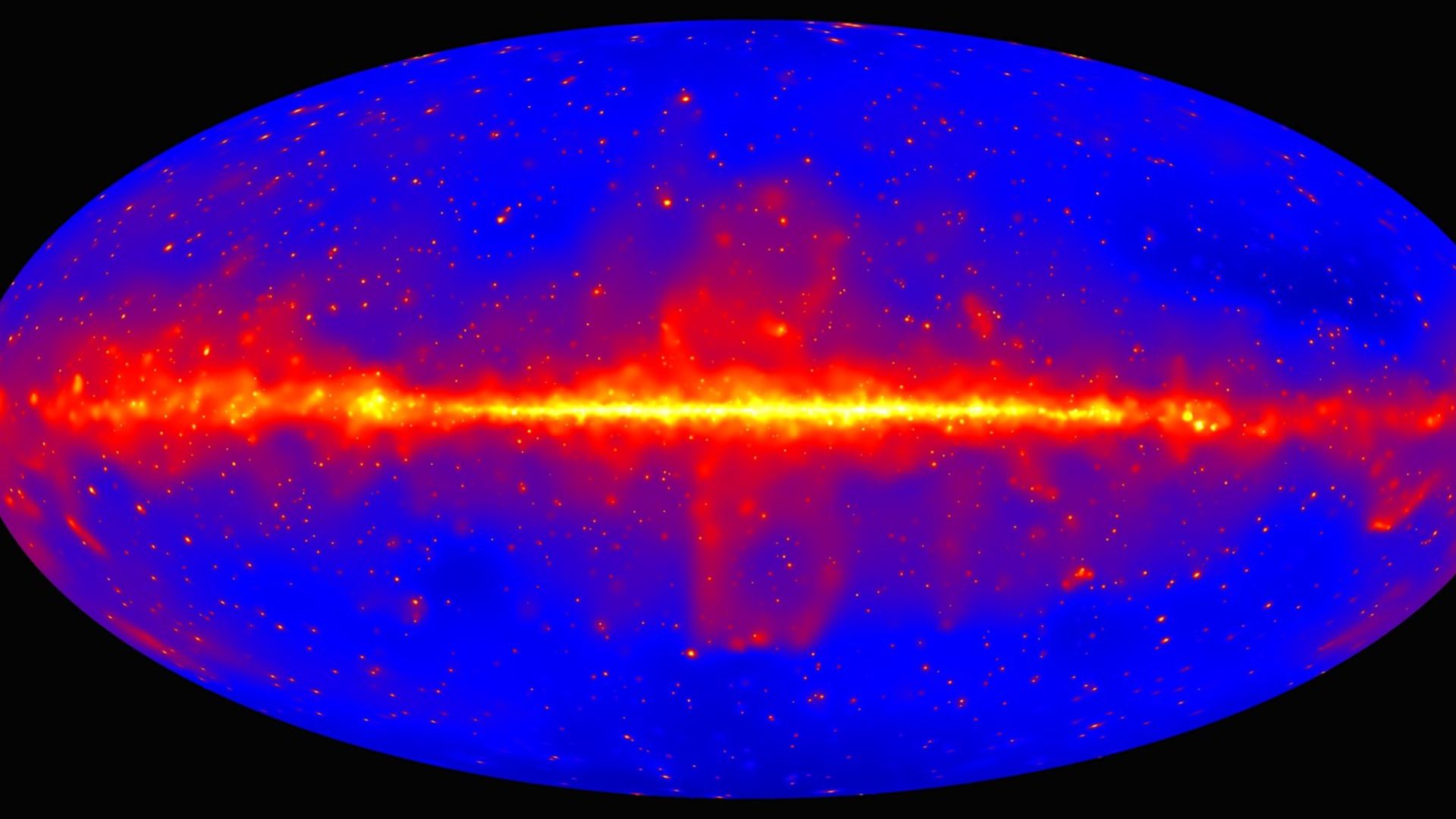
Clemson University scientists, relying on imagery from NASA’s Fermi Gamma-ray Space Telescope, claim for the first time to have measured all of the starlight ever generated throughout the history of the observable universe.
By the numbers: According to the new data, which was published in the journal Science on Friday, the number of photons — particles of visible light — emitted by stars amounts to 4 times 10 to the 84th power.
- Or, to put it another way, the researchers tallied up 4,000,000,000,000,000,000,000,000,000,000,000,000,000,000,000,000,000,000,000,000,000,000,000,000,000,000,000,000 photons.
Why it matters: The new study provides insight into the history of star formation over much of the universe's 13.7 billion year lifetime. Specifically, the research helps measure the extragalactic background light, which contains information about stars' history dating back to the early history of the universe. This is a scientific breakthrough, since previous attempts have been stymied by the faintness of distant galaxies and inability of telescopes to detect such faint light.
- In addition, getting a better idea of the history of star formation will inform future missions that aim to look at the early history of our universe, such as the James Webb Space Telescope, currently scheduled to be launched in 2021.
The big picture: According to a press release accompanying the new study, while the number of photons is extremely large, most of the visible light that reaches Earth is dim, given the large size of the universe. Much of the visible light, the release states, is "equivalent to a 60-watt light bulb viewed in complete darkness from about 2.5 miles away."
What's next: “The first billion years of our universe’s history are a very interesting epoch that has not yet been probed by current satellites,” Ajello said. “Our measurement allows us to peek inside it. Perhaps one day we will find a way to look all the way back to the Big Bang. This is our ultimate goal.”
Go deeper: Scientists trace neutrino to source outside our galaxy