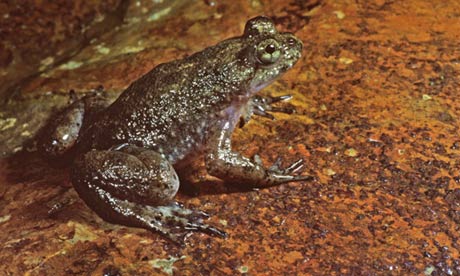
In 1983, a genuine freak of nature was lost to science. The gastric-brooding frog – Rheobatrachus silus – was native to the rainforests of Queensland, Australia and best known for giving birth through its mouth, having incubated its offspring in its stomach. But habitat loss and disease saw the species officially declared extinct.
Until now. Scientists in Australia have announced that they have brought the frog's genome "back to life". Employing a cloning technology called somatic cell nuclear transfer, they used tissue obtained from samples of a frog kept in a freezer since the 1970s to implant a "dead" cell nucleus into a fresh egg from a similar species.
None of the embryos created survived for more than a few days, but the "Lazarus Project" team believe their work is a landmark moment for the new science of "de-extinction" – the artificial recreation of lost species that featured fictionally in the Jurassic Park films. "Now we have fresh cryo-preserved cells of the extinct frog to use in future cloning experiments," says team leader Professor Mike Archer of the University of New South Wales, in Sydney. "We're increasingly confident that the hurdles ahead are technological and not biological, and that we will succeed. Importantly, we've demonstrated already the great promise this technology has as a conservation tool when hundreds of the world's amphibian species are in catastrophic decline."
Last week, scientists and conservationists met in Washington DC to thrash out the ethical, moral and technical questions of, as they admit, "playing God". A central question is whether such cloning techniques "bring back" an extinct species, or just create a new one that looks exactly like the old one.
"That remains to be seen," said the conference organisers. "It is one reason to do the research: is the genome the species? The answer will vary from species to species. De-extincted plants should flourish as if they'd never left, if suitable pollinators are still around. But if California condors had gone extinct, it's unclear if they could be brought back fully, because the young rely on parental training."
Archer says his focus is now on cloning the extinct Australian thylacine, or Tasmanian tiger. However, at the conference talk was already moving on to targeting other extinct species, such as the woolly mammoth and dodo.