Scientists have taken new images that could be the first direct evidence of a baby planet being born.
The observations from the European Southern Observatory’s Very Large Telescope show a swirling, dense disc of dust and gas. Inside of it can be seen a spiral structure with a “twist” – which could be the trademark indication of a new world being formed.
The research could help us understand how the many thousands of exoplanets that lie scattered through the universe first came about, the scientists say, by allowing them to watch the actual process that gives birth to them.
“Thousands of exoplanets have been identified so far, but little is known about how they form,” said Anthony Boccaletti who led the study from the Observatoire de Paris, PSL University, France.
While scientists know that planets are born as dusty discs surround young stars, where cold gas and dust are clumped together, the new observations give new information about that process.
“We need to observe very young systems to really capture the moment when planets form,” he said.
The new images show a hug spiral of dust and gas that has formed around AB Aurigae, a star found 520 lightyears away. Those spirals are an indication that baby planets are being born, since the worlds disturb the gas in ways that can be seen from Earth.
As the planet rotates around its star, the wave follows the shape of a spiral arm. It is the “twist” in the new images that indicates one of those disturbances, and therefore an indication that a new planet is being made.
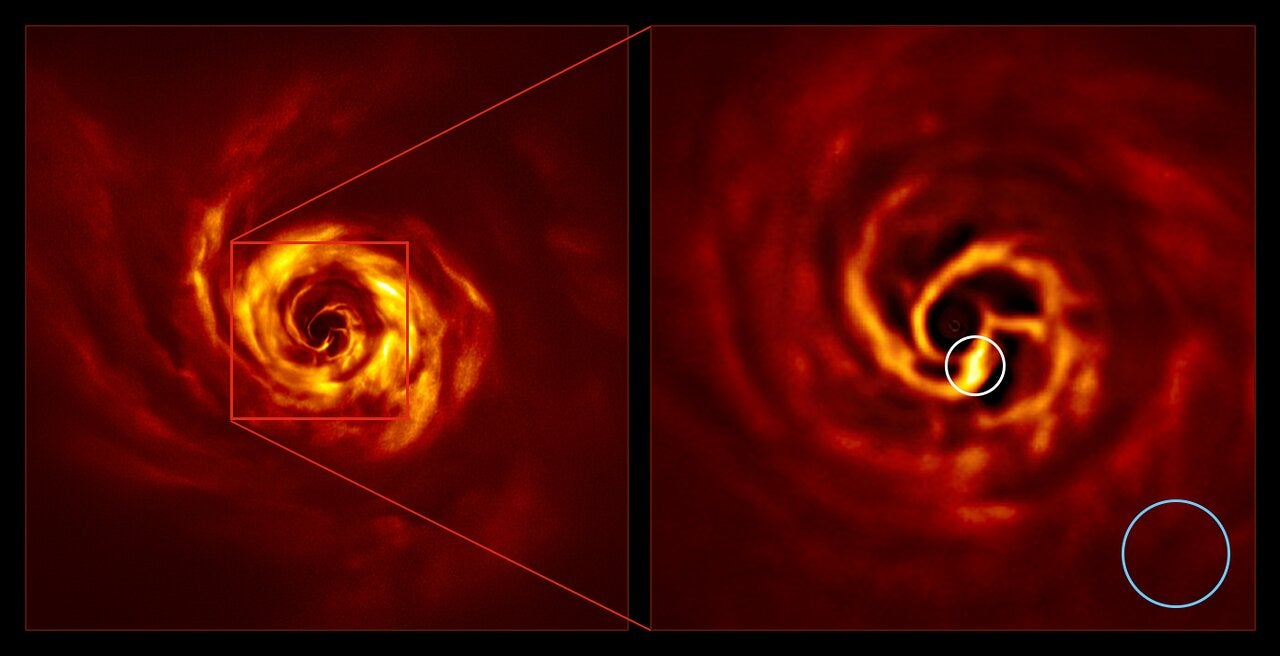
“The twist is expected from some theoretical models of planet formation,” said co-author Anne Dutrey, from the Astrophysics Laboratory of Bordeaux.
“It corresponds to the connection of two spirals – one winding inwards of the planet’s orbit, the other expanding outwards – which join at the planet location. They allow gas and dust from the disc to accrete onto the forming planet and make it grow.”