Science is full of big, complex ideas, and one of the most important skills a scientist can develop is a knack for communicating those ideas to others. It’s a difficult job, and one which is even harder if you want to condense a lot of information into a tight word count or timeframe.
However, that’s exactly what we’re going to try to do over the next couple of months. Every two weeks we’ll be trying to break down a range of scientific concepts into six-second vines, which we’ll launch on the Guardian Vine account and here in the Notes & Theories blog.
Our first attempt is a look at the life cycle of a small star.
We decided to use stop-motion animation and Play-Doh to illustrate the life and death of a small star. It begins with the swirling of gases and dust from collapsing nebulae, which are drawn together by gravity, the centre growing hotter and hotter, to form a protostar.
If the protostar has sufficient mass, the gas and dust burn with increasing heat, eventually reaching temperatures which allow the nuclear fusion hydrogen into helium. This turns the body into a main sequence star, producing light, heat and enough radiation pressure to stop gravitational collapse.
How long the star lives depends on its mass: a star with higher mass will burn through material faster due to a higher core temperature, caused by greater gravitational forces.
After about ten billion years, the hydrogen at the core of a small star will run out, putting an end to the nuclear fusion powering the star and causing gravitational collapse. This collapse increases the density and heat of the core until the fusion of helium into carbon is triggered. This in turn causes the outer layers of the star to expand and start to cool. The cooling turns them red: the star is now a red giant.
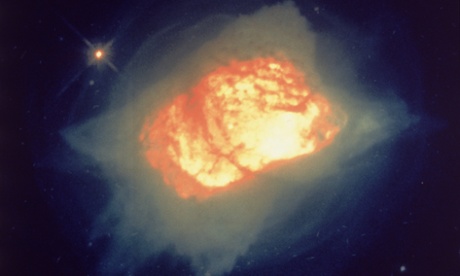
There’s now almost a repeat of the previous process: the helium runs out so no further fusion can take place and gravitational collapse resumes. The collapse will cease and stability occur once the carbon electrons become so close together that electron degeneracy pressure occurs with enough force to balance out gravity. The star’s outer layers expand and puff away to form a planetary nebula, leaving a white dwarf in place of the red giant, dimming and cooling until eventually it is a black dwarf, emitting no significant light or heat.
It’s quite a lot to fit into six seconds, but we had a go. However, if you think you could do a better job, or have another idea to condense into a vine, we’d love to see: post them using #guardianscienceinsix . We’ll publish the best ones here and will feature a collection on our Youtube channel.