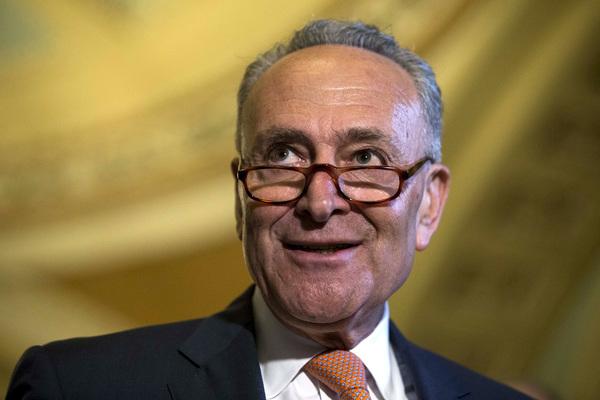
WASHINGTON _ Senate Minority Leader Charles E. Schumer said Friday he would not allow quick action on a pair of Trump administration trade policy nominees because of what he said was the Commerce Department's slow-walking action against China on its overproduction of steel and aluminum.
"I am deeply frustrated by Secretary (Wilbur) Ross's perpetual foot-dragging on this critical investigation, and I was shocked by his recent nonsensical excuse that the Department of Commerce is waiting until after the unrelated Republican tax plan passes to complete these investigations," Schumer said. "The steel industry has seen a surge of imports since the announcement of these investigations that has already cost jobs."
In an April executive memorandum, President Donald Trump asked Commerce to investigate if foreign-made steel threatens domestic production and national defense readiness. Trump has pledged to boost U.S. steel production and to counter excess steel output by China that has lowered global steel prices.
The New York Democrat made his announcement ahead of a Trump trip to Asia that is scheduled to include a visit to China.
Schumer said he will place a hold on the nominations of Gil Kaplan for Under Secretary of Commerce for International Trade and Nazakhtar Nikakhtar for Assistant Secretary of Commerce, Industry and Analysis "until the Commerce Department provides a satisfactory and meaningful response on the progress of the Sec. 232 investigations."
By placing a hold, Schumer is notifying senators he would object to an attempt to get the two nominees to be confirmed by unanimous consent.
Because of the precedent set by the last Democratic majority, Schumer cannot actually block the nominees through a hold with the backing of his caucus and would need Republican votes to block a simple majority for confirmation. It's unclear how much time and effort Senate Majority Leader Mitch McConnell of Kentucky would invest in these nominations since he has tended to prioritize lifetime appointments to the federal bench instead of executive branch appointments.
As for the Commerce Department nominees, Schumer said in his statement that, "I hold these nominees reluctantly, as they could be an asset to the Commerce Department, but this situation is dire and this administration must be sent a clear message that action, not rhetoric, is needed immediately."
In the April executive action, Ross initiated two investigations under Section 232 of the Trade Expansion Act of 1962, a rarely-used statute that allows the president to take nearly unfettered action to restrict imports on national security grounds.
Under the statute, Commerce has 270 days from the date an investigation is initiated to produce a detailed case laying out recommendations for the president; once the report is delivered, the president has 90 days to decide what action to take, if any.
Ross launched the steel investigation on April 20, and the aluminum investigation on April 27, so both reports are due in January 2018. Trump initially wanted both reports submitted in June 2017, but the investigations stalled due to pushback from other federal agencies including Treasury, State and Defense, concerned that tariffs on imports not only from China but also several U.S. allies and trading partners would cause economic harm and damage diplomatic relations. Trump also was seeking China's aid in sanctioning North Korea over its ballistic missile program and nuclear ambitions.
Farm and steel manufacturers also have cautioned against imposing tariffs on foreign-made steel products that they fear could cost U.S. jobs and make American agricultural products likely targets of retaliation from angry trading partners.