The fear of being infected with the novel coronavirus has resulted in a tendency to discriminate and slander others. Correctly facing the threat of the virus is difficult even for adults, not to mention children. Schools continue to seek methods of teaching appropriate etiquette amid concerns about bullying of students infected with the virus.
-- Patience, understanding needed
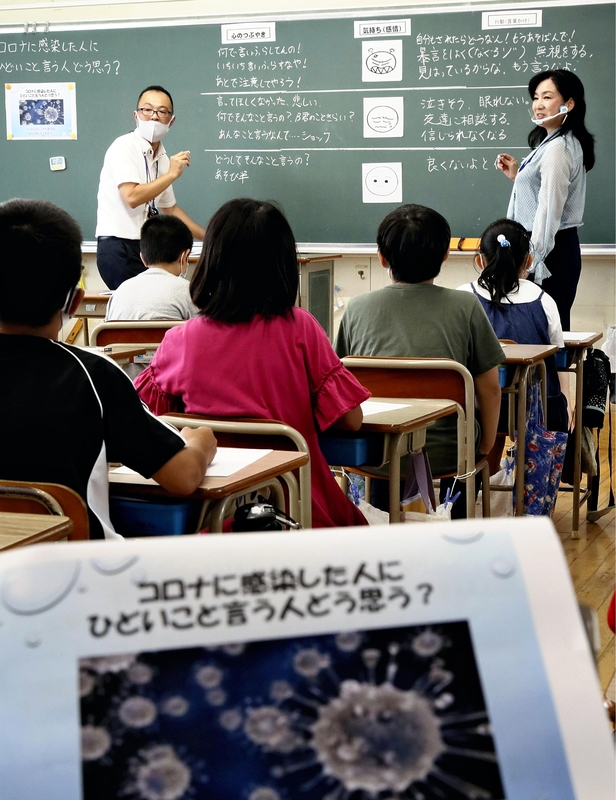
"Some spread word from one person to another about friends who have been infected with the coronavirus. What's your opinion of this situation?
Toshinori Mashima, a fifth-grade teacher at city-run Hanasato Elementary School in Itami, Hyogo Prefecture, posed this question to his students in mid-September.
During a special class held in place of the regularly scheduled health education lesson, the instructor talked about how the virus is invisible and said those infected with it often do not realize they have it. The lesson also included the fact that it is safe to meet with people who had been infected but are now recovered.
After listening to the lecture students expressed their feelings on paper.
Mashima told them: "When we are apprehensive or frustrated, we tend to lash out at others. But once you have an understanding of the coronavirus, you can be relaxed in the way you behave."
"I learned that it's helpful to take deep breaths and calm down when in times of stress," a 10-year-old girl said following the lesson.
The school's principal Masahiro Murakami said, "We never know who will be infected and when. Learning how to respond to the virus is the most important thing."
According to the Education, Culture, Sports, Science and Technology Ministry, 1,166 students at elementary, junior high and high schools were found to have the virus between June 1 and Aug. 31. More than half of them were infected at home and 15% picked up the contagion at school.
-- Reports on bullying
Meanwhile, there have been instances of discrimination and bullying because of virus infections.
In Saitama Prefecture, there have been about 20 reports of bullying, including a case in which students of a school where an infection was confirmed were referred to as "corona" by students of another school. In Niigata Prefecture, there have been at least eight instances believed to have been bullying cases.
In a survey conducted by the National Center for Child Health and Development on 912 students at elementary, junior high and high schools in June and July, 22% of the respondents said they do not want to play with someone who has been infected with the virus, even after the person has recovered.
Thirty-two percent said they want to keep it a secret if they themselves or a family member is infected.
In light of these situations, education minister Koichi Hagiuda said in an Aug. 25 statement: "If someone is infected with the virus, that person is not at fault. Rather than blaming them, I would like to see people encourage them and give them a warm reception when they recover and return to school."
-- 'Time for integrated learning'
It is not enough to tell children that they must not discriminate against those infected. Conveying the proper age-appropriate knowledge is considered necessary. However, the education ministry has not issued guidelines on what material is to be taught in what classes at each grade level.
In fact, such lessons are only given at certain schools, which are said to work to determine the material and how to teach it.
City-run Ogo Junior High School in Kobe in June provided all its students with a special lesson that a school counselor delivered. The students were told to write about their anxieties over the coronavirus and matters related to the infection. The school counselor then talked to individual students. The school continues to provide this kind of support.
The lesson was offered as part of integrated learning, under the rare term, "sogo gakushu," in Japanese. Sogo gakushu is included in the school curriculum and its details are set up by each school.
Some other schools use the time for health education lessons or moral education to show students educational material the Japanese Red Cross Society and other organizations have created. Many schools have difficulty in setting time aside to deliver such lessons.
Many schools have no time to do so as they cannot alter their original educational programs or complete other classes as planned.
-- Ministry must develop measures
University of Hyogo Prof. Yoshiki Tominaga, who is well-versed in child psychology, said: "As in times of disasters and other emergencies, when children's anxiety grows, they are likely to become aggressive and driven to bully other children.
"The most important thing is to have all the children properly understand characteristics of the coronavirus. But there are limitations on this because doing so is simply left to individual schools. The education ministry must present specific measures to deal with this matter."
Read more from The Japan News at https://japannews.yomiuri.co.jp/