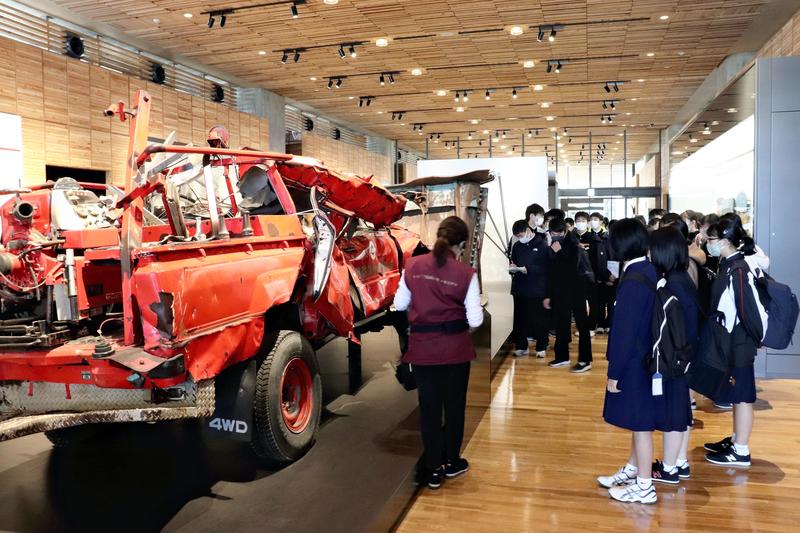
An increasing number of schools are choosing areas affected by the Great East Japan Earthquake for their school trips.
As the coronavirus continues to spread, many schools have changed their plans from places such as the Tokyo area to the Tohoku region, where there have been relatively few infections.
March 2021 will be the 10th anniversary of the earthquake and tsunami. Locals hope that visits to the affected areas will keep memories of the disaster from fading.
-- Miyagi students travel to Iwate
"Even a 30-centimeter wave [that is triggered by an earthquake] can knock a person off their feet if the current is fast enough," a guide at the Iwate Tsunami Memorial Museum in Rikuzentakata, Iwate Prefecture, explained to a group of 121 junior high school students from Kakuda, Miyagi Prefecture, on Nov. 4.
The school decided not to go to its usual destination in the Kanto region partly because of the pandemic, but also so that students "can feel the scars left behind by the tsunami and see the state of reconstruction first hand," a school official said.
Kakuda is an inland city, which was rocked by a lower 6 earthquake on the Japanese seismic intensity scale of 7 in 2011 but was not damaged by the tsunami.
"A tsunami destroys everything people have built," said Tomohiro Saito, a third-year junior high school student. "It's tragic."
The museum opened in September 2019 to convey the lessons learned from the tsunami and to inform visitors about the events that occurred during that time.
More than 10,000 students from 215 schools are expected to visit the museum this year, about eight times more than in 2019.
They come on school trips and as part of off-campus studies. Most schools are from the Tohoku region, but some have come from the Kanto region.
"We want to improve the descriptions of the exhibits and turn this into a regular destination for school trips," said Masanori Kumagai, deputy director of the museum.
-- 90% usually go to Tokyo
More than 90% of junior high schools in the six prefectures of the Tohoku region go to the Tokyo metropolitan area for their annual school trips, according to KNT Tohoku Co. However, this year, 40% have canceled their trips and 60% have decided to visit neighboring prefectures instead.
A representative of the Iwate prefectural tourism association pointed out that among alternate destinations, "interest in areas affected by the disaster is particularly high."
In September and October, 70 schools visited the former Miyagi Prefecture Kesennuma Koyo High School building, where the classrooms have been left untouched since the disaster to serve as a memorial. This is more than double the number compared to the same period last year.
-- Dispelling rumors
In Fukushima Prefecture, a public-private organization, which is working to promote the area's recovery from the Tokyo Electric Power Company Holdings Inc.'s Fukushima No. 1 nuclear power plant disaster, is among the groups that are trying to attract school trips.
By having visitors see the state of reconstruction in-person, they hope to dispel harmful rumors and increase the number of people traveling to the area.
Earlier this month, about 400 students from a high school in Fukuoka City visited the town of Futaba, Fukushima Prefecture.
"We want the younger generation to have a deeper understanding of Fukushima," a person in charge at the organization said.
Read more from The Japan News at https://japannews.yomiuri.co.jp/


.jpg?w=600)