Ninety-nine point nine per cent of pop and rock music is vocal, but what of the minuscule remaining fragment? Why do people write instrumentals and, just as importantly, should they bother?
The list of Grammy Award winners for Best Rock Instrumental Performance makes for a rum read. Bruce Springsteen's superfluous version of Ennio Morricone's Once Upon a Time in the West was 2008's dubious winner. It's stretching the imagination to see how this is a rock performance as opposed to an orchestral film score that happens to have a rock musician playing on it. This begs the question of whether the award should exist at all, as with each year it seems to scrape the barrel for relevant nominations. It begs another question too: are there decent rock instrumentals out there that the Grammy Awards are missing?
The casual instrumental
Most pop and rock instrumentals are mere filler. Blur litter their albums with pleasant enough interludes that, on both Lot 105 and Intermission, morph into grating lad romps. Yet, tiresomely, some insist on conferring greatness on such padding. The Smiths' Oscillate Wildly makes it into Rolling Stone's top 25 instrumentals of all time. Surely this was a case of the band's clouding the panel's judgment rather than the instrumental having any great musical value? Similarly, Flaming Lips have won the rock instrumental Grammy twice, for Approaching Pavonis Mons by Balloon and The Wizard Turns On. Another fine band, but the instrumentals are again the weakest links, neither achieving great musical heights.
The more dedicated
That rock critics should applaud these lacklustre arrangements is bizarre because the best instrumentals are capable of stimulating the most intense emotions. Within jazz and classical music, of course, a reverse snobbery is evident. Vocal music was judged by 19th-century critic Eduard Hanslick to be inferior to that of instrumental music, like Beethoven's peerless late quartets. Why? Because he believed that music became less beautiful the more it attempted to represent a definite "feeling", so framing words in music, or using music to tell a story, was deemed vulgar compared to the abstract constructs of "absolute" music.
But as we move into the jazz and classical-influenced realms of Prog, however, we find more inspired instrumental fare. King Crimson's Red, for example, manages to sustain both an aggressive sound and the listener's interest through using less obvious musical devices; a whole tone scale (as opposed to the combination of tones and semitones that make up more familiar scales) on the opening theme, shifting time-signatures (without losing a monumental groove) and a sinister cello break. This is a genuinely interesting piece of music for its own sake, without referring to any extra factors (lyrics or a suggestive title to tell us what it is about), nor merely flexing the band's musical muscle.
The specialists
There is also the handful of bands whose sole output consists of instrumentals. Surf guitar, such Link Wray and Dick Dale, provided a hefty boost to the rock instrumental. Link Wray's Rumble is a mighty kick in the teeth that sounds as if it inspired Black Sabbath's War Pigs, with its identical chords and bassline, as much as it did the Beach Boys. Moving forward, the 90s post-rock movement threw up a few bands like Tortoise and Godspeed You! Black Emperor that specialised in non-vocal music.
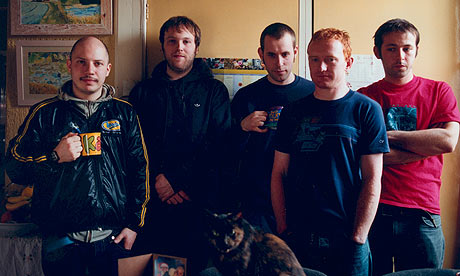
What did these different-sounding bands have in common? Not much apart from a willingness to abandon the constraints of writing music for lyrics and to stretch out in other directions. Some achieved this better than others, with many of these bands, like GY!BE, being a little overreliant on atmospheric build-ups exploding into waves of jubilant noise. But Warren Ellis's Dirty Three get it right for me with just the right blend of restraint and explosion with an emphasis on more folk-based melodies rather than minor arpeggios.
From Fleetwood Mac's Albatross through Krautrock to Mogwai, rock instrumentals are out there, but you really have to search to sort out the great from the mundane.