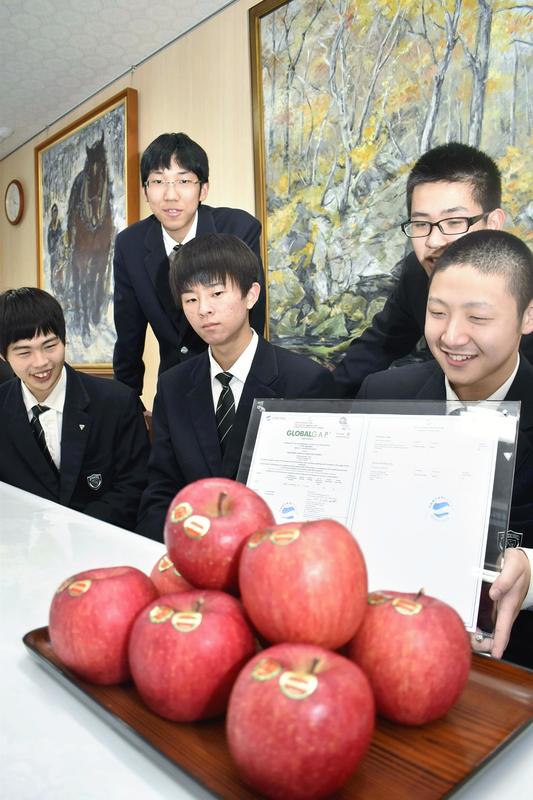
A growing number of agriculture-focused high schools have acquired an internationally recognized certification for produce they have grown and hope will be served to athletes competing at the 2020 Tokyo Olympics and Paralympics.
The Global G.A.P. (see below) is a worldwide standard for good agricultural practices. According to the Agriculture, Forestry and Fisheries Ministry, 22 schools have acquired this certification, up from five just two years ago. If the schools' carefully grown fruit and rice are selected as ingredients for meals served in the Athletes' Village, it would be a golden chance to showcase this local produce and the schools' club activities across Japan and overseas. The students have high expectations for these projects.
Food served at the 2020 Games will be chosen by the organizing committee based on lists submitted by each prefecture. Selected produce will be used in meals at the village and also supplied to food stands at competition venues.
As of the end of December, the 22 high schools from 14 prefectures including Aomori, Ibaraki, Kyoto and Fukuoka had been notified that they acquired the certification, according to the ministry. This number has increased from just five at the end of March 2018, and 20 at the end of March 2019.
At the end of January, the prefectural Kashiwagi Agricultural High School in Hirakawa, Aomori Prefecture, acquired G.A.P. certification for Fuji, Orin and Jonagold apples that are prefecture specialties. Eleven second- and third-year students from the school's apple research club had been preparing since last spring to get the certification to deepen understanding of local apple cultivation methods. Twice a week, the club repeated trial-and-error processes to clear at least 200 strictly checked screening criteria, ranging from the production process to equipment maintenance. The students addressed issues including whether agrochemicals were stored at an appropriate temperature, and whether there were methods for checking pest numbers and exterminating them.
The students compiled documents detailing methods for retrieving their produce, because their response to a recall also was examined. The students also practiced question-and-answer sessions daily right up until the inspection.
"The preparation was really hard, but I'm glad we passed," second-year student Yasuharu Kudo, 17, said. "If we get chosen to provide food for the Tokyo Games, we'll confidently supply it."
School efforts to acquire G.A.P. accreditation also are aimed at boosting students' appetite to learn. After the Tochigi prefectural Mookahokuryo High School's biological production department had acquired the certification for koshihikari rice in 2018, students began to more neatly maintain their fields and practical training rooms.
"Students who tended to be passive learners in class are now thinking for themselves and taking action," said Hiroyuki Akiyama, a teacher at Ehime Prefectural Minamiuwa Senior High School, which acquired the certification for two kinds of citrus fruit in 2018.
Global G.A.P.:
An international certification from Europe awarded to producers who reach certain standards on issues such as food safety and environmental considerations. G.A.P. is an abbreviation for good agricultural practices.
Read more from The Japan News at https://japannews.yomiuri.co.jp/