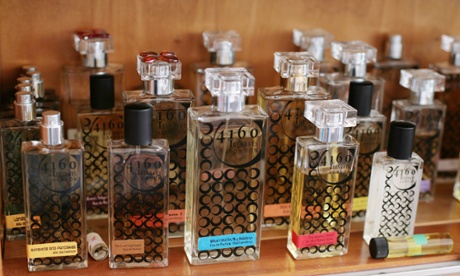
Perfume has existed for thousands of years and manufacturers have used scents in everyday products – candles, soap, lip balm, lotions – for more than a century. Even today’s scent-free products contain an odor neutralizer, which in essence is one fragrance that masks the scent of another, writes Dr. Anne Steinemann of the Physicians for Social Responsibility’s Environmental Health Policy Institute. Michael Edwards, author of Fragrances of the World, the definitive annual perfume guidebook that classifies more than 8,000 fragrances, says upwards of 5,000 new perfumes have been introduced since 2000.
At banquets, the Romans refreshed themselves between courses with flower-scented water. Edwards notes that perfume’s origins come from ancient Romans’ temple rituals, in which they crushed and threw flowers, leaves, wood shavings, spices and aromatic resins onto burning coals as offerings to the gods, releasing their scents “per fumum” – the Latin phrase meaning “through smoke”.
The aromas that resulted when ancient civilizations burned frankincense and sandalwood created a lucrative trade, says Simon Cotton, a senior lecturer in chemistry at the University of Birmingham in England.
According to Edwards, the Egyptians, who developed the study of fragrance in the Nile Valley, created aromatic oils and essences. They adored perfume and used oils including almond, rose, frankincense, myrrh, cedar, mimosa and lily in aphrodisiacs, medicines, cosmetics and incense.
The Persians, meanwhile, developed the technique of extracting essential oils from flowers and plants through steam distillation, and a side benefit emerged: delicately scented aqueous solutions such as rose water, which today remains popular in Arabia. Persians eventually brought the practice to Western Europe.
There, by the late Middle Ages, perfumes resembled what we see today — essential oils in alcohol solution. In the Middle Ages, people used scents and perfumes for preventative health rather than beauty reasons due to the scarcity of soap and water, writes Cotton. To ward off plague and bad odors, Henry V reportedly carried scented materials such as musk and ambergris, a solid wax from the intestines of sperm whales, which produces a pleasant, subtle odor when exposed to air.
During the Renaissance, perfumes became hugely popular in Europe. Historians credit Catherine de Medicis, the wife of King Henry II, along with her personal perfumer, Rene the Florentin, for introducing fashion fragrances to France. Later, in 1799 after the French Revolution, the name Eau de Cologne became synonymous with Napoleon Bonaparte, who used vast quantities of the stuff.
While major perfume makers are Paris-based, the small city of Grasse, northwest of Nice, is the heart of France’s perfume industry. The region’s mild Mediterranean climate makes Grasse conducive for farmers to cultivate a range of crops including jasmine, lavender and myrtle for natural fragrances. Cotton says that until the mid-19th century, perfumes were made with natural ingredients, largely by pressing or distilling plant products. Then the fragrance industry grew with the introduction of synthesized materials.
As organic chemists’ understanding of the structure and synthesizing of molecules increased, new fragrances became possible. Synthetics helped bolster supplies of familiar molecules. For example, in 1882, Houbigant’s Fougere Royale used synthetic coumarin – which smells like marzipan. Then in 1889, Guerlain’s Jicky used vanillin, a synthetic vanilla essence made possible by the discovery of the Reimer-Tiemann chemical reaction in 1874.
Edwards touts Coco Chanel as the first designer to encourage perfumers to use synthetics. When her company released Chanel No 5 in 1921, the fragrance became the first floral aldehydic perfume, “a bouquet dominated by the soft, clean notes of synthetic aldehydes intertwined with the costliest jasmine and may rose from Grasse.”
The use of synthetics can help create a more consistent fragrance, because there is no crop-to-crop or region-to-region variability as in natural products. Natural sources also depend on good or bad growing seasons, which can cause price fluctuations. Some fragrance materials can only be harvested in a particular part of the world. This means that when a particular scent becomes popular, as sandalwood from India did, it can cause environmental damage from overharvesting of a region.
Also, some scents like civet and musk come from animal secretions – and the creatures were killed or treated cruelly to extract them. Synthetic versions are more critter-friendly.
Today, nearly all perfumes blend natural-sourced materials with synthetic molecules. Most experts endorse this trend, saying both natural and artificial oils are important to perfumers, scent chemists and manufacturers of products using fragrances. As Cotton notes, “perfumery is a tribute to the artistry of perfumers in blending fragrant molecules, and the skill of chemists in synthesizing molecules, both new and old”.
Copy on this page is brought to you by SC Johnson, sponsor of An apple a day series and the values-led business hub.