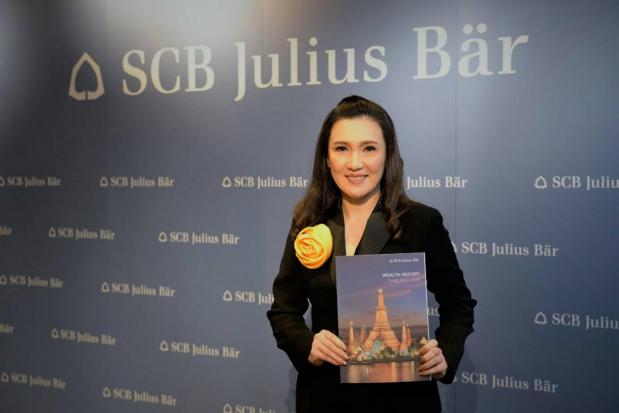
SCB Julius Baer, a strategic wealth management joint venture, aims to take up a 10% market share of Thailand's private banking industry over the next five years by attracting investment from local high net worth (HNW) individuals.
According to "Wealth Report Thailand 2019", a survey of 351 Siam Commercial Bank clients defined as HNW individuals with a combined fortune of US$341 billion (10.7 trillion baht), the wealth of local HNW individuals is projected to deliver a compound annual growth rate of 9.9% to $401.2 billion from 2015-20.
The wealth expansion is driven by steady growth of household wealth, economic development and the buoyant property and stock markets, according to the report.
"We expect our market share to be around 10% over the next five years," said Jiralawan Tangitvet, Julius Baer's chief executive.
"However, the short-term target for the first two years is focused on competency of relationship managers as a key to business success."
The venture aims to increase its relationship managers to 40 people by the end of this year from the existing 15.
Next year's target is 50 people.
"We must serve our customers with the same standard as [private banking institutions in] Singapore and Switzerland for our asset size to grow," Mrs Jiralawan said.
SCB Julius Baer is targeting local HNW individuals with minimum assets under management of 100 million baht.
She did not disclose the number of existing customers or the size of assets under management, only stating that half of the customers are from SCB and the rest are new customers.
"We operate an open architecture, not producing our own products but acting as a marketplace for all financial services and asset classes," said Mrs Jiralawan, citing currencies, fixed income securities, equities, properties and structured products worldwide as examples.
The report said local HNW individuals invest in liquid assets, such as stocks, bonds and various types of investment funds, with 55% of asset allocation, higher than their global counterparts at 47%.
Thai HNW individuals have the largest exposure to cash (21.5%), followed by fixed income securities (20.4%), stocks (19.5%), funds (15.3%), insurance (7.8%), real estate (6.7%) and others (8.8%).
The majority of local HNW individuals invest in onshore investment products, with investments allocated in real estate and alternative assets, at 7% and 6% of their portfolios, respectively, lower than their global peers, who invest 17% in real estate.