Our invitation to the world of disused quarries, ironworks and lime-kilns in the wooded gorges carved out of Mendip rock near Mells came from a direct descendant of Professor John Morris, one of the first archaeologists to visit the place. Back in 1868, he had particularly admired the rockface that was now our destination.
But first we had to pick our narrow way beside the stream, bending back overhanging branches, clambering up and down steep inclines, passing the overgrown ruins of iron workings and stepping over fragments of tram tracks. There was scarcely a sound but birdsong and the rush of water in this place that once rang with the clang and clamour of industrial toil. The thick woodland of ash, oak, lime and hazel is a rich wildlife habitat; crayfish live in the waters, and derelict tunnels and flues make homes for greater horseshoe bats. As we went, knowledgeable members of the group pointed out some of the flora and fauna (including the rare alternate-leaved golden saxifrage) that contribute to its status as an site of special scientific interest.
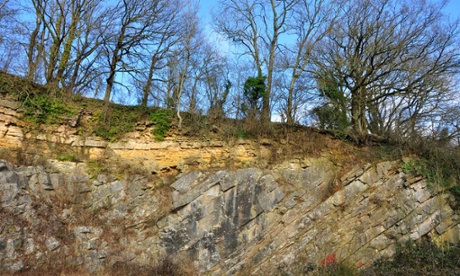
And then we were there, in an open arena that was once the site of an old quarry, facing directly a sheer wall of rock and the De la Beche unconformity, named after the man who, in 1846, had recorded its significance in the world’s first geological survey. The greater part of the rockface, from the ground upwards, is formed of massive beds of hard, blue-black Carboniferous limestone, its diagonal pattern made of deep scars or cracks between beds of rock that were once forced up to an angle of around 45 degrees.
It is the fact that the horizontal lines of the much younger sand-coloured oolithic limestone above do not conform with the steep diagonals of the older Carboniferous limestone below that makes the “angular unconformity” that is so notable in the archaeological record. The thin upper layers are made of thousands of tiny sea creatures deposited as, over immense stretches of time, the sea rose to overwhelm the land beneath.
Follow Country Diary @gdncountrydiary
• The picture with this article was changed on 26 June as the comment (below) is correct. The new picture is of the De la Beche unconformity described in the article.