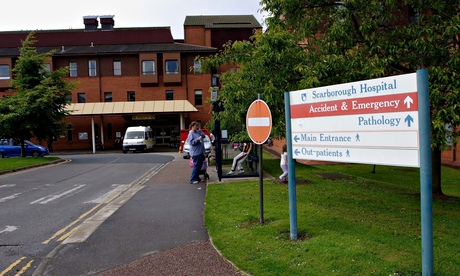
Scarborough hospital has become the third in two days to declare a major incident because of unexpectedly high demand for its services, raising fears that the widely predicted NHS winter crisis is materialising.
A spokesman for the North Yorkshire hospital said yesterday that it had been forced to postpone some planned surgery and other procedures after patients had been left waiting for a bed in the emergency department.
The problems came a day after two hospitals in Gloucestershire also declared major incidents due to high demand in their A&E departments – the second time in a month that Gloucestershire NHS trust had declared the status.
Mike Proctor, deputy chief executive at York teaching hospital NHS foundation trust, which includes Scarborough, said: “While the winter months are traditionally a busy time for all hospitals across the country, we have been experiencing an unprecedented surge in demand for our services and we have today reached a point in Scarborough where we have needed to enact our major incident plan.
“Doing this enables us to increase our focus on our most ill patients and step up our management of our resources to ensure that we are seeing, treating and admitting those who most need our care.”
He said that the situation had been particularly acute yesterday. A major incident is defined as one that presents serious threat to the health of the community, and disruption to the service. The medical director of NHS England, Sir Bruce Keogh, said last month that A&E units were “creaking” under the pressure.
Figures due to be published this week expected to show performance in A&E units in England has dropped to its worst level since the four-hour waiting time target was introduced a decade ago.
The target, of 95% of patients admitted, discharged or transferred in four hours, has been met in just one week since August. The latest NHS England figures showed that the number of patients who were forced in the last month to wait up to 12 hours for a bed on a ward had more than doubled compared to the same period last year, to 29,151 patients.
Proctor said that members of the public “can really help us by only coming to the emergency departments in an emergency”. He urged them to contact their GP or pharmacist or attend a walk-in centre or minor injuries unit where appropriate so the hospital could concentrate on those with the greatest needs.
Simon Cox, chief officer for NHS Scarborough and Ryedale clinical commissioning group, said staff were working hard “during this time of great pressure”.
People in Bristol and north Somerset were urged on Sunday not to visit A&E departments with minor ailments, with the health trusts also citing “unprecedented demand” over the weekend that had caused delays for patients requiring urgent attention.
The NHS said that problems at Gloucestershire Royal and Cheltenham general hospitals had been exacerbated by 30% of incoming patients having “non-urgent ailments”. In November the health secretary Jeremy Hunt announced a £300m boost to pay for more staff and extra bed space to cope, amid fears of a winter crisis due to an ageing population and a surge in demand during the cold weather. It took the total winter pot to £700m, 75% up on the previous year.
Cliff Mann, president of the College of Emergency Medicine, said the number of hospitals declaring major incidents was evidence of the strain they are under. “The events in Scarborough, Cheltenham and Gloucester and recently in Colchester [which declared a major incident in November] demonstrate the unprecedented demand being placed on acute admissions units and A&E departments,” he said. “Even before Christmas the number of attendances had increased by 20,000 per week compared to the previous year. The time has come to fund A&E departments properly so they can cope rather than penalising acute hospitals with the current iniquitous tariff system. We cannot continue to be duped by the claims that other agencies will ‘divert’ these patients. We also need to ensure that patients can be safely discharged seven days per week – better for them and better for those in need of a bed urgently.”