Victims support ordinances had been passed by 19 of 47 prefectures, or 40%, and six of 20 ordinance-designated cities, or 30%, as of the end of January, an investigation by The Yomiuri Shimbun found.
Crime victims and their families have been demanding local governments nationwide enact such ordinances.
Experts have pointed out that support should not differ depending on where someone lives. It is widely believed that all local governments should enact these ordinances.
Assistance for crime victims was behind the enforcement of the Basic Law on Crime Victims in 2005. The law stipulates that all municipalities "have responsibilities" for assisting crime victims.
Crime victims are often unable to return to how their lives were before the incident, and administrative support based on an ordinance is indispensable. However, only 25 prefectures and ordinance-designated cities have enacted ordinances specifically on support for crime victims.
There are differences between how financial support is provided, with only eight prefectures (17%) and four designated cities (20%) having introduced systems for compensating crime victims, such as through "encouragement" payments.
Oita Prefecture's ordinance, which was enacted in 2017, was enforced in all of the prefecture's 18 municipalities within a year.
A system was introduced in the 18 municipalities to issue payments of up to 300,000, yen half of which is paid for by the prefecture. "Support coordinators" have been appointed to mediate between victims, the government, private aid organizations, and other entities.
In municipalities where ordinances have not been enacted, local officials cite a variety of reasons. A Nagano prefectural official said, "We haven't had any major incidents and no requests from bereaved family members." A Hiroshima city official said such a system would be "difficult to include in the budget."
'It's past time'
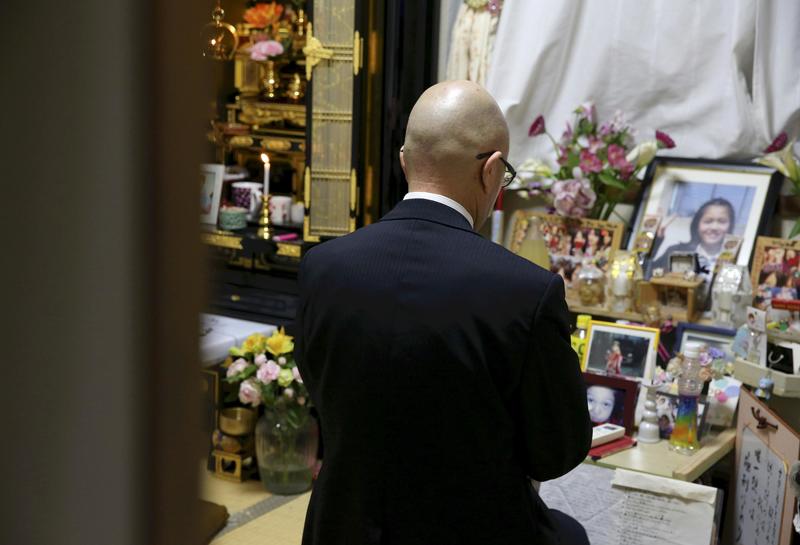
"Support ordinances are needed for when something unfortunate happens. I want them for future generations," Satoru Terawa, 51, told Chihiro Takeuchi, the mayor of Shima, Mie Prefecture, at a meeting in city hall on Jan. 16. Terawa, is a company employee from Yokkaichi in the prefecture.
The body of Terawa's second-oldest daughter, Hiromi, was found in a vacant lot in Asahi in the prefecture in August 2013. She was in her third year of junior high school, only 15 years old at the time.
He and his wife were unable to work due to shock. With no income, the cost of their daughter's funeral, hospital visits for sick family members and other necessities was difficult to bear. In the blink of an eye their savings of about 6 million yen and 3.2 million yen in government benefits disappeared.
About six months later, a man, who was an 18-year-old third-year high school student at the time of the murder, was arrested. He received an indeterminate sentence of at least five to nine years in prison.
He was ordered to pay about 78 million yen under a system enabling victims to claim damages from the accused within the criminal trial, but he has not paid anything so far. They also sued the man's parents, but the lawsuit cost 700,000 yen in revenue stamp fees alone.
The grief of losing their daughter was bad enough, but why, they wondered, did they also have to suffer financially?
Terawa decided to push for an ordinance, and in June 2018 he sent a letter to Mie Gov. Eikei Suzuki saying, "It is past time to provide relief to crime victims."
Suzuki invited Terawa to a meeting, where he listened to him with tears in his eyes, saying, "I have a daughter, too."
In April of the following year the prefecture enforced an ordinance with a groundbreaking framework, which includes a system for payments up to 600,000, yen the highest in the country.
After the prefectural government acted, Terawa's hometown of Yokkaichi enacted an ordinance in October. Terawa's goal is to get all 29 municipalities in the prefecture to enact ordinances. He continues to approach mayors for meetings.
"Incidents happen every day and the number of bereaved families like us continues to grow," he said. "I want there to be ordinances nationwide."
Read more from The Japan News at https://japannews.yomiuri.co.jp/