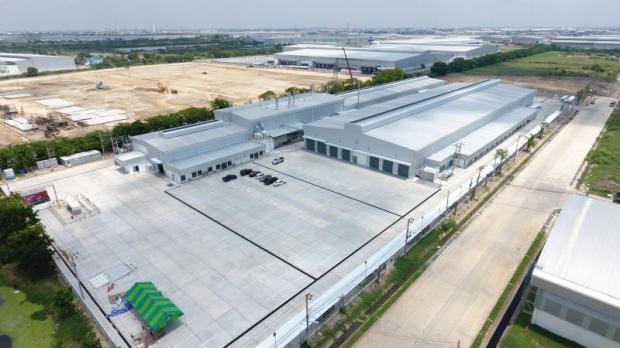
Swedish bus and truck maker Scania AB expects significant growth in local sales and exports after an 800-million-baht assembly plant in Samut Prakan began full operations in the fourth quarter of 2018.
Scania Group Thailand Co, the local manufacturing unit, will formally inaugurate the assembly plant in Bang Sao Thong district on Feb 22.
The new plant occupies land in the Bangkok Free Trade Zone after a relocation from Chachoengsao province.
With the investment of 800 million baht, the new plant will make cabs, tractors and bus chassis.
Thailand is the third country after Sweden and Brazil to have a cab manufacturing facility for Scania.
Ted Goransson, business development director of Scania Group Thailand, told the Bangkok Post that the new facility hired 100 employees for production and logistics, purchasing, and R&D. It also gained access to various Thai suppliers.
Mr Goransson declined to reveal the production capacity of the plant, but he said it would be greater than the 600-800 units a year at the former Chachoengsao plant.
"Scania also has been granted the Board of Investment's promotion for this plant," he said.
Mr Goransson said exports will be possible to wherever it makes sense from a business and trade perspective, including Southeast Asia and Oceania.
Moreover, Scania has established a regional headquarters in Thailand for the whole of Asia and Oceania to support distributors in these regions.
Stefan Dorski, managing director of Scania Siam Co, the local distribution arm, said his company provides four product types to the local market: trucks, buses, engines and used trucks.
Scania expects to sell more than 700 trucks in 2019, up from 506 in 2018 and 466 in 2017.
For buses, Scania is keeping an optimistic outlook of over 100 units sold this year, though sales will depend on tourism sentiment and demand from bus operators.
Scania sold 122 buses in 2017 and 97 last year. It expects to sell 15 engines and 45 used trucks in 2019.
The company is supporting increased demand for biodiesel B20 usage in Thailand, Mr Dorski said, noting that all of Scania's diesel engines can easily be adapted to run on B20.
"In Europe, Scania has long experience with biodiesel, and our vehicles can run completely on biodiesel, which goes hand in hand with Scania's vision of sustainable transport," he said.