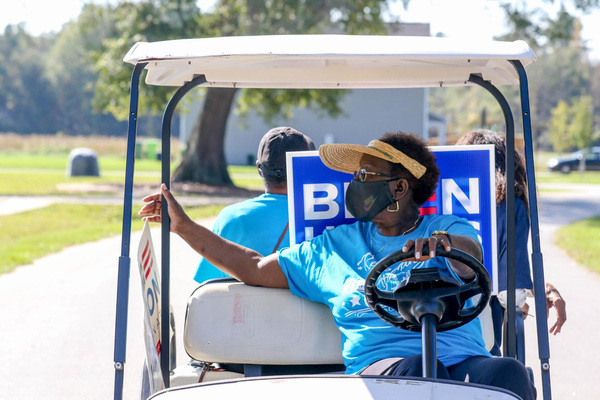
COLUMBIA, S.C. — Patrick Moses was fixing something under the hood of his car, parked in the garage of his Hopkins home in his neighborhood — a former cow pasture now dotted with single-family homes decorated for fall and Halloween — when a golf cart pulled into his driveway interrupting the quiet.
In the driver's side of the golf cart was Bernice Scott, Moses' across-the-street neighbor, who turned off the ignition key, which had attached to it a picture of her and President Barack Obama in front of the White House, and got out.
It was Tuesday, a week before Election Day, and Scott — the 75-year-old former Richland County councilwoman and founder of The Reckoning Crew, a grassroots mostly all female and Black voter education group out of Lower Richland — was an evangelist with a message for Moses.
The two talked for about 10 minutes until Moses told her he didn't vote in the primary because he was out of town.
"It just drives me to go get two more people or three more people," Scott said hours later when asked whether she gets disappointed with voters. "You got to have tough skin to do anything in this society with people."
As African Americans, Moses and Scott represent a powerful group of voters — a key to any winning coalition for Democrats. Their force in S.C. politics is best illustrated in the Democratic presidential primaries when, in 2016, they made up two-thirds of the electorate.
But despite voting overwhelmingly Democratic — a recipe for being on the losing side in a state that hasn't elected a Democrat to statewide office in more than a decade — Black voters in South Carolina can play a critical role in November. For example, while their historic turnout in the 2008 presidential election helped boost then-candidate Barack Obama to his White House win, in South Carolina, high turnout among Black voters helped Obama hold Republican nominee John McCain to a single-digit margin of victory in 2008, something that Hillary Clinton in 2016 could not replicate.
One factor for the 2016 loss? A lack of enthusiasm for Clinton.
"Think about the America electorate, people often come out to vote for what they are against, rather than what they are coming out to vote for," said Fredrick Harris, a political scientist at Columbia University and director of the Center on African American Politics and Society in New York. "This time the motivation is behind what they're voting against, which is Donald Trump. Maybe that level of concern wasn't there in 2016."
Now, Democrats in South Carolina have Jaime Harrison, a Black candidate mounting a historic campaign — he's broken state and national fundraising records and competed in the polls — to unseat U.S. Sen. Lindsey Graham. The party hopes Harrison will drive turnout among Black voters and other Democratic constituents. And at the top of the ticket is Obama's former vice president, Joe Biden, now the Democratic presidential nominee who won handily in the state's primary.
Though most forecasts say the odds are still in Graham's favor, Harrison's victory math includes getting Black voters to turn out in force alongside other key demographics he's looking to win, namely educated white voters and women.
"The Harrison-Graham race, if that results in Harrison pulling off what would be an upset victory in the state, you can say, to some degree, it was an Obama coalition that elected Harrison," said Todd Shaw, a University of South Carolina political scientist.
That coalition, Shaw said, means a serious and significant mobilization of Black voters, "probably at record level of the African American vote as combined with sort of younger voters who were highly mobilized," such as liberal white voters, he added.
"Although it's certainly not Obama being on the ballot, it's all the other issues that people are thinking about particularly when they're thinking about that Senate race," he said.
Harrison has work to do to get Black voters to the polls.
Though more than half of the state's Black voters asked in a recent poll said they had made up their mind, not all Black voters have. According to the most recent New York Times/Siena College poll, 12% of Black voters were undecided or refused to say who they would vote for in the Senate race. Another 6% answered Graham and 1% answered they were not going to vote.
Some, like Moses, had not voted yet when The State met him in his garage — a week out from Election Day.
Moses told The State he planned to vote later Tuesday but offered no certainty who he would cast a vote for president.
"Like I told her (Scott), I don't have a dog in the fight," Moses told The State, shortly after Scott left. "I don't really too particularly care for (President Donald) Trump, but I've seen his type, and I rather know who, how you feel versus you saying you like me and you really don't. The president has an office to fill, whoever that may be. They push a pen after Congress has met and said whether or not they are going to be for a bill or against a bill. He's a representation of the people. But Congress is the one who is really making the changes."
Moses said he was still "up in the air" about who he'd vote for in the U.S. Senate race. He said it won't be Sen. Lindsey Graham.
"And Jaime?" Moses said, referring to Harrison, an Orangeburg native who has made stops at Yale, Georgetown Law School, the halls of Congress as an aide to Columbia's Clyburn and as a lobbyist on Capitol Hill before returning home to become chairman of the S.C. Democratic Party.
"I don't know yet."
PREDICTING TURNOUT
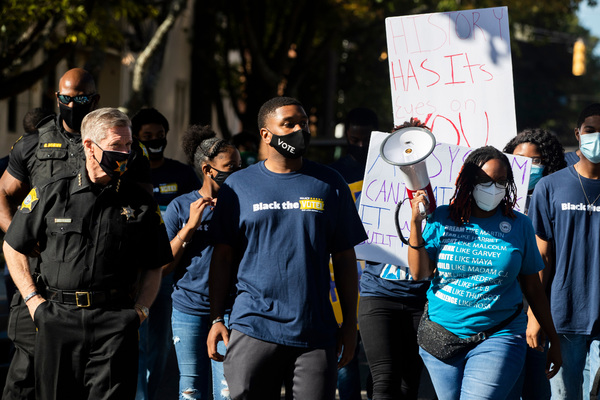
Some signs suggest Black voter turnout likely will be higher this election than in 2016.
To start, more South Carolinians have already voted absentee this year than in all of 2016 after the Legislature expanded early voting for this election to all registered South Carolina voters, citing concerns about the pandemic.
This week, state officials announced that more than one million S.C. voters had so far voted early. Based on those estimates, 1.3 million or more voters are likely to cast ballots in advance of Election Day. Of the ballots already cast, nearly 30% were returned by Black voters as of midday Thursday, and of the ballots issued to just Black voters, more than 94% had already been returned.
COVID-19 and heightened fears over voter suppression also are driving voters to cast ballots early.
"We have an electorate disproportionately affected by the COVID-19 pandemic, appalled by the racially-tinged rhetoric, the rise of white supremacy and that the president has not firmly condemned it — these are motivating factors to a huge turnout and efforts of voter suppression," said Harris, of Columbia University.
"If there are explicit efforts to suppress the Black vote, this is a huge motivating factor for Black voters to come out. This is why you're seeing people in low lines, high absentee voters, people are ensuring that their vote is going to count."
S.C. Democrats are confident Tuesday will not be a repeat of 2016.
"Not going to happen," House Majority Whip Jim Clyburn, D-Columbia, told The State over Zoom last week, when asked whether he feared Black turnout would resemble 2016 when then fewer than 60% of eligible Black voters cast a ballot.
"I don't have any fears of it being a low turnout," Clyburn said. "I do have a fear of what would happen if we aren't successful in our efforts. We always talk about whether or not people believe the science. Well, the question is, do you believe in history?"
Four years ago marked a 7 percentage point decline in Black voter turnout from 2012 when the country's first Black president was back on the ballot. That year also marked the first time in 20 years that Black turnout dropped in a presidential election, according to the Pew Research Center.
After two years of non-white voters making up about 30% of the total vote in 2008 and 2012 when Obama was on both ballots, fewer than 29% of non-white voters cast a ballot in the 2016 general election in South Carolina.
"Everybody said, 'Oh, Hillary's going to win. Don't worry about it,'" Bernice Scott said. "And they woke up Wednesday morning and Hillary had lost and they wanted to kick themselves. But they're not going to let that happen again. The numbers are here if we just go out and vote."
Clyburn, the third-ranking Democrat in the House, told The State he can't fathom Black voter support for Trump.
He also said he doesn't buy the Trump campaign's confidence that Black voters will turn out in droves for the president, calling it "poppycock."
"He refers to ... (the) first Asian American woman, African American woman of color of a major national ticket, he calls her a monster," Clyburn told The State. "He calls the countries that we are, the people of color, came from s-hole countries, and they go and vote for him? I've never seen anything more masochistic in my life."
BLACK PEOPLE 'LOSE WHEN WE'RE DIVIDED'
Black South Carolinians make up almost a third of the state's 5 million population, nearly that of the state's total electorate and a significant segment of the voting population, said USC's Shaw, meaning Black votes for candidates "can be quite key," he said.
More than 3.5 million South Carolinians are registered to vote in next week's election, and, of those voters, more than 919,000 — or nearly 26% — identify as Black, or roughly 56,000 more Black voters than those who registered ahead of February.
For four months, Ra Shad Frazier-Gaines, 30, has been working to get Black men and women registered all over the country. He says he's up to 30,000 voters, 16,000 of whom are from South Carolina.
They're voting because of issues concerning public education, health care, wealth creation, judicial transformation and protecting Black lives, he said.
"We don't want to reform the system. You can't reform a system that was never designed or never had you in mind at its design," said Frazier-Gaines, an Aiken native, who describes himself politically as a progressive — not a Democrat.
"I am pro-Black. Period," he said. "The only way we're going to get over all this political drama ... is by working together. We lose when we're divided. Everything that Black people have gotten in this country has come from us working together."
He plans to vote for Biden and his running mate Kamala Harris, who would be the first Black, South Asian American woman to hold the second highest office in the country. But Frazier-Gaines said his vote doesn't come without concern.
There's Biden's involvement in the 1994 Crime Bill, whose critics say contributed to the mass incarceration of Black and brown people. And Biden's flippant remark, 'You ain't Black,' made in reference to Black voters still weighing their support for him instead of the current president. Biden has since apologized for his remark and the crime bill, calling the legislation a "big mistake."
"I'm not advocating for anybody to vote Donald Trump, but you can be anti-Trump and still not be pro-Biden," he said.
Offering a different perspective, Jacorie McCall, a Dillon native, said words matter, but so do policies.
McCall, 21, who helps lead the S.C. Federation of College Republicans, said his support for U.S. Sen. Graham, Trump and Gov. Henry McMaster carries its own challenges.
"I think so often people associate the Republican Party with a symbol of those people, and that is not the Republican Party," McCall said, referring to segregationist George Wallace and U.S. Rep. Steve King, R-Iowa, who are "absolutely racists." McCall said former U.S. ambassador to the United Nations and Gov. Nikki Haley and Sen. Tim Scott — the sole Black Republican in the U.S. Senate — are signs of the diversity McCall believes is growing in the party.
McCall says racial undertones in rhetoric from candidates on both sides of the aisle are problematic. For instance, Graham's reference to "the good old days" when his Senate Judiciary Committee was taking testimony from then Supreme Court Justice nominee Amy Coney Barrett, who has since been sworn in.
"I don't know if the comment he made ... was appropriate, and I understand he made it in a sarcastic way," said McCall, a student at Wofford University and aspiring lawyer. "But we have to be socially aware about race and bigotry in this country, and I think we have to be careful with our words."
BLACK VOTERS DRIVEN BY DIFFERENT ISSUES
In South Carolina, Black voters historically favor Democrats on the ballot — a combination of a "social norm" in Black communities and "a certain degree of social pressure," Shaw said.
But they often are motivated by very different forces.
"A range of issues have driven the Black vote. Many of them are the typical economic and bread and butter issues, but certainly issues around civil rights and racial fairness have often been quite important to Black voters, partly because of the way in which racial discrimination and race have confronted Black communities in this deep, southern state," Shaw said.
For example, having a Black candidate vie for a federal political seat is significant for some voters. To Dennis Brothers, 29, a fellow Orangeburg native, Harrison's bid for U.S. Senate is even more meaningful.
"There are a lot of great things and people that come from the Orangeburg, St. Matthews area, and so just to see that, that's huge," said Brothers, who identifies as a Democrat. "That's huge for my community and that's just huge for African American males as a whole."
Meanwhile, for Lexington resident Famvie' Yongosi, a 38-year-old father of two born to a Nigerian father and American mother, earning his vote is not a matter of popularity but creating real change in his community. And having a Black candidate on the ticket is not enough, he said.
"People assume they know the Black male vote," Yongosi said, adding he didn't vote straight party ticket and would not say who will get his vote. "I actually look at the candidates. I voted on both sides of the aisle, and I've always been that way. I want to see what tangibly you're actually doing for the district that you're representing."
COVID-19 and the ongoing outbreak has also proven to be a motivator for Black voters in a state where Black men and women are disproportionately affected by the virus.
And as the country began to grapple with the COVID-19 pandemic, thousands of protesters poured into the streets to demand change after George Floyd, a Black Minnesota man, was killed in May after a white police officer knelt on his neck for eight minutes and 46 seconds. About a month earlier in March, a Black Louisville woman named Breonna Taylor was killed in her apartment when police served a no-knock warrant on her home.
Floyd's and Taylor's death, among other Black lives killed, surfaced a painful reality within the Black community, superseding political differences, some voters told The State.
For McCall, that reality has underscored that voting is a privilege and a responsibility.
"As an African American guy, I say this all the time, I don't care if I'm Republican, Democrat, I don't care if my friends are," McCall said. "I can't afford to sit at home. I can't afford not to be engaged, because I have people like George Floyd and Breonna dying, and they don't have any representation."
Recalling the U.S. Rep. John Lewis, a Georgia Democrat who dedicated his life to voting rights, McCall told The State the privilege and importance of casting a ballot on Nov. 3 is not lost among Black voters.
"That's what John Lewis gave his entire life fighting for," McCall said. "So, when I hear the words, 'Good trouble,' I don't care what side you're on. It should make you be inclined. It should make you go vote."