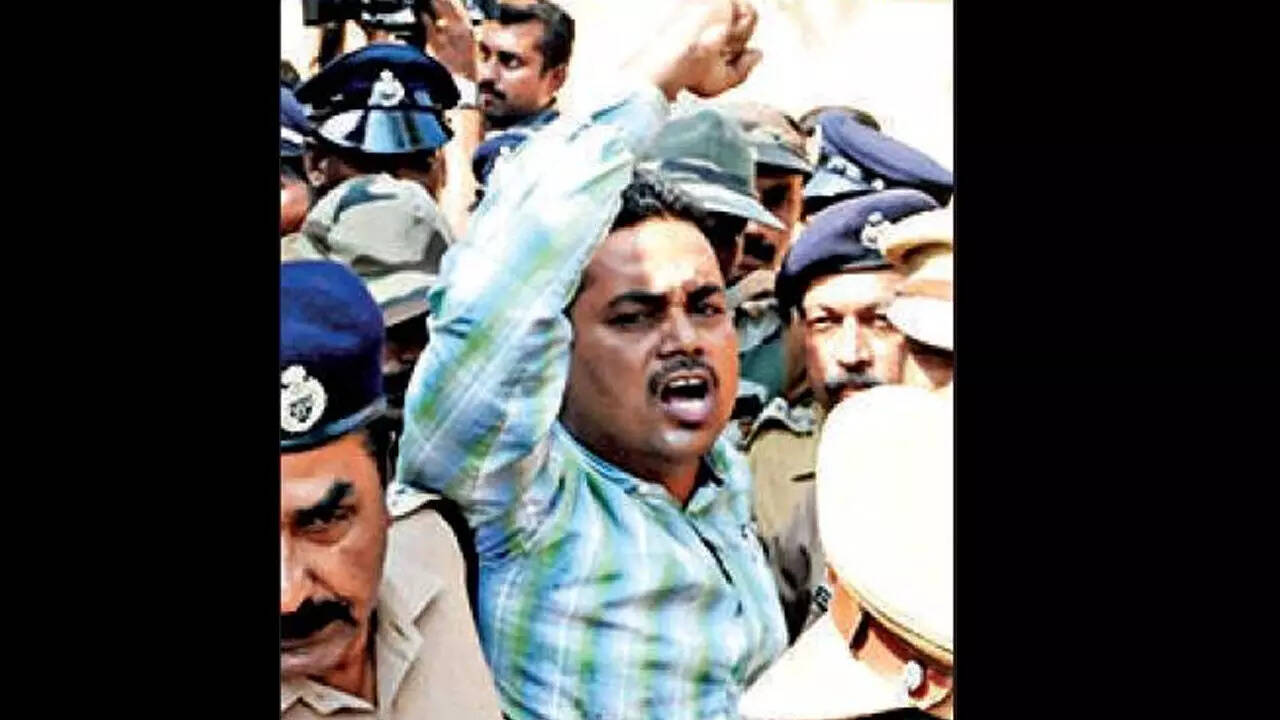
NEW DELHI: The Supreme Court has quashed the Kerala High Court order which discharged Roopesh, an accused arrested for his alleged Maoist links, for the purported offences including sedition and under the provisions of the anti-terror law, the Unlawful Activities (Prevention) Act, in three cases.
Dealing with the appeals filed by Kerala and others, the apex court said the high court’s September 2019 order was passed by a single judge which can be said to be “absolutely contrary” to the statutory provision under the National Investigation Agency (NIA) Act and the law laid down earlier by the top court.
A bench of Justices M R Shah and A S Bopanna was told by senior advocate Maninder Singh, who was appearing for the state, that revision petitions filed by Roopesh in the high court against the order of a special court refusing to discharge him for these offences ought to have been heard by a division bench as mandated under sub-section (2) of Section 21 of the NIA Act.
“In view of the above, all these appeals succeed and the common impugned judgment and order passed by the high court... discharging the accused is hereby quashed and set aside and the matters are remanded to the high court to decide the revision petition... afresh by the division bench in accordance with law and on merits,” the bench said in its October 29 order.
The top court said the revision petitions be decided and disposed of by a division bench of the high court at the earliest and preferably, within six months from the date of receipt of its order.
The high court had allowed the revision petitions filed by the accused, who was arrested in December 2015, and discharged him for the alleged offences under Sections 20 and 38 of the UAPA and under section 124-A (sedition) of the IPC.
While Section 20 of the UAPA deals with punishment for being member of terrorist organisation, Section 38 of the anti-terror law pertains to offences relating to membership of a terror outfit.
The apex court, in its order, made clear that it has not expressed anything on merits in favour of either parties.
“It goes without saying that all the contentions/ defences, which may be available to the respective parties are kept open to be considered by the division bench of the high court…,” it said.




.png?w=600)