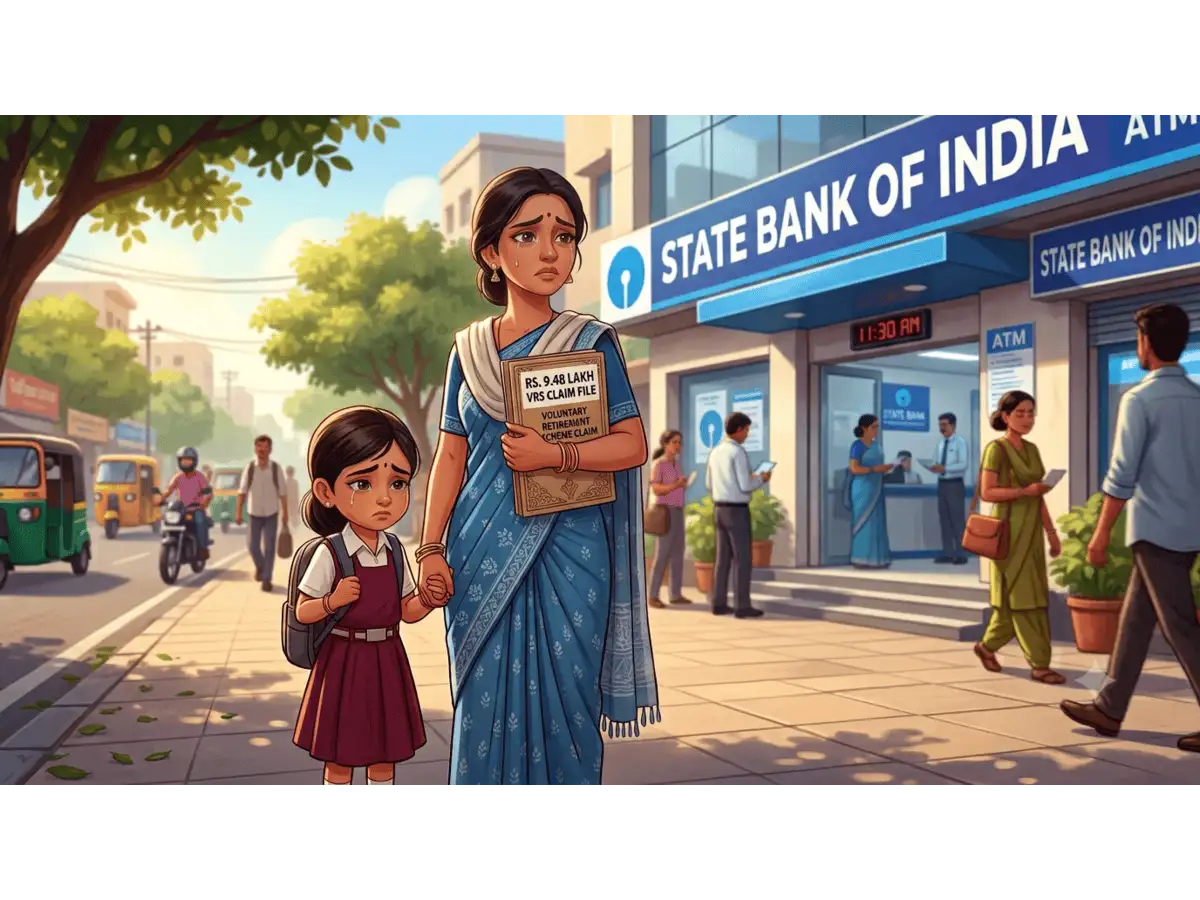
The Telangana High Court recently ruled that if an SBI employee's VRS application had been accepted, then their death before the formal retirement date won't stop his family (legal heirs) from claiming the VRS benefits.
This judgement came about after the family of late Mr K.S.R. Sastry filed a case to receive his Rs 9.48 lakh VRS benefit, which SBI had denied because Sastry had passed away just one month before the VRS retirement cut-off date.
Sastry had joined the bank [1.1]on November 9, 1971 and died on February 27, 2001 due to a heart attack. The VRS retirement cut-off date was March 31, 2001.
Background details of SBI Hyderabad VRS scheme and the subsequent dispute regarding Sastry's VRS payment
The State Bank of India had announced a VRS scheme for its employees on December 30, 2000 via a circular (No.Per/39/200-2001). This VRS circular said that employees who have put in 15 years of service or have completed 40 years of age as on December 31, 2000, are eligible to apply for it.
Sastry applied for VRS on January 15, 2001 and his application was sent to the Deputy General Manager, State Bank of India, Hyderabad Circle through Branch Manager, Fathekhanpet Branch, State Bank of India, Nellore.
The Branch Manager, after a discrete enquiry, found that Sastry was eligible for VRS and accordingly forwarded his application to the Deputy General Manager and Circle Development Officer, who accepted it and communicated this to the Branch Manager, S.B.I., Fatekhanpet Branch, Nellore, on March 3, 2001.
But on February 27, 2001, four days before he could take VRS, Sastry died from a heart attack. This information was passed to the Branch Manager, Fathekhanpet Branch, Nellore as well.
On March 18, 2001, Sastry's family applied to the Branch Manager requesting payment of the VRS and other benefits pertaining to Sastry. However, on March 29, 2001, the Assistant Manager, Region-II, Zonal Office, Tirupathi, rejected the application saying that since the effective date of retirement under VRS was March 31, 2001, Sastry's VRS application was invalid, refusing to pay his family the VRS money.
Sastry's family felt aggrieved with this decision and wrote another letter on June 1, 2001 stating that once the application for VRS was accepted and the applicant (Sastry) was no more, the benefits have to be extended to the heirs of the deceased employee.
On November 16, 2001, the Branch Manager replied that, since Sastry's death occurred before the relevant date i.e., March 31, 2001, the VRS application became invalid and cannot be considered under SBI VRS.
Sastry's family then filed a writ petition in Telangana High Court Hyderabad bench, (W.P.No.13509 OF 2002, dated May 6, 2026).
Sastry's family's lawyer pointed out before the high court that other banks have paid VRS benefits to legal heirs of deceased employees under similar circumstances. Sastry's family's lawyer cited Clause 11.13 of State Bank of Hyderabad (Employees') Voluntary Retirement Scheme, 2001 which reads as follows :-
"In the event of the death of an employee whose request for voluntary retirement under the scheme has been accepted, the ex-gratia which would have become due and payable to the deceased employee will be paid to the legal heirs of the deceased employee on submission of claim papers and on completion of all the laid down formalities.".
On May 6, 2026, Sastry's family won the case in Telangana High Court. Advocate K.V.V.Vedantha Charya represented his family.
Telangana High Court order and discussion
Justice Namavarapu Rajeshwar Rao of Telangana High Court passed the judgment on May 6, 2026. A summary of the judgement is as follows:
Denial of VRS benefits to Sastry's legal heirs is not justified
The high court said that when a VRS application filed by an applicant has not been scrutinised and is not yet accepted by the bank, the court can accept the contentions of the bank about not giving the benefit in the event of the applicant's death.
However, in the present case, Sastry had applied for VRS, the withdrawal period had already expired, and the application had been scrutinised and accepted, and it was told to the concerned Branch. At that juncture, the applicant passed away.
The high court said: "In these circumstances, this Court feels that the denial of VRS benefits to the petitioners cannot be justified."
For VRS scheme, all nationalized banks have to follow a uniform methodology
The high court said that the State Bank of Hyderabad (Employees') Voluntary Retirement Scheme 2001, said that in the event of the death of an employee, the benefits are payable to the legal heirs of the deceased employee.
The high court said: "This was a proper decision by the then State Bank of Hyderabad, which has now merged with SBI. For the VRS scheme, all nationalized banks are required to follow a uniform methodology for the consideration of VRS applications."
Timing of death cannot be predicted
The high court observed that in the present case, all formalities had been completed, and the applicant (Sastry) was to receive the benefits after one month. However, the applicant died due to a heart attack.
The high court said: "The death of an individual cannot be predicted, and the same situation occurred in the present case. Between the applicant's (Sastry) death and the prescribed date, only one month remained. Under these circumstances, the petitioners' (Sastry's legal heirs) claim can be considered."
Case law cited: ASSISTANT GENERAL MANAGER AND OTHERS Vs. RADHEY SHYAM PANDEY (2020) 6 Supreme Court Cases 438
The high court said that the Supreme Court case cited above supports Sastry's family's contention. All nationalized banks are required to follow the same procedure. In the present case, the entire exercise was completed; however, the applicant (Sastry) was yet to enjoy the benefits of the said scheme and, unfortunately, passed away less than one month before the prescribed date.
High court is not rewriting the scheme
SBI's lawyers argued that as per a Supreme Court case STATE OF HIMACHAL PRADESH AND ANOTHER Vs. PRAKASH CHAND (Civil Appeal No.977 of 2019 dated 17.01.2019), it was held that it was not open to the High Court to re-write the terms of the policy.
Telangana High Court said: "But the present case is in no way concerned with the above mentioned issue. In the instant case, the High Court is not re-writing the terms of the policy."
In the case at hand, Telangana High Court said that they are relying solely upon the judgment of the three-judge Bench of the Supreme Court ((2020) 6 Supreme Court Cases 438 ), wherein the Supreme Court held that the Scheme was introduced by the Government of India and accepted and implemented by all the banks in the true spirit, except by SBI. The Supreme Court also found fault to that extent.
Thus under these circumstances, Telangana High Court said they feel Sastry's family's case can be considered for granting VRS scheme benefits, as they are the legal heirs of the applicant (Sastry).
SBI paid all terminal benefits to Sastry's family
SBI's lawyers told the high court that under the Service Rules, terminal benefits have already been settled and paid to Sastry's family.
High court order:
- In the instant case, the petitioners are claiming an amount of Rs. 9,48,474 under the VRS. If any amount has already been paid to the petitioners, the respondent authorities may deduct the same and pay the remaining amount to them.
- In view of the foregoing circumstances and discussions, and keeping in view the judgment of the Apex Court ((2020) 6 Supreme Court Cases 438), the petitioners (Sastry's family) are entitled to receive the benefits of the deceased employee under the VRS scheme.
- Therefore, the respondents (SBI) are directed to pay the amount to the petitioners under the VRS scheme, after deducting the amount if any paid, within four months from the date of receipt of a copy of this order.
- With the above direction, the writ petition is disposed of. No order as to costs