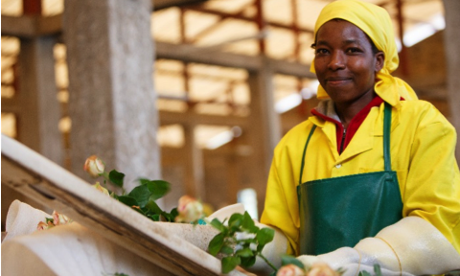
With Valentine’s Day fast approaching, the flower industry is gearing up for its busiest time of year. An estimated 70% of the roses sold in the UK are imported from Kenya, where up to 2 million people rely on the flower industry for an income.
The UK also imports flowers from countries such as Ecuador, Ethiopia and Zimbabwe. With a mostly female workforce, the flower industry has a reputation for poor working conditions, including low pay, over-crowded housing, and a lack of trade union representation.
But Fairtrade is making a difference for flower farmers and workers at 56 producer organisations around the world, through Fairtrade standards that protect workers’ rights and Fairtrade Premiums, which have been invested in education, better housing and healthcare.
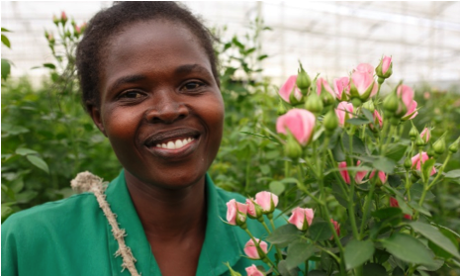
Flower picker Christine Adhiambo has been working at Harvest Ltd’s Athi River flower farm near Nairobi, Kenya for 10 years.
Since becoming Fairtrade certified in 2011, the farm’s sales have increased by 30% and productivity has been boosted. It now produces over 35m roses annually.
Fairtrade Standards ensure that workers receive written contracts, pay slips, regulated working hours, paid overtime, entitlement to holiday and sick pay, maternity leave and pension provision, and at least the national minimum wage (or collective bargaining agreement, if higher).
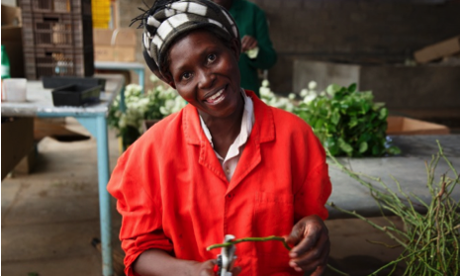
Janet Murkali is one of 700 employees at the Athi River flower farm in Kenya. Safety standards have been improved and wages have been increased under the company’s existing collective bargaining agreement.
Fairtrade’s Hired Labour Standard requires plantation owners to move towards payment of a living wage over time. Workers say that the compliance with Fairtrade Standards has significantly improved fairness and social justice in their workplace.
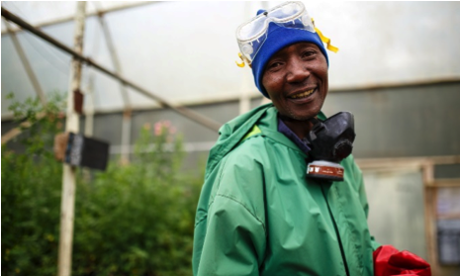
Sprayer, Lawrence Mwangi has worked at Athi River flower farm for 12 years. The farm’s workers have launched an ambitious development plan to improve livelihoods through the Fairtrade Premium.
This gives them an extra 10% for every stem or bunch sold, which they can invest as they choose to benefit their business and their community.
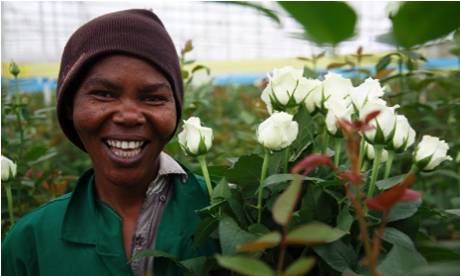
Rachel Kasyoka Kilumbu is a flower harvester at the Athi River flower farm in Nairobi.
The Harvest Premium Committee has elected to dedicate a portion of their Fairtrade Premium toward environmental projects, including reforestation to prevent soil erosion, preserve the water catchment area, and improve the local ecosystem, which has its share of crocodiles and hippos.
Indigenous trees from their fast-growing nursery are donated to the local council and municipality, schools and hospitals and sold to employees at subsidised prices, setting an example for surrounding neighbourhoods.
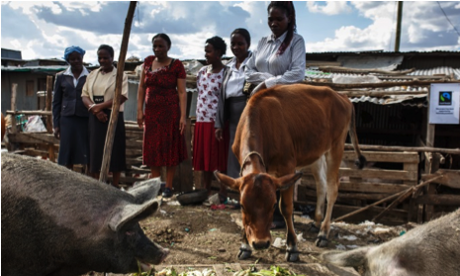
As well as investing in environmental protection, the Harvest Premium Committee is working on the implementation of an ambitious development plan focused on gender.
This includes the formation of women’s empowerment groups to collectively start businesses that will generate additional income, including small grocery stores, pig and cattle farms, and rabbit breeding.
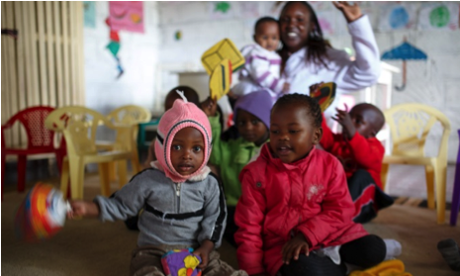
Athi River flower farm provides some essential services to its workers, such as transport and free lunch, clean water, medical treatment and childcare, such as the crèche pictured.

Workers have elected to invest a portion of the Fairtrade Premium in education and 50% of harvest workers have already benefitted from bursaries to help pay secondary school fees.
“This is the most important, sending your kids to school. Our future will be better, my children will be educated. Then they get a good life,” says Agnes Mulwa, a 34-year old flower harvester whose first born son now attends secondary school.
“I hope things go on like now, and then my two girls can study as well. Without Fairtrade on the farm, I have no hope to give my children education.”
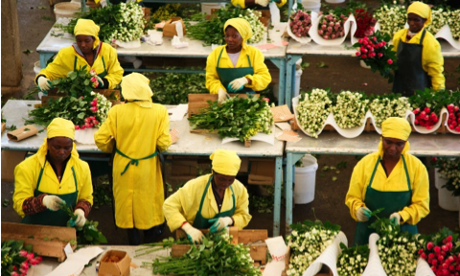
Workers in the grading hall at Athi River flower farm defoliate, size, bunch, and pack bouquets. As a result of their achievements in education, women’s empowerment, health and environmental sustainability, the Harvest Premium Committee earned the Fairtrade Award for Best Worker’s Premium Committee in Africa in 2014.
Samuel Atieno, the Committee’s chairperson, says: “If this premium money can change the life of a worker in such a short time, turn around the life of a family, of a community, can’t this premium also change the structure of the country? In the long run we will impact Kenya and then even Africa.”
Finlays is one of the world’s largest producers and packers of Fairtrade flowers.
It has 278 hectares under greenhouse or polytunnel in Kenya and South Africa, producing 450m stems per annum for sale in the UK, Europe and Japan, through retailers including Marks & Spencer, Sainsbury’s and The Co-operative.
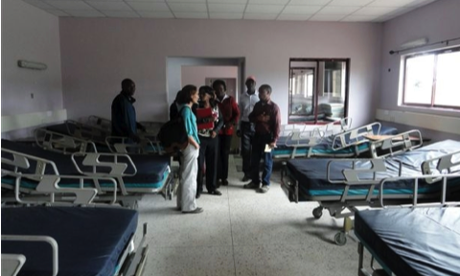
Fairtrade Premiums earned as a result of these sales have been invested in education, empowerment of women, and health facilities and programmes including vaccination campaigns, x-ray and ultrasound machines. The funds have also been used to support the construction of the Navaisha Women Care Hospital, pictured.
When Aldi launched Fairtrade roses and spray roses in June 2014, it boosted volumes of Fairtrade stems sold in the UK by an estimated 18%.
The product sleeves carry images of Fairtrade Premium-funded projects, to show customers the difference that they can make by choosing the Fairtrade product line.
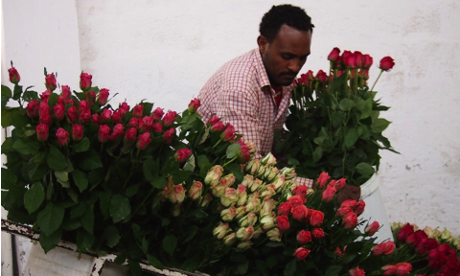
Aldi’s decision to offer Fairtrade flowers has also resulted in the Herburg flower farm in Ethiopia, pictured, becoming Fairtrade-certified. This will benefit farmers and workers through the Fairtrade Standards and Fairtrade Premium.
Content on this page is paid for and provided by Fairtrade Foundation, sponsor of the supply chain hub