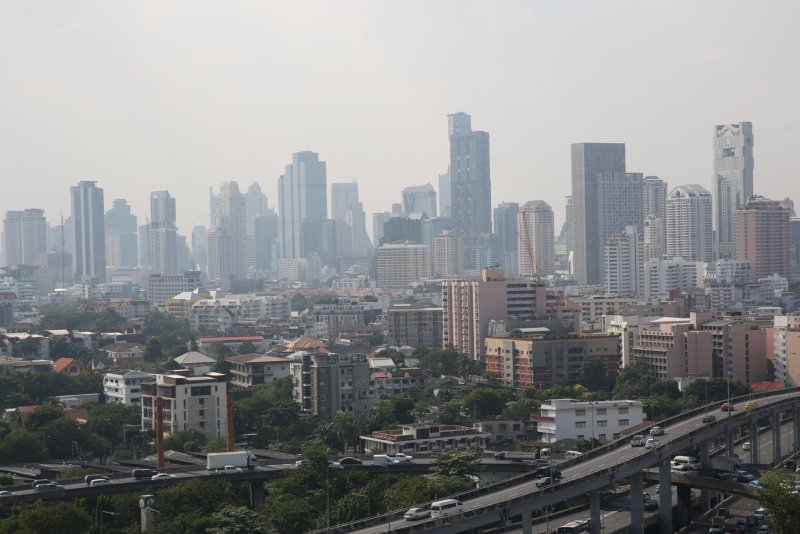
The slowing residential market has prompted property consultancy Savills (Thailand) to reposition its business, shifting its focus towards recurring income from property management while resuming overseas marketing of Thai luxury homes after a six-year hiatus.
Prapaporn Boonkajornkul, deputy managing director, said the company's strategy has evolved alongside changing market conditions, with residential brokerage becoming more selective as domestic demand slowed, while industrial and property management businesses expanded.
"Before Covid-19, overseas roadshows for Thai residential projects were very active, particularly for Phuket and Krabi," she said. "Now we are bringing Bangkok branded residences back to international markets as demand from overseas buyers gradually returns."
Savills plans to organise roadshows in Singapore and Dubai during the second half of 2026 to market Bangkok branded residences priced at more than 20 million baht per unit, marking its first overseas campaign since the pandemic.
Prior to Covid-19, the company regularly promoted Thai residential projects in Singapore, Hong Kong and Shanghai during the country's property boom in 2017-18, before international marketing activities were suspended.
The company is also preparing an exhibition in Thailand this September to market residential properties in Japan's Niseko, targeting Thai buyers seeking holiday homes that can also generate rental income.
Ms Prapaporn said demand from Thai investors for overseas residential property has changed significantly over the past decade.
Before the pandemic, London was among the preferred destinations for Thai buyers, alongside Niseko. More recently, interest in London has moderated as market conditions have become more challenging.
Buyers have also become more price-conscious. Budgets that previously ranged from £1.5 million to £5 million have typically narrowed to £800,000-1.5 million, while purchases in the £1-2 million segment have shifted towards homes priced at around £500,000.
Rather than purchasing expensive properties in central London, buyers are increasingly looking at homes in Zones 2 and 3, where prices are lower.
Some families now prefer leasing properties for the duration of their children's studies instead of buying.
The slowdown in overseas residential transactions also encouraged Savills Thailand to diversify its business several years ago by expanding its industrial services, particularly after seeing rising interest from data centre investors.
Property management has since become the company's largest business, contributing about 65% of total revenue, followed by industrial brokerage at 20% and research services at 15%.
Savills manages 38 buildings in Bangkok, comprising 33 residential towers and five mixed-use developments. It expects to increase its portfolio to at least 40 buildings by year-end after adding three projects in the first half and targeting two more in the second half.
Most of the buildings under management are positioned in the high-end and luxury segments, providing recurring management income that is less dependent on residential transaction volumes.
"The broader shift reflects how property consultancies are adapting alongside developers, as Thailand's residential market becomes increasingly challenging," Ms Prapaporn added.
Instead of relying primarily on residential brokerage, firms are building businesses with more diversified income streams while selectively pursuing opportunities in sectors that continue attracting investment despite a slower housing market.
The shift in strategy also comes as Savills strengthens its global investment advisory platform following the completion of its acquisition of Eastdil Secured, a leading US real estate investment bank, for an enterprise value of US$1.11 billion.
The acquisition significantly expands Savills' real estate investment banking capabilities, particularly in North America, while reinforcing its capital markets leadership across Europe and Asia-Pacific through the newly branded Eastdil Secured Savills.
"The acquisition would significantly strengthen the firm's capital markets capabilities across the region, broadening the expertise available to clients facing increasingly complex investment decisions," said Martin Fidden, chief executive of Savills Asia Pacific.