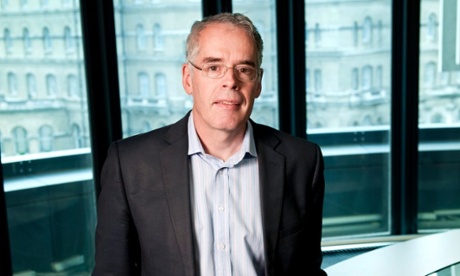
The new vice-chancellor of the Open University has called on MPs to arrest the calamitous decline in part-time students in higher education, with 200,000 fewer part-timers enrolling since tuition fees were hiked and student loan rules tightened.
Peter Horrocks, the former BBC executive who took over running the Open University last month, argues that current policies are discouraging workers from upgrading their skills and depriving the UK economy of an adaptable labour force.
The government’s decision to raise tuition fees in 2012 appears to be behind the huge drop in the number of part-time and mature students. But the Open University – the country’s largest educational institution – has been hit hardest because the two groups make up most of the students on its distance-learning courses.
“If you looked where you would put your money if you wanted the most cost-effective social mobility engine in this country, it’s the Open University.
“Policymakers, I hope, can look at the total picture and say: that is the institution to back,” said Horrocks, in his first interview since taking office.
Specifically, Horrocks wants parliament to undo a rule – introduced by the last Labour government - that stops people from accessing further student loans if they are studying for a qualification at the same level as the one they already hold.
“There are lots of people who got a degree and who realise they took the wrong degree and need a different set of skills,” Horrocks said.
Horrocks plans to summon the spirit of Margaret Thatcher to make his case: “The [1970] Conservative government came in with a manifesto commitment to kill the Open University, to kill Harold Wilson’s brainchild at birth. Margaret Thatcher saved it,” Horrocks said.
“And I think there’s an opportunity for this new Conservative government to realise the kind of social and economic benefits that the Open University creates.”
According to Horrocks the economic case is strong: part-time students are “spectacularly better bets in terms of paying back [loans] because they are starting from the position, overwhelmingly, of already being in work”.
Horrocks takes charge of the OU at a turbulent time. Five years ago, it had more than 260,000 students, the vast majority part-timers. Last year the total fell to 187,000. The OU’s budget hit a £17m deficit on revenue of £400m in 2013-14 – a long way from the £38m surplus it enjoyed in 2011-12.
While conventional universities raised their fees to £9,000 in 2012, the OU’s own fee rise was more modest: the cost of full-time study trebled from around £1,500 to £5,000, and part-time fees shot up from £700 to £2,500.
Many universities have barely noticed the fall in part-timers because of increased revenue from their mainly full-time student intakes. But as an institution reliant on part-timers, the OU was uniquely exposed.
“People just don’t understand how important part-time is, because their own social experience is not with people who need the benefits of part-time education,” said Horrocks.
He blames the failure on the “media/political bubble” inhabited by policy-makers and journalists who passed directly from school to university.
“In terms of the numbers game, it’s been overwhelmingly focused on the full-time numbers, to the exclusion of a sector of society where it really matters.
“My intention is to call that out and to say that people should focus on that - and really think about the disciplined, self-reliant learners who want to get on in their lives. The kinds of people to whom the Conservative party wants to appeal, in the signals it has been sending out since the election,” he said.
Horrocks has also been lobbying MPs on retaining student opportunity funding, designed to widen participation in higher education but now threatened by government cuts.
“The OU has huge numbers of students from disadvantaged areas and 20,000 disabled students – that’s just the number of declared disabled students. The OU’s disabled student body is larger than many universities have students on their whole campus. These are people who also want to be able to be self-reliant.
“If the student opportunity allocation were to be cut, that cuts the ability for us, at scale, to help some of the most disadvantaged but most ambitious people in our society,” Horrocks said.
Even if Horrocks manages to convince the government of his cause, the OU still faces a struggle. After a month in the job, the new vice-chancellor unveiled sweeping structural reforms, telling staff in an email the changes would “help the university grow into the more agile, innovative institution we need to become”.
As director of the BBC World Service, Horrocks had to make significant cuts and find new revenue sources after government funding was slashed after 2010. Will he have to undertake similar crisis management in his new job?
“I wouldn’t say there’s a crisis for the Open University. I’d say there’s a problem for part-time education. And that’s the thing that probably hasn’t been addressed,” Horrocks said.
Join the higher education network for more comment, analysis and job opportunities, direct to your inbox. Follow us on Twitter @gdnhighered.