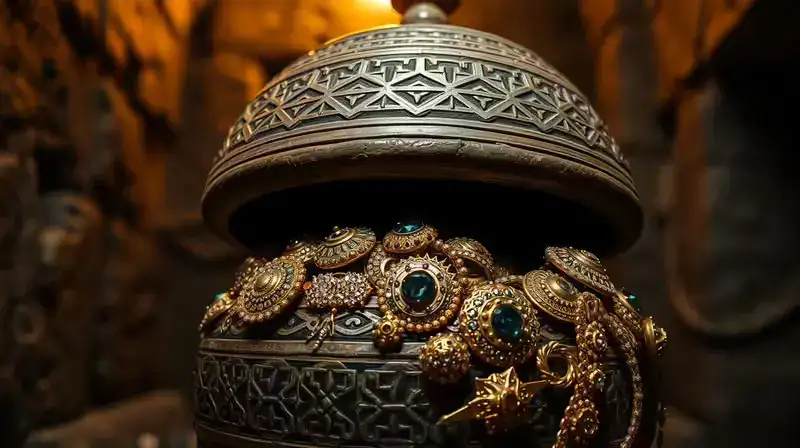
A stunning archaeological discovery in Saudi Arabia’s Al-Qassim region has brought medieval Islamic history back into the spotlight. Excavations at the ancient site of Diriyah have uncovered a ceramic jar filled with more than 100 pieces of gold, silver, and gemstone-studded jewellery, buried for over 1,200 years.
The discovery, now being called the “Diriyah Treasure,” is being hailed as one of the most significant finds in recent Middle Eastern archaeology.
ALSO READ: This weapon found in an Egyptian pharaoh's tomb wasn't made on Earth
A Jar Hidden Along an Ancient Pilgrimage Route
The treasure was found during excavations led by the Saudi Heritage Commission at Diriyah, a historic settlement located on what was once a key medieval Hajj route connecting Basra (Iraq) to Mecca. Archaeologists believe the hoard dates back to the early Abbasid period, a time when the region was part of a vast and wealthy Islamic empire.
Researchers suspect the jewellery may have been buried by a traveller or pilgrim passing through the area, though the exact owner and reason for concealment remain unknown.
ALSO READ: Love samosa, pakoras and vada pav? FSSAI issues fresh warning on newspaper-wrapped street snacks
What Was Inside the ‘Diriyah Treasure’
Inside the sealed ceramic jar, archaeologists uncovered what appears to be a carefully assembled jewellery set.
The collection includes:
Floral gold pendants
Ornamental discs
Multi-coloured gemstone beads
Intricately crafted gold spacers
A large circular ornament decorated with symmetrical stone inlays
Officials say the craftsmanship reflects highly advanced metalworking techniques, including gold hammering, embossing, and fine stone inlay work.
Alongside the treasure, excavations also revealed residential structures, pottery fragments, glass pieces, and tools—suggesting Diriyah was once a functioning settlement rather than a temporary stop.
The Abbasid Era Behind the Jewellery
The jewellery has been linked to the early Abbasid Caliphate, which rose in 750 CE and ruled much of the Islamic world until 1258. This period is widely known as part of the Islamic Golden Age, when science, art, medicine, and literature flourished across vast territories stretching from North Africa to Persia.
The empire’s capital, Baghdad, became a global hub of culture and innovation, and its prosperity supported highly skilled artisans, including goldsmiths.
The floral and geometric patterns found on the Diriyah pieces reflect classic Abbasid artistic styles influenced by Persian, Byzantine, Mesopotamian, and Arabian traditions.
A Stop on the Historic Hajj Route
The discovery site lies along the ancient Basran Hajj route, one of the major pilgrimage paths used by travellers journeying to Mecca from southern Iraq. Radiocarbon analysis suggests the settlement was active between 743 and 753 CE, placing it firmly in the early Abbasid period.
These pilgrimage routes were part of a wider network of infrastructure supporting the Hajj, including roads, rest stops, water cisterns, and milestones that helped thousands of pilgrims travel each year.
Diriyah served as one such stop where travellers rested, resupplied, and prepared for the next leg of their journey.
Why Was the Treasure Buried?
The biggest mystery surrounding the discovery remains simple: why was such valuable jewellery buried and never retrieved? Researchers believe one possibility is that it belonged to a pilgrim who hid it for safety during travel along dangerous routes.
Long-distance Hajj journeys were often risky, with threats of theft and bandit attacks, especially during periods when central authority weakened. Another theory suggests the treasure may have belonged to a wealthy resident of Diriyah, hidden during a moment of instability.
Despite several theories, no definitive explanation has been found.
A Glimpse Into Ancient Trade and Wealth
Beyond the mystery, the hoard reveals how connected the medieval Islamic world truly was. The gemstones and materials suggest long-distance trade routes stretching across seas and deserts, linking Basra, Arabia, and beyond.
Historians note that jewellery and precious metal objects from the Abbasid era are extremely rare today, as many were melted down and reused over time.
This makes the Diriyah Treasure not just a beautiful archaeological find, but a rare surviving link to a highly sophisticated and globally connected civilization.
A Window Into a Lost World
The Diriyah discovery offers more than just gold and gemstones—it opens a window into a world of pilgrims, traders, artisans, and ancient cities that once thrived across the Arabian Peninsula.
Buried for over a millennium, the treasure now tells a silent story of wealth, travel, faith, and mystery from the heart of the Islamic Golden Age.