Get all your news in one place.
100’s of premium titles.
One app.
Start reading
The Guardian - UK
The Guardian - UK
Environment

Satellite Eye on the Deepwater Horizon oil spill

Satellite Eye:  Deepwater Horizon oil spill
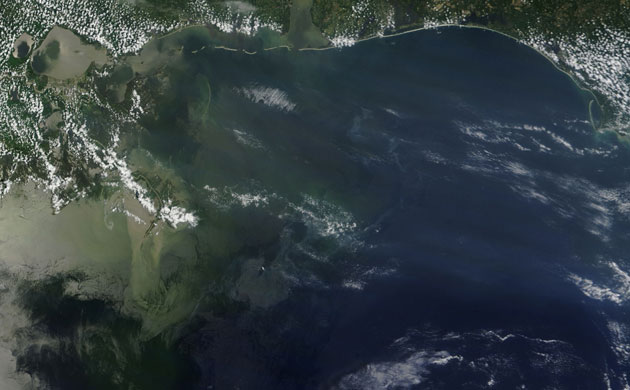
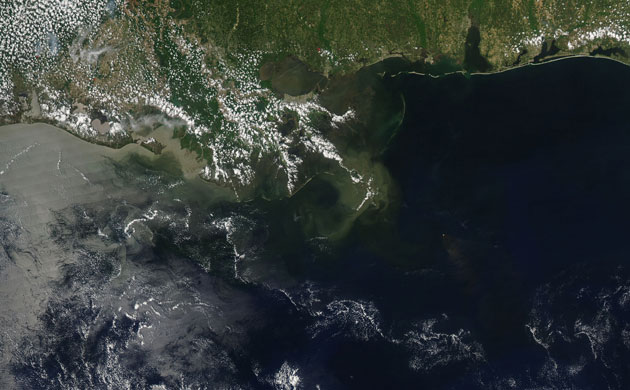
On 20 April 2010, an oil rig explosion in the Gulf of Mexico left a dozen workers missing, several more critically injured and started a large fire that was still churning out smoke days later. The Mississippi River Delta is speckled with clouds and outlined by a wide border of greenish-tan sediment. The oil platform appears as a white dot, and a fan of brown smoke extends to the south-east. Although photographs show that the damaged rig was leaking oil, no oil slick is obvious in this image. Oil slicks are notoriously difficult to spot in natural-color (photo-like) satellite imagery because a thin sheen of oil only slightly darkens the already dark blue background of the ocean. Under unique viewing conditions, oil slicks can become visible in photo-like images, but usually, radar imagery is needed to clearly see a spill from space
Photograph: Aqua/MODIS/NASA
Satellite Eye:  Deepwater Horizon oil spill
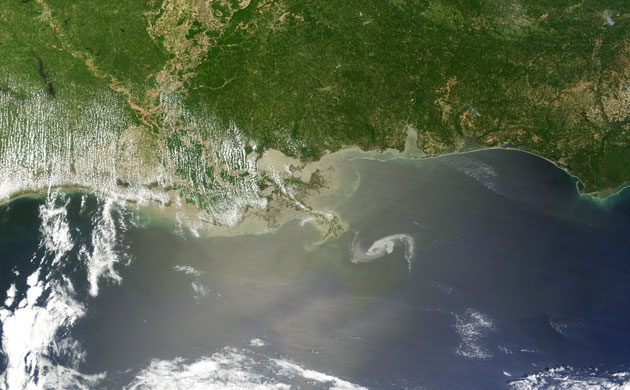
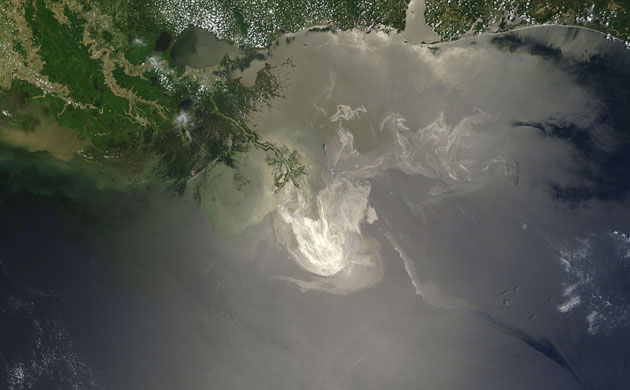
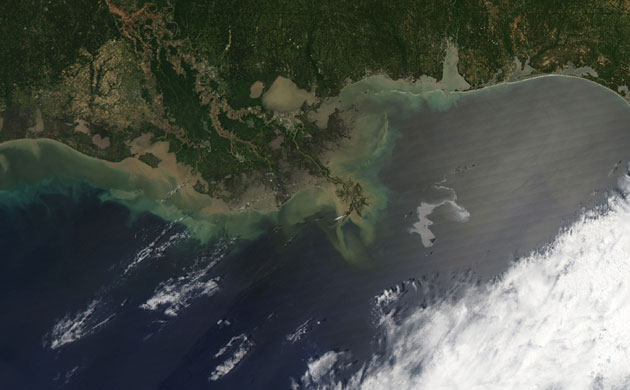
25 April 2010. In the top image, the Mississippi Delta is at image centre, and the oil slick is a silvery swirl to the right. The oil slick may be particularly obvious because it is occurring in the sunglint area, where the mirror-like reflection of the Sun off the water gives the Gulf of Mexico a washed-out look. An emergency response effort is under way to stop the flow of oil and contain the existing slick before it reaches wildlife refuges and beaches in Louisiana and Mississippi. The slick may contain dispersant or other chemicals that emergency responders are using to control the spread of the oil, and it is unknown how much of fuel that was on the oil rig burned in the fire and how much may have spilled into the water when the platform sank
Photograph: Aqua/MODIS/NASA
Satellite Eye:  Deepwater Horizon oil spill
29 April 2010. The oil is moving perilously close to shore. The US coast guard attempted controlled burns on some of the oil to prevent its spread, but had to halt the process due to high winds. Meanwhile, the US national oceanic and atmospheric administration constructed a dome-and-pipe system to contain the spread of oil at the sea floor
Photograph: Terra/MODIS/NASA
Satellite Eye:  Deepwater Horizon oil spill
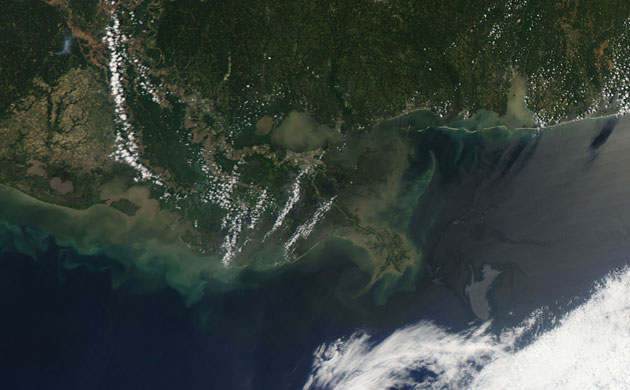
4 May 2010: Two weeks after the explosion, an oil slick lingered not far from the Mississippi Delta. The slick appears as an uneven grey shape immediately north of a bank of clouds. Sunlight bouncing off the ocean surface gives the oil slick a mirror-like reflection easily detected by satellite sensors. The Pentagon approved the deployment of as many as 17,500 national guard soldiers to assist with clean-up efforts. Meanwhile, well operators considered drilling a relief well: a diagonal well intersecting the original that could be filled with mud or concrete to block the flowing oil
Photograph: Aqua/MODIS/NASA
Satellite Eye:  Deepwater Horizon oil spill
Eighteen days after the Deepwater Horizon accident, an oil slick lingered in the Gulf of Mexico, off the coasts of Louisiana, Mississippi, and Alabama. Although partially obscured by clouds, oil is discernible in two areas, a serpentine slick near the Mississippi Delta, and a large round slick south of the Mississippi-Alabama border. Oil on the water is visible in this image thanks to sunglint (sunlight reflecting off the ocean's surface into the satellite sensor)
Photograph: Terra/MODIS/NASA
Satellite Eye:  Deepwater Horizon oil spill
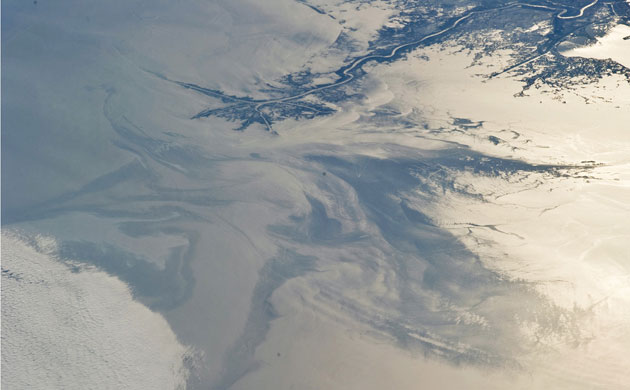
4 May 2010: This detailed astronaut photograph provides a different viewing perspective on the spill. The view in this image is towards the west; the ISS was located over the eastern edge of the Gulf of Mexico when the image was taken. The Mississippi river delta and nearby Louisiana coast (image top) appear dark in the sunglint that illuminates most of the image. Sunglint is caused by sunlight reflecting off the water surface - much like a mirror - directly back towards the astronaut observer on the Space Station. The sunglint improves the identification of the oil spill. Oil on the water smooths the surface texture, and the mirror-like reflection of the Sun accentuates the difference between the smooth, oil-covered water (dark to light grey) and the rougher water of the reflective ocean surface (coloured silver to white). Among the coastal ecosystems threatened by the spill are the Chandeleur Islands (image right centre)
Photograph: ISS/NASA
Satellite Eye:  Deepwater Horizon oil spill
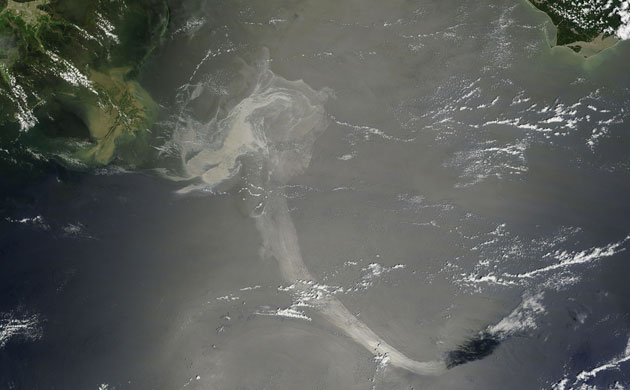
17 May 2010: Nearly a month after the explosion, the damaged well on the bottom of the Gulf of Mexico continued to spill oil. In the weeks since the accident occurred, the oil slick has periodically drifted north-east toward the Mississippi delta and reached the Chandeleur Islands. A large patch of oil was visible near the site of the accident, and a long ribbon of oil stretched far to the south-east
Photograph: Terra/MODIS/NASA
Satellite Eye:  Deepwater Horizon oil spill
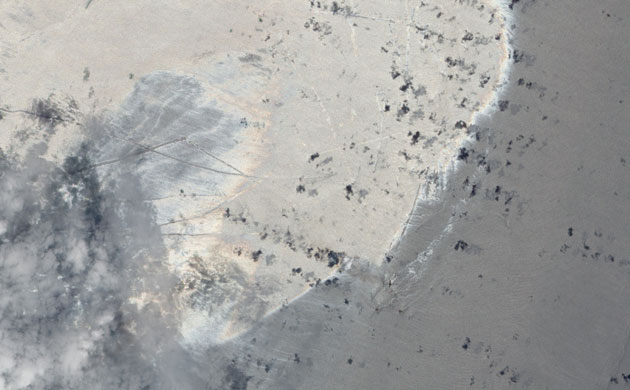
On 21 May, one month and one day after the explosion, boats left discernible wakes on the oil slick south and east of the Mississippi delta. Boat wakes appear as slightly curved lines, accentuated by the pastel tones of the oil slick. One boat wake, running roughly west-to-east through the upper middle part of this image, can be traced to the ship that has made it, which is heading toward the east-north-east. South-east of the brightest part of the slick, a cluster of boats appears. These boats are in approximately the same area that the Deepwater Horizon rig had been located before the accident
Photograph: EO-1/ALI/NASA
Satellite Eye:  Deepwater Horizon oil spill
24 May 2010: Sunlight illuminated the lingering oil slick off the Mississippi delta. The oil slick is brighter than the surrounding water in some places (image centre) and darker than the surrounding water in others (image lower right). The tip of the Mississippi delta is surrounded by muddy water that appears light tan. A small, dark plume along the edge of the slick, not far from the original location of the Deepwater Horizon rig, indicates a possible controlled burn of oil on the ocean surface. To the west of the bird's-foot part of the delta, dark patches in the water may also be oil, but detecting a man-made oil slick in coastal areas can be even more complicated than detecting it in the open ocean
Photograph: Terra/MODIS/NASA
Satellite Eye:  Deepwater Horizon oil spill
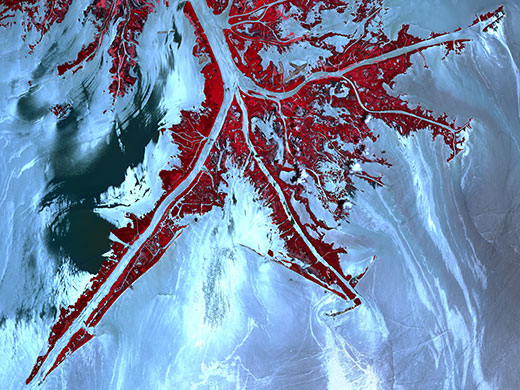
24 May 2010: This false-colour, high-resolution view of the very tip of the Mississippi river delta shows ribbons and patches of oil that have leaked from the well offshore are silver against the light blue colour of the adjacent water. Vegetation is red. The cause of the dark patch of water in the upper left quadrant of the image is unknown
Photograph: terra/ASTER/NASA
Satellite Eye:  Deepwater Horizon oil spill
31 May 2010: Beneath scattered clouds, streaks and ribbons of oil. Oil is visible 355 kilometers (221 miles) south-west of the site of the damaged, leaking Deepwater Horizon well, but this oil may be natural oil seeps that have been documented in the Gulf before. The streaks of oil in the south-west corner of the image are one mile wide. Photo-like satellite images are not a perfect tool for detecting oil on the surface of water. Outside of the sunglint area the oil may be imperceptible against the dark background of the water
Photograph: NASA
Satellite Eye:  Deepwater Horizon oil spill
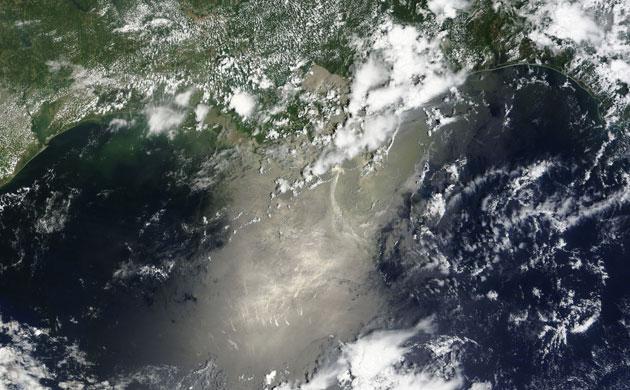
7 June 2010: Oil on water has many appearances, at least part of the oil slick is pale grey. A large area of oil is south-east of the Mississippi delta, at the site of the leaking BP well. Traces of thick oil are also visible farther north. Not all of the oil that is in the Gulf is visible here. Several other features may mask the oil in the image. Pale white haze (possibly smoke from fires in central America) hangs over the Gulf, partially obscuring the view of the oil slick. The oil slick also blends with sediment washing into the Gulf from the Mississippi river. The sediment plume is tan and green
Photograph: Terra/MODIS/NASA
Satellite Eye:  Deepwater Horizon oil spill
12 June 2010, oil from the still-leaking well was particularly visible across the northern Gulf of Mexico. Oil appears to have reached beaches and barrier islands in Alabama and the western Panhandle of Florida. Close to the location of the well, the oil appears grey, but to the north-east, it is bright silver. The increased brightness does not necessarily mean the oil is thicker or more concentrated there; it may simply be that the oil is located in the sunglint region of the image. When the oil slick is not in that part of the image, it may be imperceptible against the dark background of the ocean.
Photograph: Aqua/MODIS/NASA
Sign up to read this article
Read news from 100’s of titles, curated specifically for you.
Already a member? Sign in here
Related Stories
Top stories on inkl right now
One subscription that gives you access to news from hundreds of sites
Already a member? Sign in here
Our Picks
Fourteen days free
Download the app
One app. One membership.
100+ trusted global sources.