Get all your news in one place.
100’s of premium titles.
One app.
Start reading
The Guardian - UK
The Guardian - UK
Environment

Satellite eye on Earth: October 2010

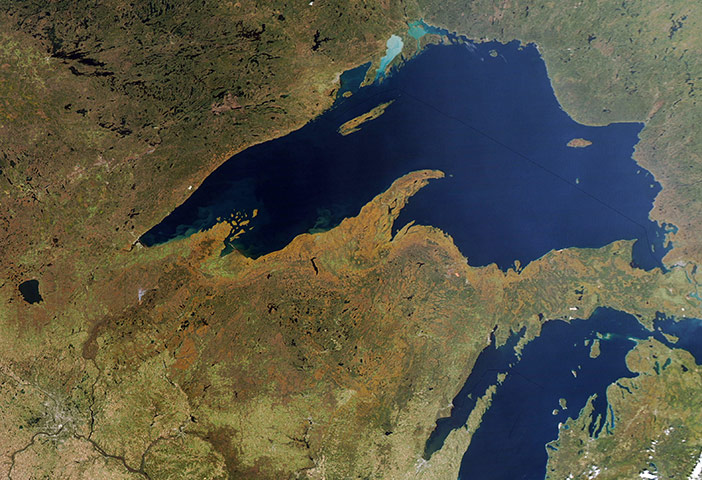
Satellite Eye on Earth: Upper Midwest of US
The autumnal colours of the upper midwest of the United States, on 5 October. The northern body of water is Lake Superior and the more southerly one is Lake Michigan. The land in the north of the image is Ontario, Canada. Most of the forests in this region are a mixture of evergreen conifers (pine, cedar, spruce and balsam) and deciduous broadleaf trees, especially birch, poplar, aspen and maple, along with some oaks. Tamarack, a type of larch, also grows here. It is a deciduous conifer, and sheds needles in the fall. Birch and aspen leaves turn bright yellow. Maples, depending on type, may turn yellow, orange, or bright red. Likewise, oaks may turn yellow, red or brownish-red. Tamarack turns a glowing lemon-yellow
Photograph: Modis/Aqua/Nasa
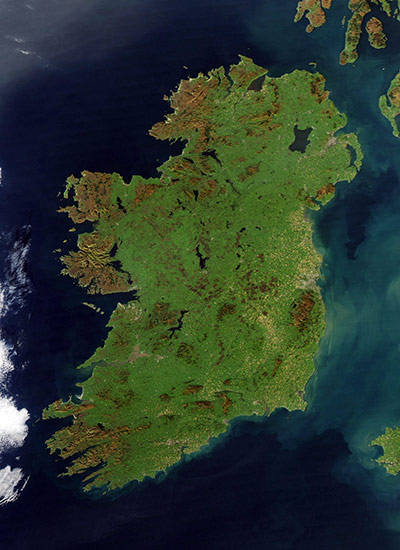
Satellite Eye on Earth: Ireland
'The emerald isle' lives up to its name on a remarkably clear October day. The red-brown of the rugged cliffs in the west of Ireland contrast with the softer inland greens of pasture and meadows. The country's topography is bowl-like, with a central lowland surrounded by broken mountains near the coasts. In the low, central regions, a network of lakes can be seen. Grey smudges mark the location of major cities: Dublin on the east coast, Galway in the west, Limerick inland and south of Galway, and near Lough Neagh in Northern Island, Belfast, on 11 October
Photograph: Modis/Aqua/Nasa
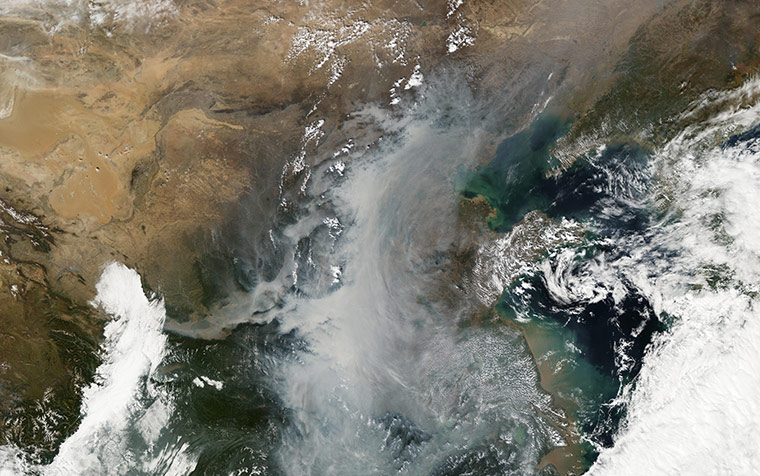
Satellite Eye on Earth: Pollution over China
In early October 2010, a high-pressure weather system settled over eastern China, and air pollution began to build up for nearly a week. By 9 October, China's National Environmental Monitoring Centre declared air quality 'poor' to 'hazardous' around Beijing and in 11 eastern provinces. Visibility was reduced to 100m in some areas, and at least 32 people died in traffic accidents caused by the poor visibility, and many more suffered with asthma and other respiratory problems. The Ozone Monitoring Instrument on Nasa's Aura satellite detected extremely high levels of aerosol particles (visible in the lower left of image) and sulphur dioxide, from coal-fired power plants (lower right) on 8 October. Peak concentrations were six to eight times the norm for China, and 20 times the norm for the US
Photograph: Modis/Aqua/Nasa
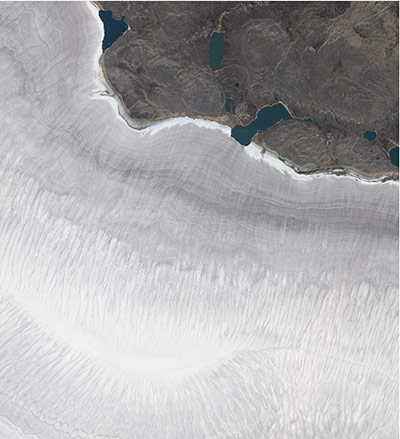
Satellite Eye on Earth:  Laurentide Ice Sheet
The Barnes ice cap, a remnant of the Laurentide ice sheet that sprawled over the US during the Pleistocene age, is a bowling-pin-shaped glacier on Canada’s Baffin Island. Seen here in early September 2010, it shows a portion of the ice cap near its south-eastern end, with Gee Lake sitting immediately off the glacier. Resembling a clamshell, grooves run roughly east-west on the glacier surface. Rather than appearing pristine white, the ice and snow is banded with dust layers spanning vast time periods. By studying such ice cores containing these dust layers, scientists can learn about ancient climates
Photograph: ALI/EO-1/Nasa
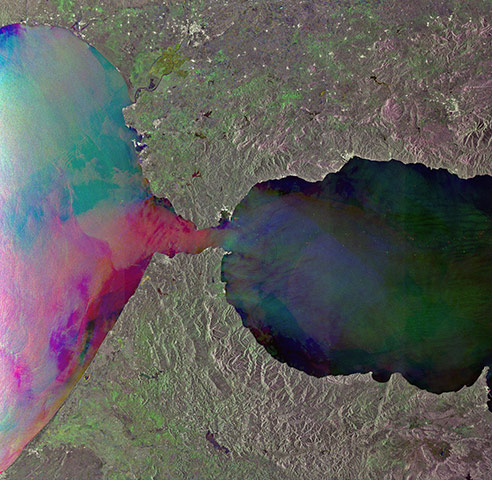
Satellite Eye on Earth:  Strait of Gibraltar
Internal waves in the Strait of Gibraltar, between the southern coast of Spain (top) and the northern coast of Morocco. From space, internal waves can be detected very efficiently using synthetic aperture radar (SAR) instruments that are sensitive to changes in the small-scale surface roughness on the ocean surface Photograph: Ensivat/ESA
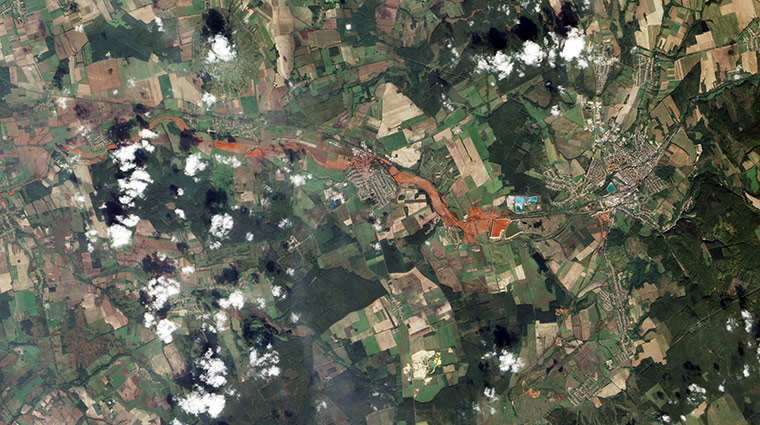
Satellite Eye on Earth:  toxic red sludge
On 4 October, a spill at the Ajkai Timfoldgyar Zrt aluminum oxide plant in western Hungary released a torrent of toxic red sludge down a local stream, killing four people and injuring hundreds more. The plant appears along the right edge of both images, and incorporates both bright blue and brick red reservoirs. The WWF suggested that heavy metals in the sludge could soak into the ground and be absorbed by vegetation, potentially causing environmental effects for decades
Photograph: ALI/EO-1/Nasa
Satellite Eye on Earth: Botswana's Boteti River
Starting in the late 1990s, insufficient rains left Botswana's Boteti river dry year after year. But in September 2010, water once again flowed. Much of the rain that falls on the highlands of Angola makes a long, slow journey to Botswana's Okavango delta. If more water flows into the delta than it can hold, some continues southward through the Boteti. On September 29, as the Okavango delta overflowed, the Boteti flows toward the south-east before turning northward into the expansive salt pans of Makgadikgadi. This image shows the river stopping short of Makgadikgadi, which lies to the east. Frank Eckhardt of the University of Cape Town, says the presence of any water in the river valley had become unusual by 2010, and some observers thought the Boteti had died Photograph: ALI/EO-1/Nasa
Satellite Eye on Earth: The storm that swept across the center of the United States
The storm that swept across the center of the United States on 26 and 27 October saw the country lashed with strong winds, rain, hail, and tornadoes. Such extratropical cyclones form over the US in the spring and autumn, when the temperature difference from north to south is large. Warm, high-pressure air rushes toward the cooler, low-pressure air in the north. Because the Earth is rotating, the air moving in circles the area of low pressure, creating the comma-shaped cyclone shown
Photograph: GOES/Nasa
Satellite Eye on Earth: Cloud-watching
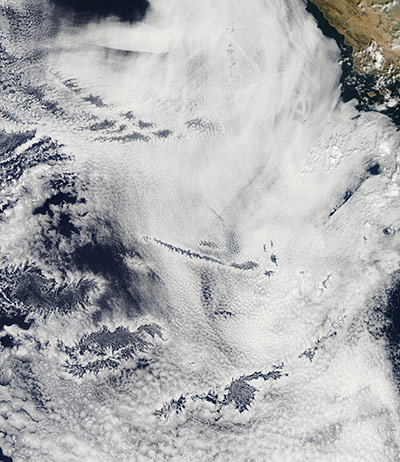
Cloudwatching from satellites reveals abstract shapes for creative interpretation – but also large-scale patterns that increase our knowledge of climate science
Photograph: Modis/Aqua/Nasa
Satellite Eye on Earth: Melting of the Imja Glacier creates Imja Tsho lake
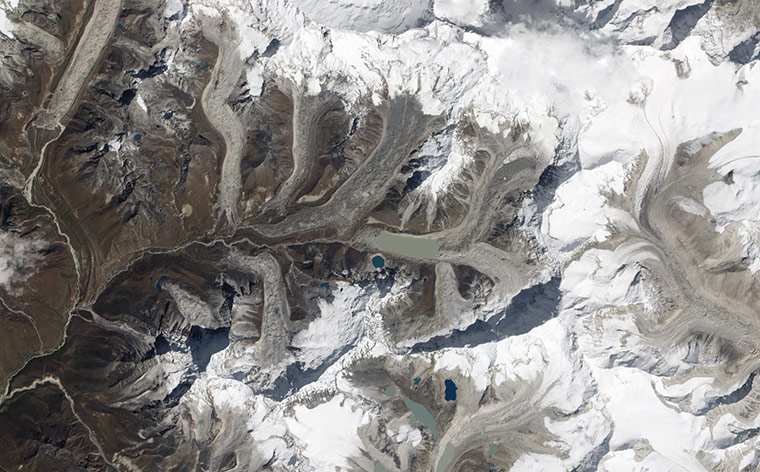
Starting from the western face of Kali Himal, the Imja glacier flows through eastern Nepal, part of a network that ultimately feeds the Ganges. In the 1960s, meltwater began collecting at the foot of the glacier, creating Imja Tsho. A 2009 study described this lake as one of the fastest-growing in the Himalaya. Held in place by a terminal moraine, Imja Tsho threatens downstream communities with the potential for a glacial outburst flood. Dirt and debris coat these rivers of ice; like the glaciers feeding it, Imja Tsho appears dull grey-brown. The 2009 study concluded that the Imja Glacier had retreated by 34m per year from 1976 to 2000, and by 74m per year from 2000 to 2007. Imja Tsho, meanwhile, grew rapidly from roughly 48,811m3 in the 1960s to 945,662m3 by 2007
Photograph: ALI/EO-1/Nasa
Satellite Eye on Earth: The Great Dyke of Zimbabwe
The Great Dyke of Zimbabwe is a layered mafic intrusion of igneous, metal-bearing rock that is around 2.5bn years old. The dyke intrudes through the even older rocks of African craton, the core of oldest rocks forming the continent of Africa. This geological feature extends more than 342 miles north-east to south-west across the centre of Zimbabwe, varying from 2-8 miles in width. The southern end of the dyke is captured in this photograph. Layered mafic intrusions are usually associated with valuable metals such as chromium, nickel, copper, platinum, titanium, iron, vanadium, and tin
Photograph: ISS/Nasa
Satellite Eye on Earth: Ouachita Mountains
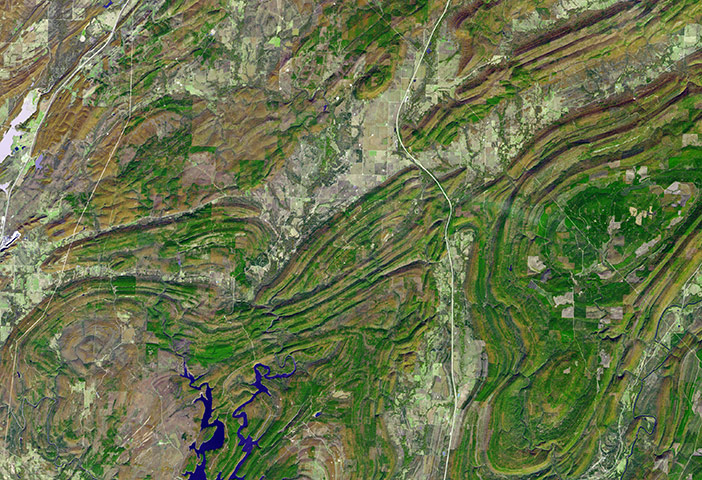
Prairies stretch across much of Oklahoma, but the state also holds mountain ranges, including the Ouachita mountains in the south-eastern corner. Formed over 300m years ago, these mountains are a highly eroded remnant of a much larger range, one that may have stretched from Texas into south-eastern Canada. Long before the first dinosaur evolved, what is now the southern-central US sat at the bottom of an ancient sea. From roughly 550-340m years ago, the area collected sediment eroding off nearby continents, as well as detritus of sea life. Starting around 340m years ago, a tectonic plate that had previously been attached to Africa and South America collided with the North American plate. The process helped form the supercontinent of Pangaea, and it thrust the ancient sea floor skyward. The similarities between rock layers of the Ouachita Mountains and the Appalachian Mountains indicate that they were part of a massive mountain chain formed by this collision Photograph: ASTER/Terra/Nasa
Satellite Eye on Earth: Klyuchevskaya Volcano
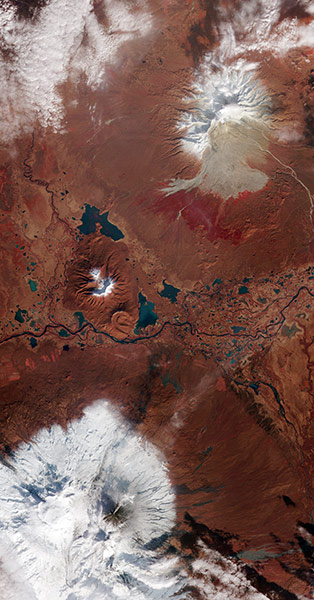
Klyuchevskaya volcano (seen at the foot of this image), on the Kamchatka peninsula in Russia’s far east, continues its frequent but relatively mild volcanic activity, seen here on 11 October. The ash-rich plume is grey, as are the ash-covered slopes near the summit, while snow and clouds are the white areas
Photograph: ASTER/Terra/Nasa
Satellite Eye on Earth: Pyramid Lake in western Nevada
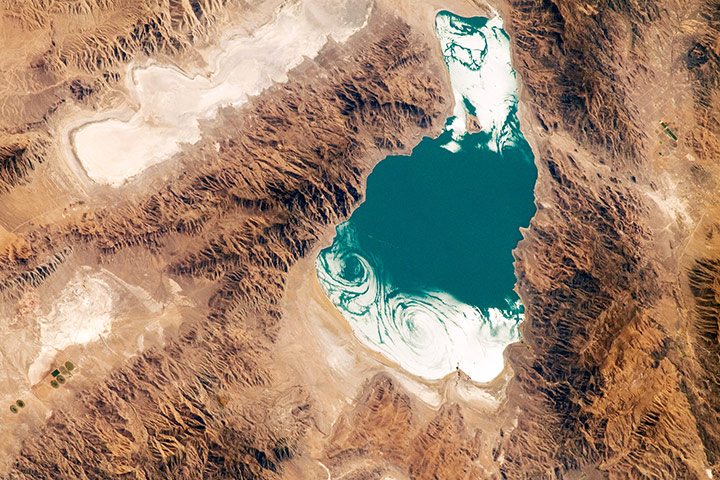
Pyramid lake in western Nevada, USA, is a remnant of the ancient and much larger Lake Lahontan, which formed during the last ice age when the regional climate was significantly cooler and wetter. Pyramid Lake and the now-dry Lake Winnemucca are two of seven smaller lakes that collectively formed Lake Lahontan when water levels were higher. The deepest part of Lake Lahontan survives today as Pyramid Lake. The lake takes its name from one such pyramid-shaped deposit of 'tufa', rock formed by the precipitation of calcium carbonate. Over time, these deposits develop a wide variety of forms including mounds, towers, sheets, and reefs while sometimes coating other rocks. The tufa is exposed when water levels drop due to changes in regional climate or the diversion of water for human use
Photograph: ISS/Nasa
Satellite Eye on Earth:  Hubbard Glacier
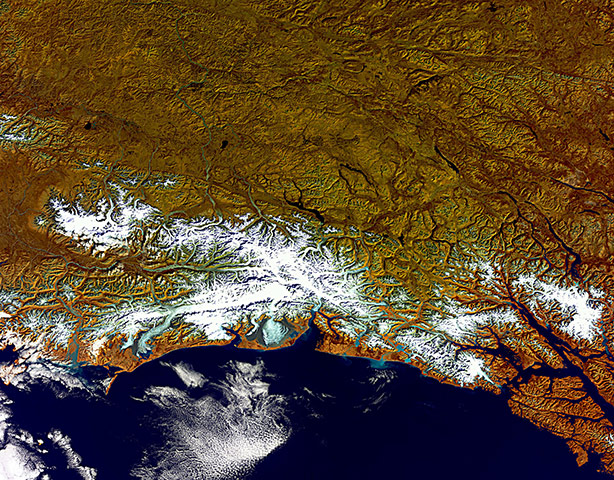
Mountains, glaciers and icefields in south-eastern Alaska and British Columbia, Canada. Hubbard glacier (bottom centre), the largest tidewater glacier in North America, spans the US-Canadian border. Its source is in Canada's Yukon Territory (roughly right of centre), and it stretches across Alaska (left) into Disenchantment Bay, the mouth of Yakutat Bay. The pancake-shaped Malaspina glacier is west of Yakutat Bay. Covering nearly 4000sq km, Malaspina is the largest piedmont glacier in the world. It is so large that it can only be seen in its entirety from space Photograph: Envisat/ESA
Satellite Eye on Earth: Antarctica
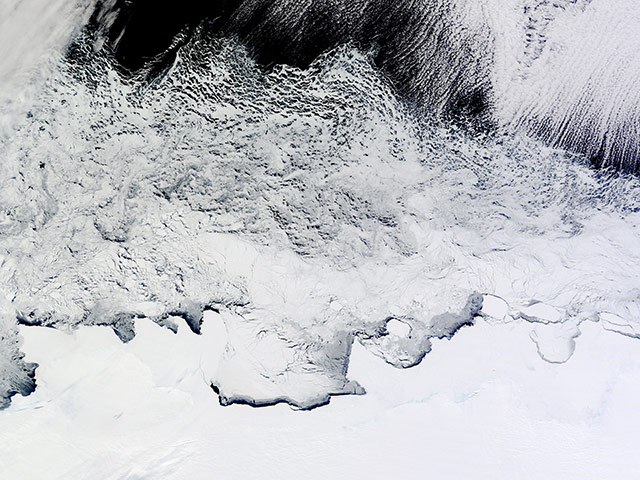
The black waters of the Southern Ocean form a stark backdrop to white land ice and the blues, greys and pale whites of the pack ice and clouds of the Banzare, Sabrina and Budd Law Dome Coasts, Antarctica, on 14 October Photograph: MODIS/Terra/Nasa
Satellite Eye on Earth: Okavango Delta, Botswana
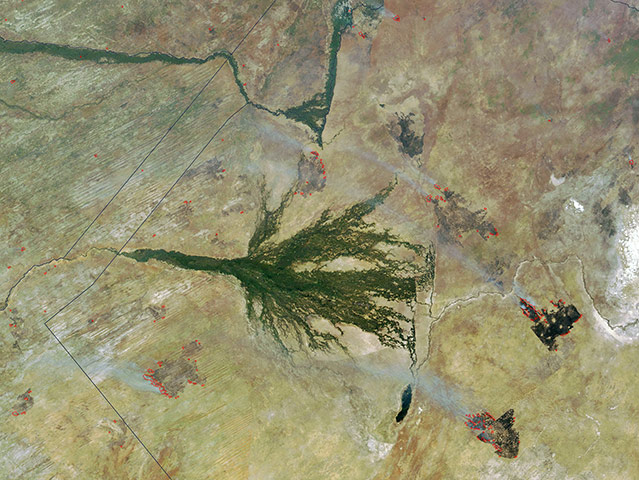
Patches of black, scorched earth and pale grey plumes of smoke surround the Okavango Delta, Botswana, in this 15 October shot. Red boxes outline active fires on the edges of the newly burned land. It is likely that at least some of the large fires were intentionally set to manage vegetation
Photograph: MODIS/Terra/Nasa

Sign up to read this article
Read news from 100’s of titles, curated specifically for you.
Already a member? Sign in here
Related Stories
Top stories on inkl right now
One subscription that gives you access to news from hundreds of sites
Already a member? Sign in here
Our Picks
Fourteen days free
Download the app
One app. One membership.
100+ trusted global sources.