Get all your news in one place.
100’s of premium titles.
One app.
Start reading
The Guardian - UK
The Guardian - UK
Environment

Satellite eye on Earth: May 2010

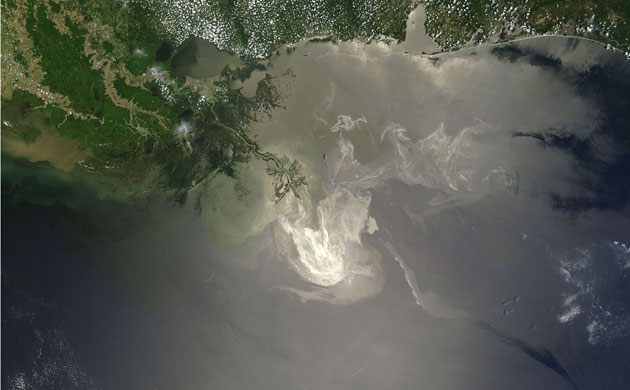
Satellite Eye on Earth: Deepwater Horizon oil spill
Sunlight illuminates the lingering oil slick off the Mississippi delta on 24 May, 2010. In this image, oil smooths the ocean surface, making the Sun’s reflection brighter in some places, and reducing the scattering of sunlight in other places. As a result, the oil slick is brighter than the surrounding water in some places (image centre), and darker in others (lower right). The tip of the Mississippi delta is surrounded by muddy water that appears light tan. Bright white ribbons of oil streak across this sediment-laden water. A small, dark plume along the edge of the slick, not far from the original location of the Deepwater Horizon rig, indicates a possible controlled burn of oil on the ocean surface
Photograph: NASA
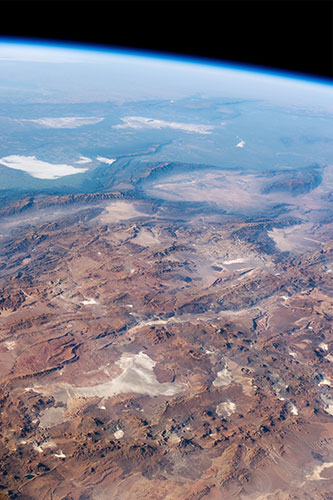
Satellite Eye on Earth: Atacama Desert near Chile’s Pacific coast
This panorama was taken by an astronaut looking south-east across the South American continent when the International Space Station (ISS) was almost directly over the Atacama desert near Chile’s Pacific coast. The high plains (3,000–5,000 metres) of the Andes mountains appear in the foreground, with a line of young volcanoes (dashed line) facing the much lower Atacama desert (1,000–2,000m elevation). Several salt-crusted dry lakes occupy the basins between major thrust faults in the Puna. The largest of these, Salar de Arizaro, is seen in the foreground in this view. The Atlantic Ocean coastline, where Argentina’s capital city of Buenos Aires sits along the Río de la Plata, is dimly visible at image top left
Photograph: ISS/NASA
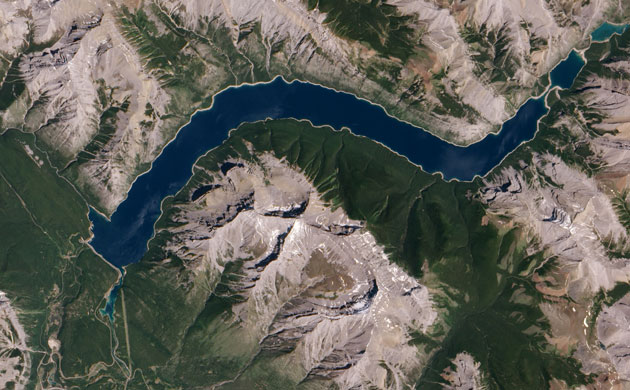
Satellite Eye on Earth: Canada’s Banff National Park, Lake Minnewanka
At the easternmost tip of Canada’s Banff national park lies Lake Minnewanka. The lake fills a zigzagging valley just north-east of the city of Banff. Fed by the Cascade river, Minnewanka owes its existence to a succession of dams, the first built in 1895, the second in 1912, and the third in 1941. The second dam raised the lake’s level by 3.5 metres, and the third dam by 30m. The area has been shaped by a combination of rivers and glaciers. Beginning 25,000 years ago, the Bow valley glacier ground through the region before being overtaken by a continental glacier. Besides the Bow valley, evidence of glaciation also appears in this image south of the lake, in the amphitheatre-shaped cirque
Photograph: ALI/EO-1/NASA
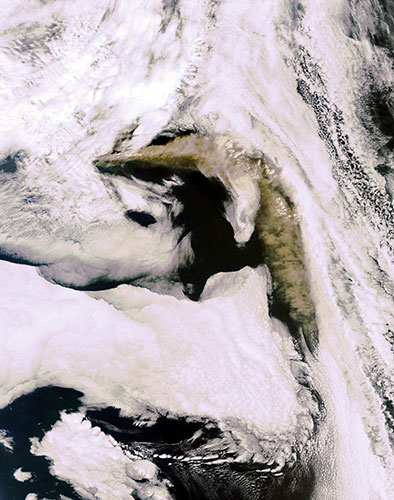
Satellite Eye on Earth:  Iceland’s Eyjafjallajoekull volcano
New eruptions from Iceland’s Eyjafjallajökull volcano have produced a 1,600km-wide ash cloud over the Atlantic. The brownish plume, travelling east and then south, is clearly visible in stark contrast to white clouds framing this Envisat image from 6 May 2010
Photograph: Envisat/ESA
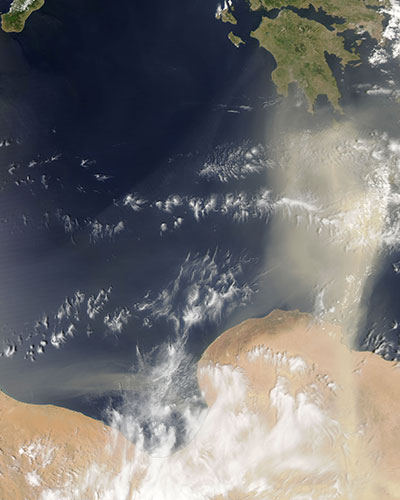
Satellite Eye on Earth: Dust plumes blew off the coast of Libya and over the Mediterranean Sea
Dust plumes blew off the coast of Libya and over the Mediterranean Sea on 13 May, 2010. Thick dust blows northwards off the African coast, past the island of Kriti (Crete), and toward Peloponnisos (Peloponnese). In places, the dust is thick enough to completely hide the land or sea surface below. Source points for the dust storm are not obvious in this image, and the dust may have arisen far inland. More than 90% of Libya’s land surface is desert or semi-desert, and sand seas sprawl over much of the country’s arid interior
Photograph: MODIS/Aqua/NASA
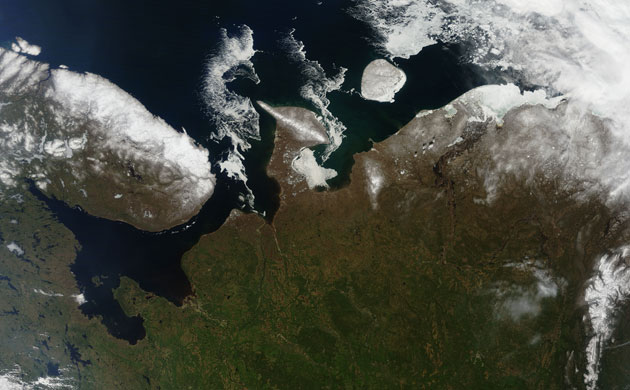
Satellite Eye on Earth: This image of northeastern Russia
This image of north-eastern Russia was captured on 17 May 2010. At the top of the image is the Barents sea. The Kola peninsula on the left contains the Russian Murmansk oblast. This oblast - or administrative region - borders Norway and the Lapland province in Finland. Sweden is also located nearby. Despite it being May, there is still snow on the ground in this northern region. Across the White Sea from Murmansk oblast is the city of Arkhangelsk, visible as a long, pale grey streak on the Northern Dvina river. To the east is Kanin peninsula and nearly circular Kolguyev island
Photograph: MODIS/NASA
Satellite Eye on Earth: Goat Paddock Crater
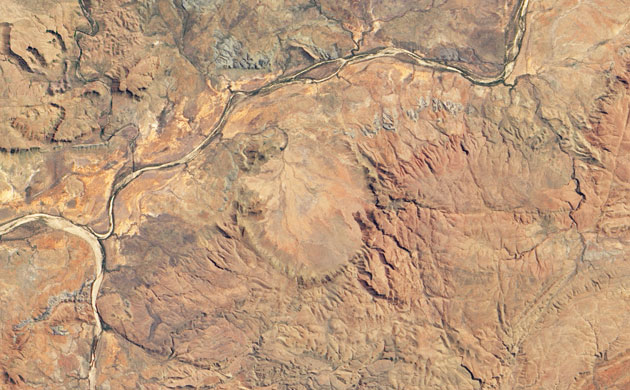
Geologists typically characterise Earth’s impact craters as one of two kinds: simple or complex. Simple craters are relatively small and bowl-shaped, while complex craters are relatively large with central uplifts and slumped rims. Goat Paddock crater, located on the Kimberley plateau of north-west Australia, appears to straddle the simple-complex category. Spanning roughly five kilometres, it has a slightly elliptical shape. The crater is likely less than 50m years old, but the impact bored into sandstones is well over 500m years old. Neither bowl-shaped nor uplifted, the surface of the crater is flat and much of the rim slumps inward
Photograph: NASA
Satellite Eye on Earth: The Amazon region of Brazil
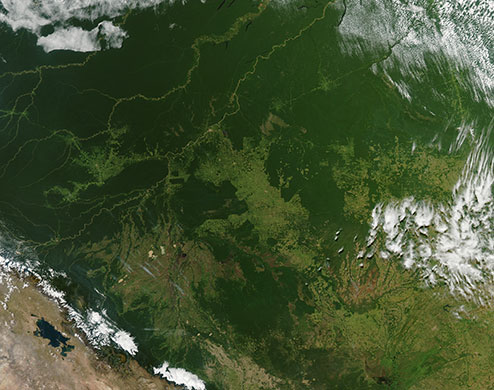
The Amazon region of Brazil, on 12 May, 2010. The red dots are the locations of active fires, which are likely the result of agriculture. The Amazon rainforest (top left) is becoming fragmented by areas of deforestation, which appear as geometric shapes of light green amid the deeper green of remaining forest. The Amazon river runs across this region, but further north than this view shows. The three rivers that run diagonally across the top left corner of the image are Jurua, Purus and Madeira. Rio Madeira runs along the Brazil-Bolivia border for a short time before it continues into Bolivia. Rio Purus runs into Peru. Lake Titicaca is visible on the Peru-Brazil border at the bottom left. It is the largest lake in South America
Photograph: NASA
Satellite Eye on Earth: Deepwater Horizon oil spill
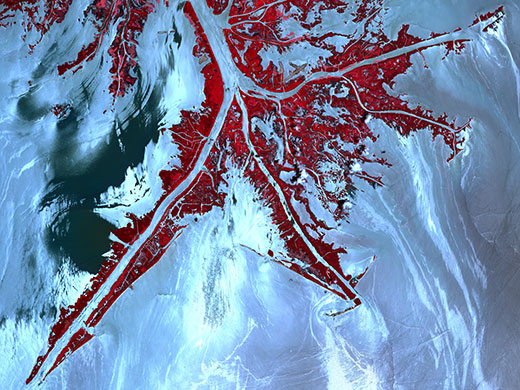
On 24 May, 2010, the Advanced Spaceborne Thermal Emission and Reflection Radiometer on Nasa’s Terra satellite captured this false-colour, high-resolution view of the very tip of the Mississippi river delta. Ribbons and patches of oil that have leaked from the Deepwater Horizon well offshore are silver against the light blue colour of the adjacent water. Vegetation is red. In the sunglint region of a satellite image - where the mirror-like reflection of the Sun gets blurred into a wide, bright strip - any differences in the texture of the water surface are enhanced. Oil smooths the water, making it a better 'mirror'. Oil-covered waters are very bright in this image, but, depending on the viewing conditions (time of day, satellite viewing angle, slick location), oil-covered water may look darker rather than brighter
Photograph: Aster/NASA
Satellite Eye on Earth: hundreds of active fires in southern Democratic Republic of Congo
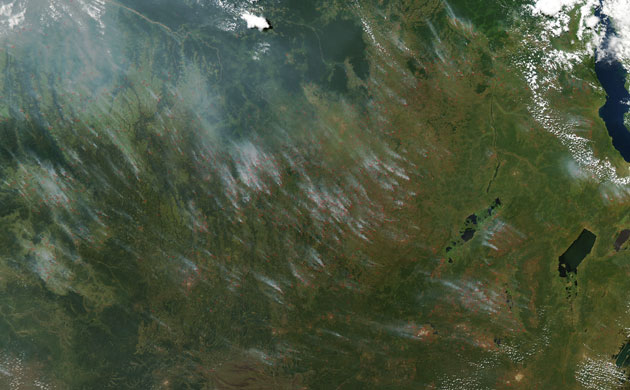
Early in the dry season in Democratic Republic of Congo (DRC), on 13 May, 2010, Modis satellites detected hundreds of active fires - marked here with red dots - in southern DRC and north-eastern Angola, a sign that the agricultural burning season was in full swing. More than half of the gross domestic product of DRC comes from the agricultural sector, and fire is a key part of farming in most of Africa. People burn crop residue to clear fields after harvest, and forest and other natural vegetation to clear new land for farming. Fire is also used to drive game and grazing animals to new locations and to stimulate new growth in pastures. This annual burning has taken place for hundreds - possibly thousands - of years, and is not necessarily hazardous. But it can have a strong influence on air quality and public health, as well as on climate and natural resources
Photograph: MODIS/NASA
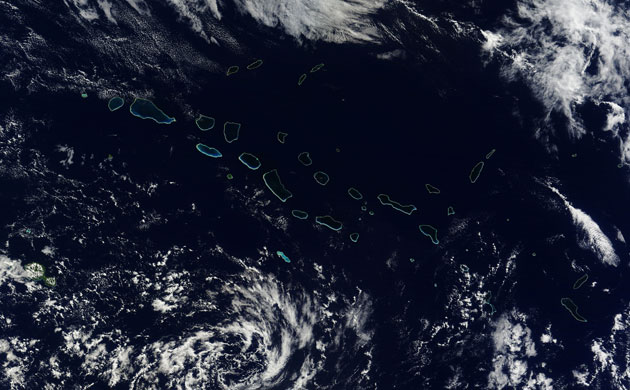
Satellite Eye on Earth: The atolls of the Tuamotu Archipelago
The atolls of the Tuamotu archipelago almost blend into the dark waters around them and are only distinguished in this image by their bright outlines. An atoll is a coral island which either partly or completely surrounds a lagoon. Tuamotu is part of French Polynesia. Lying in the South Pacific Ocean, it is actually the largest chain of atolls in the world, and spans an area around the size of western Europe, though its actual land area is not nearly so big. This image, captured on 19 May, 2010, shows the western end of the archipelago. The largest island on the left is Rangiroa
Photograph: MODIS/Terra/NASA
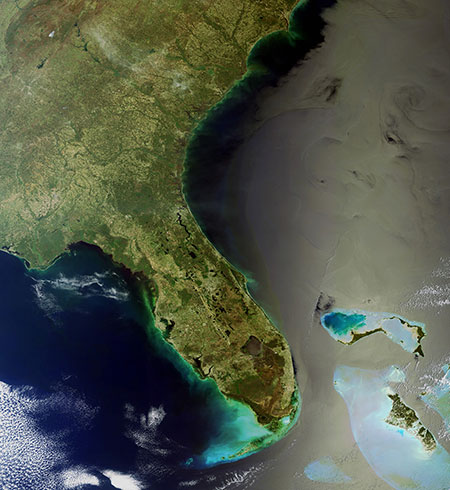
Satellite Eye on Earth: the Straits of Florida
This image shows the straits of Florida, where the loop current flows eastward out of the Gulf of Mexico (visible west of Florida) before joining the Gulf Stream and flowing along the eastern coastlines of the US and Newfoundland
Photograph: MERIS/Envisat/ESA
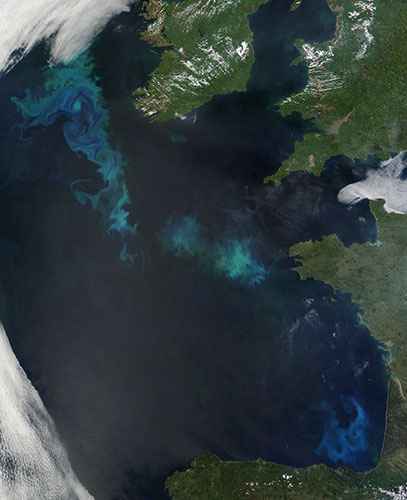
Satellite Eye on Earth: phytoplankton on European coast
Late May 2010 brought peacock-hued swirls of blue and green to the north Atlantic. The iridescent waters formed a giant arc hundreds of kilometres across, extending from west of Ireland to the Bay of Biscay. The vibrant colours are from tiny organisms, phytoplankton, that grow explosively in the north Atlantic - from Iceland to the shores of France - in the spring and summer
Photograph: MODIS/Terra/NASA
Sign up to read this article
Read news from 100’s of titles, curated specifically for you.
Already a member? Sign in here
Related Stories
Top stories on inkl right now
One subscription that gives you access to news from hundreds of sites
Already a member? Sign in here
Our Picks
Fourteen days free
Download the app
One app. One membership.
100+ trusted global sources.