Get all your news in one place.
100’s of premium titles.
One app.
Start reading
The Guardian - UK
The Guardian - UK
Environment

Satellite eye on Earth: March 2010

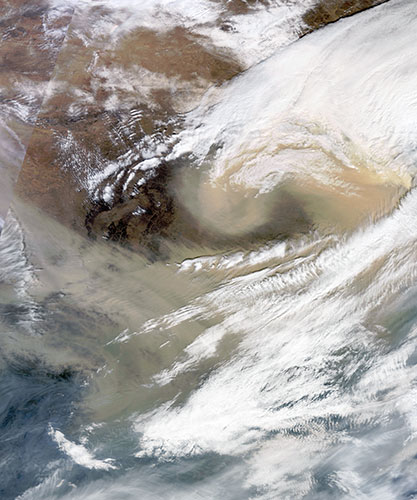
Satellite Eye: massive sandstorm over China
March brought a massive sandstorm to China. Sand was swept thousands of miles south and east from the arid terrain of Inner Mongolia. The yellow dust reduced visibility and air quality to potentially hazardous levels in Beijing, and as far away as Taiwan and Japan. This image shows the storm on 20 March. This pattern is consistent with the passing of a cold weather front bearing a strong area of low pressure at the surface.
Photograph: Modis/Terra/Nasa
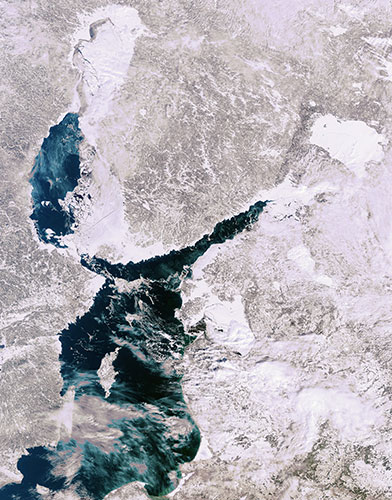
Satellite Eye:  the Baltic Sea
The Baltic Sea, with the northern part of the Gulf of Bothnia (top), the Gulf of Finland (right) and the Gulf of Riga (directly below image centre) covered in ice. This image was acquired on 15 March 2010. The Baltic Sea is a brackish inland sea bounded by the Scandinavian Peninsula, the mainland of Europe and the Danish islands. Bothnia is a Latinisation of Old Norse botn, meaning "bottom".
Photograph: Meris/Envisat/ESA
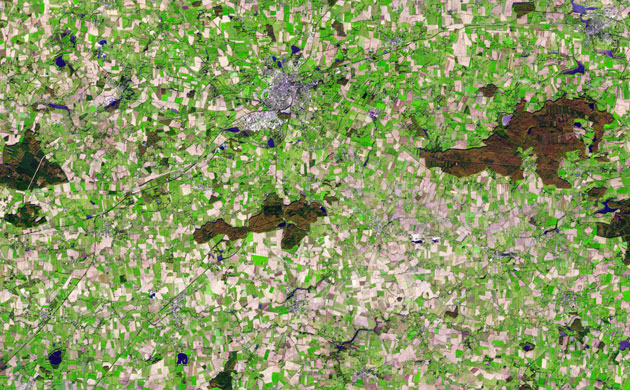
Satellite Eye: Chateaubriant, France, and surrounding as vestiges of Medieval Brittany
This aerial view of Chateaubriant in France is unlike anything ever seen by the human eye. The simulated natural colour satellite image shows the small city as silver because of light bouncing off the reflective surfaces of modern buildings. The surrounding country is an irregular patchwork of small fields – many first enclosed in the Middle Ages. The image shows the region in a combination of visible and infrared light. Plant-covered land is still green and water is dark blue, so this particular combination is called simulated natural colour. By late November, crops had been harvested and many of the fields were bare. The exposed soil ranges from pale tan to brown in the image.
Photograph: Aster/Terra/Nasa
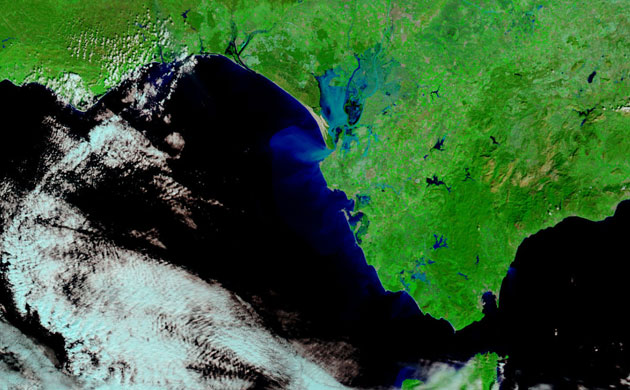
Satellite Eye: Floods in Southern Spain
Heavy rain in southern Spain this year left rivers and lakes swollen and led to the evacuation of more than 1,000 people. The provinces of Cordoba, Jaen and Seville were especially badly affected. Much of the flooding in the province of Seville occurred along the Guadalquivir River, which flows past the city en route to the Gulf of Cadiz. Before emptying into the gulf, the river feeds wetlands along the coast. The landscape appears greener than usual, indicating that greater rain has spurred plant growth in the normally arid region.
Photograph: Modis/Terra/Nasa
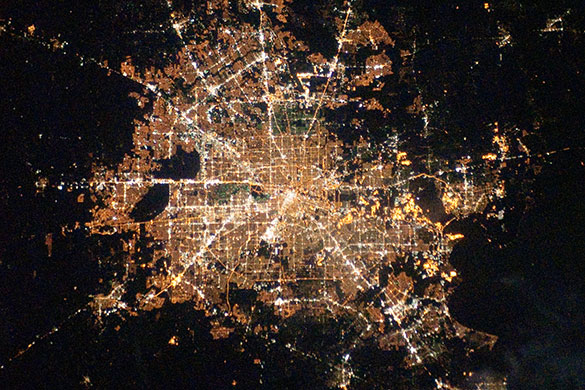
Satellite Eye: Houston, Texas at night
Houston, do we have problem? This night time image shows the lit-up 60-mile wide Texas city. Houston is home to five million people and is the largest area in the US without formal zoning restrictions on where and how people can build. This freedom has led to a highly diverse pattern of land use. The city has been called the energy capital of the world due to its role as a major hub of oil and power industries.
Photograph: ISS/Nasa
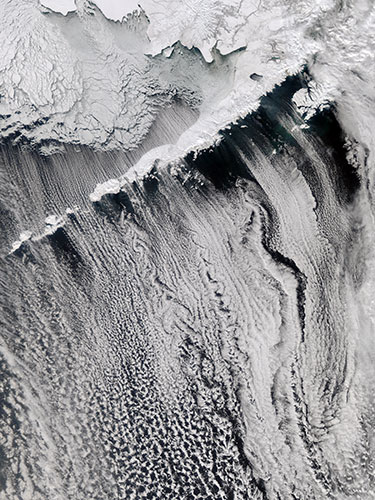
Satellite Eye: Interesting cloud patterns were visible over the Aleutian Islands, Arctic
Interesting cloud patterns were visible over the Aleutian Islands between Alaska and Russia last month. Turbulence, caused by the wind passing over the highest points of the islands, produces the pronounced eddies that swirl the clouds into a pattern called a vortex "street". Here, the clouds have aligned in parallel rows or streets. Cloud streets form when low-level winds move between and over obstacles causing the clouds to line up into rows that match the direction of the winds. At the point where the clouds first form streets, they are very narrow and well-defined. But as they age, they lose their definition, and begin to spread out and rejoin each other into a larger cloud mass.
Photograph: Modis/Aqua/Nasa
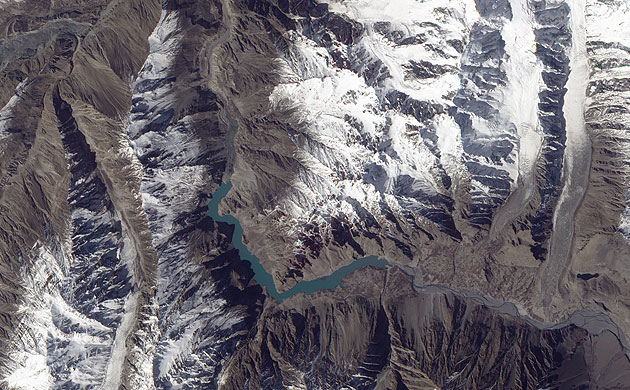
Satellite Eye on Earth: Landslide Lake in Northwest Pakistan
A landslide in the Hunza Valley of northern Pakistan on 10 January buried the village of Attabad, destroying 26 homes and killing 20 people. It also blocked the Hunza River, creating a seven-mile lake that inundated several villages and submerged three miles of the Karakoram Highway. Dark rock covers the river in the upper left corner of the image and the turquoise v-shaped lake stretches out behind the slide. Near the temporary lake, the Karakoram Highway is a faint meandering line of pale brown.
Photograph: ALI/EO-1/NASA
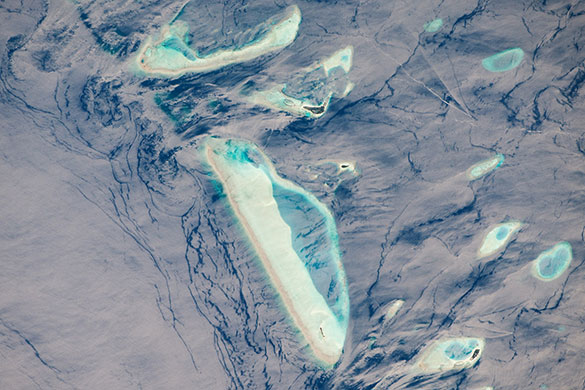
Satellite Eye: Maldive Islands chain
This detailed photograph, taken by an astronaut on the International Space Station, shows one of the numerous atolls in the Maldive Islands. The Maldives are an island nation comprised of 26 atolls that stretch in a north-south chain for almost 560 miles southwest of India. The silvery, almost pink sheen on the normally blue water of the equatorial Indian Ocean in the image is the result of sunglint. Sunglint occurs when sunlight is reflected off water like a mirror, directly back towards the observer. The largest island seen here (centre) is four miles long and is one of the outer ring of larger islands that make up the 40-mile long, oval-shaped Male Atoll. Shores facing deeper water have well-defined beaches. A small boat was navigating between the islets at the time the image was taken, as indicated by its v-shaped wake at top right in the image.
Photograph: ISS/Nasa
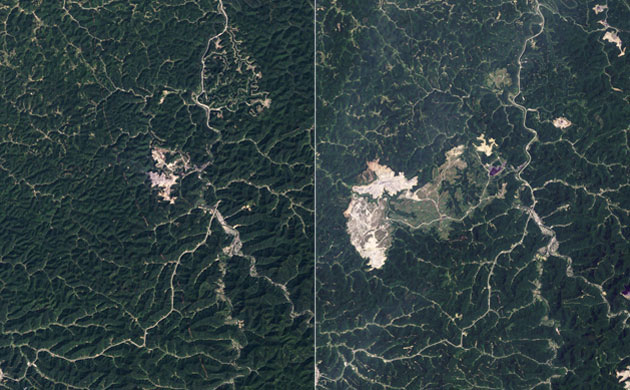
Satellite Eye: Mountain top removal surface mines in West Virginia
This pair of images shows the growth of one of the largest surface mines in West Virginia from 1984 (left) to 2009. The Hobet mine in Boone county reaps coal from thin seams below the densely forested slopes of the Appalachian Mountains. The active mining areas appear off-white, while areas being reclaimed with vegetation appear light green. In 1984, the mining operation is limited to a relatively small area west of the Coal River. By 2009, it is has expanded across more than 15.6 square miles to the south and west.
Photograph: Nasa
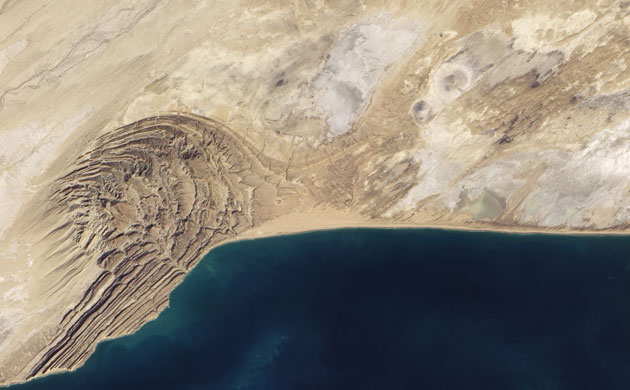
Satellite Eye: Mud volcano of the Chandragup Complex Along the coast of Pakistan
Along the coast of Pakistan, the tectonic plate underlying the Arabian Sea is diving beneath the Eurasian continent. This process of subduction typically creates volcanoes, but the volcanoes that rise from this arid landscape are not the typical kind. Instead of lava, ash, and sulphur dioxide, these volcanoes spew mud and methane. On rare occasions, the gas plumes spontaneously ignite, shooting flames high into the sky. This natural-colour image shows the most dramatic group of mud volcanoes in the area, known as the Chandragup Complex.
Photograph: Ali/EO-1/Nasa
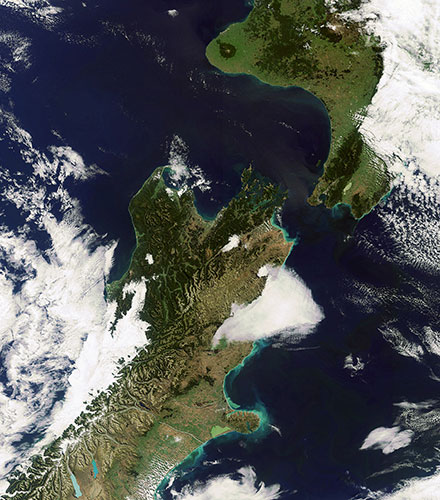
Satellite Eye: New Zealand's North and South Islands, separated by the Cook Strait
New Zealand's North and South Islands, separated by the Cook Strait, pictured on 8 March.
Photograph: Meris/Envisat/ESA
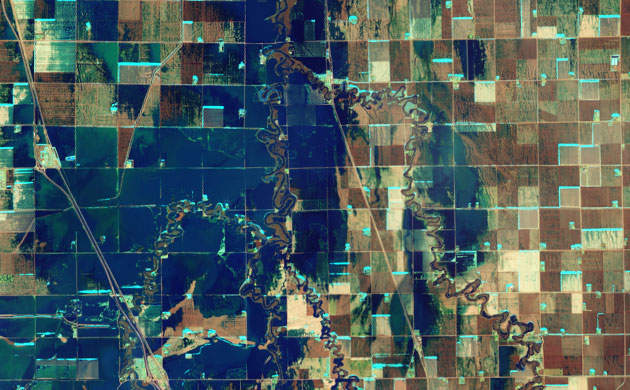
Satellite Eye: Flooding in North Dakota, near Fargo
Dark days in North Dakota – this false-colour image shows standing water (dark blue) after the Red River in the US state burst its banks last month. The river crested at 11.3m (37ft) according to the country's National Weather Service. Although high, this was still 1m below 2009's record. A cold front passing through the area on 19 March slowed the rate of snowmelt feeding local rivers. That, combined with sandbags and dikes, spared the town of Fargo from serious flooding. North of town, however, agricultural fields and roads were submerged. As well as the Red River, the Sheyenne and Buffalo Rivers flow through the area pictured here. The flooding resulted primarily from the Red River’s failure to absorb water from the tributaries feeding it.
Photograph: Ali/EO-1/Nasa
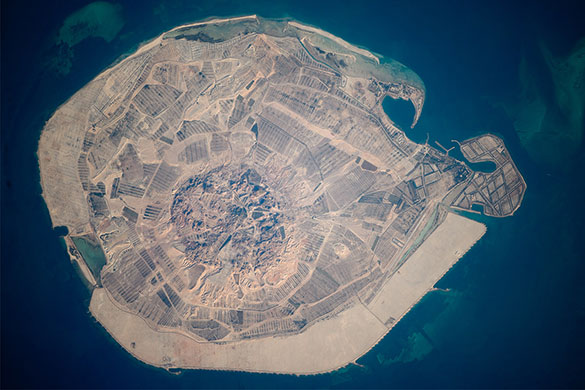
Satellite Eye: Sir Bani Yas Island in the Persian Gulf United Arab Emirates (UAE)
Sir Bani Yas Island is located in the Persian Gulf near the western coastline of the United Arab Emirates (UAE). Roughly 9.7 miles by 6 miles, the island is the surface expression of a salt dome – a pocket of salt minerals that balloons upward into overlying layers of sedimentary rocks. Sir Bani Yas Island was the personal retreat of the late Sheikh Zayed Bin Sultan Al Nahyan who was president of the UAE from 1971-2004. He established a nature reserve on the island for animals native to the Arabian Peninsula (including striped hyena, cheetah, oryx, ostrich, and gazelle) that is now open to the public.
Photograph: ISS/Nasa
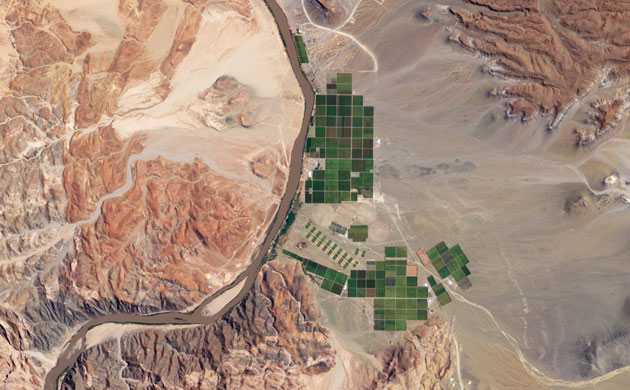
Satellite Eye: The Orange River serves as border between Namibia and South Africa
The Orange River serves as part of the border between Namibia and South Africa. Along the river’s banks, roughly 60 miles inland from where it empties into the Atlantic, irrigation projects take advantage of water from the river and soils from the floodplains to grow produce, turning parts of a normally earth-toned landscape emerald green. A network of bright rectangles of varying shades of green contrasts with surroundings of grey, beige, tan and rust. Grapes are the primary agricultural product of this area. Thanks to local climatic conditions, grapes from Namibia are often ready for market two to three weeks before those in South Africa’s Cape.
Photograph: Ali/EO-1/Nasa
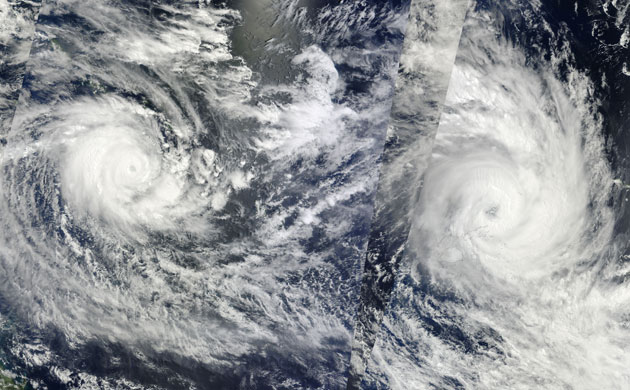
Satellite Eye: Tropical Cyclone Ului and Tropical Cyclone Tomas over South Pacific Ocean
Two fierce tropical cyclones raged over the South Pacific Ocean in mid-March 2010, the US Navy’s joint typhoon warning centre (JTWC) reported. Over the Solomon Islands, tropical cyclone Ului had maximum sustained winds of 150mph and gusts up to 180mph. Over Fiji, tropical cyclone Tomas had maximum sustained winds of 132mph and gusts up to 160mph. Tomas reportedly forced more than 5,000 people from their homes while the islands sustained damage to crops and buildings.
Photograph: Modis/Terra and Aqua/Nasa
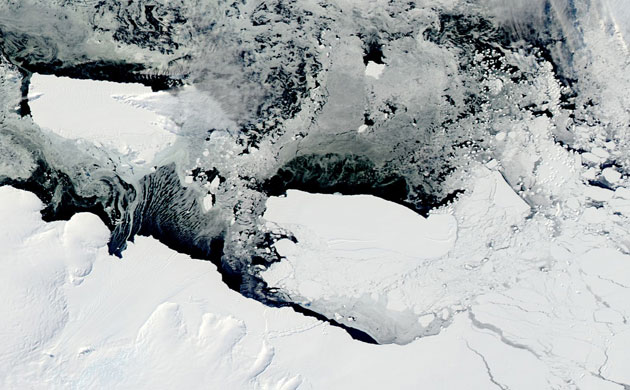
Satellite Eye: Two massive icebergs drifted along the coast of East Antarctica
As two giant icebergs lingered along the coast of Antarctica on 15 March, 2010, the Modis (Moderate-resolution Imaging Spectroradiometer) on the Aqua satellite captured this true-colour image of iceberg B-09B (left) and the iceberg recently broken off the Mertz glacier (right).
Photograph: Modis/Aqua/Nasa
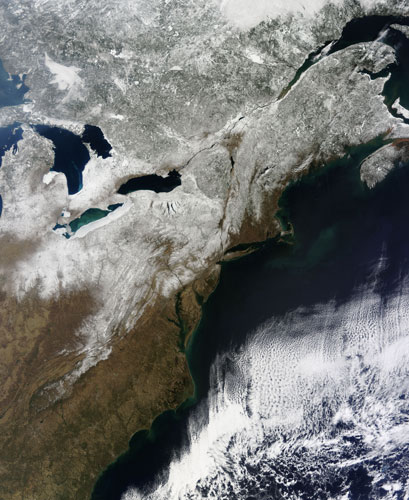
Satellite Eye: snow over eastern Great Lakes and the Atlantic Ocean
By early March 2010, several winter storms had left snow cover stretching from Canada southward to West Virginia. Mostly clear skies over the eastern US and Canada allowed this unobstructed view on 6 March. The navy blue of the eastern Great Lakes and the Atlantic Ocean contrasts with the snow cover. South of Lake Ontario, the Finger Lakes resemble giant claw marks in otherwise snow-covered New York state. Snow appears the most opaque in Ohio, central New York and between Lake Huron and its neighbouring lakes to the east.
Photograph: Modis/Terra/Nasa
Satellite Eye: the Betsiboka River in northwestern Madagascar
In northwestern Madagascar, the Betsiboka River flows towards the coast, its braided streams emptying into the Bombetoka Bay on 23 March. In late March, however, not long after tropical cyclone Hubert passed through the region, part of the river pushed over its banks, flooding nearby fields. The wide beige-and-green swath filling most of the image is flooded and uneven rectangles demarcate individual fields. Only areas of relatively high ground appear to have escaped standing water. Madagascar authorities said at least 36 people died and 85,000 others were affected.
Photograph: Ali/EO-1/Nasa
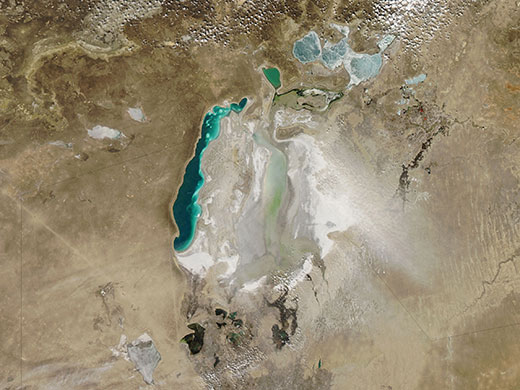
Satellite Eye on Earth: Dust plumes rose from desiccated lakebed sediments of the Aral Sea
Dust plumes rose from desiccated lakebed sediments of the Aral Sea in central Asia on 26 March. Local sediments have become a repository for salt, fertilisers and pesticides frequently used in irrigated farming. The increased frequency of dust storms combined with the chemicals contained in the lakebed sediments raised concerns about the impact on human health in the region.
Photograph: Modis/Aqua/Nasa
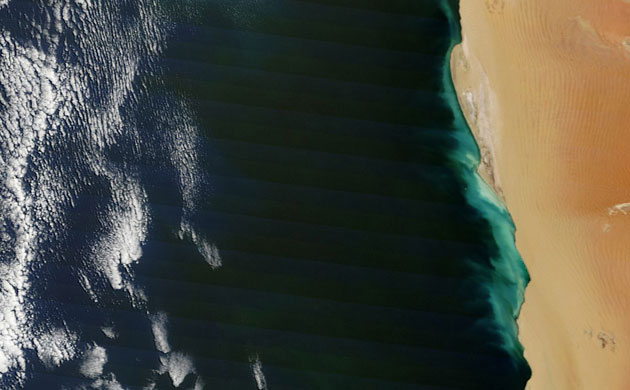
Satellite Eye on Earth: Hydrogen sulfide erupted along the coast of Namibia
Hydrogen sulphide erupted along the coast of Namibia. Pale-hued waters along the shore hinted at gaseous rumblings on 13 March, 2010. Although ocean water appears navy blue farther from shore, water along the coast ranges in colour from green to off-white. Ocean water wells up in this area along the continental shelf. The milky surface waters that coincide with gaseous eruptions along the coast have a low oxygen content. The frequent hydrogen sulphide emissions in this area result form a combination of factors: ocean-current delivery of oxygen-poor water from the north, oxygen-depleting demands of biological and chemical processes in the local water column and carbon-rich organic sediments under the water column. Commercially important fish species have hatching grounds along the Namibian coast and hydrogen sulphide eruptions often kill large numbers of fish.
Photograph: Modis/Terra/Nasa
Sign up to read this article
Read news from 100’s of titles, curated specifically for you.
Already a member? Sign in here
Related Stories
Top stories on inkl right now
One subscription that gives you access to news from hundreds of sites
Already a member? Sign in here
Our Picks
Fourteen days free
Download the app
One app. One membership.
100+ trusted global sources.