Get all your news in one place.
100’s of premium titles.
One app.
Start reading
The Guardian - UK
The Guardian - UK
Environment

Satellite eye on Earth: June 2010

Satellite Eye on Earth:  Soccer City sits in Johannesburg's Soweto Township
The site of the 11 June opening game of the 2010 World Cup, Soccer City, sits in Johannesburg's Soweto township. Previously named the FNB Stadium, the facility was upgraded for the 2010 World Cup games. Shaped roughly like a rectangle with rounded corners, the stadium has high walls that cast long shadows toward the south-west. Capable of seating 94,700 spectators, Soccer City is nevertheless dwarfed by nearby slag piles left over from decades-long mining operations. The slag heaps hold massive dumps of crushed rock discarded after gold extraction. Gold-bearing rock layers were originally discovered in this region in the late 19th century, and gold mining long powered South Africa's economy. On the opposite side of the slag piles from Soccer City is Diepkloof, and other settlements comprising Soweto
Photograph: ALI/EO-1/NASA
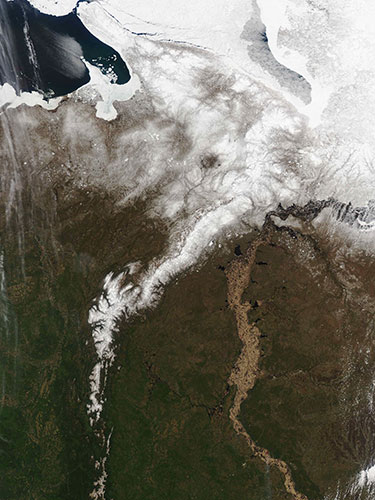
Satellite Eye on Earth: Ob river flows into the Gulf of Ob and Kara Sea
At the beginning of June this region of Russia was still covered with ice and snow. Near the top left corner, you can see the bottom tip of the Novaya Zemlya archipelago and the Kara strait, which separates it from mainland Russia. The body of water east of the Kara strait, at the top centre of the image is the Kara Sea. It's currently covered with ice. Novaya Zemelya is not far south of the Arctic circle, so the wintery landscape is not surprising. The body of water coming into the scene from the middle of the right side of the image is the Gulf of Ob. At the southwestern-most part of the gulf is the mouth of the Ob river. Freshwater from the Ob flows into the Gulf of Ob and then out into the Kara Sea
Photograph: MODIS/Aqua/NASA
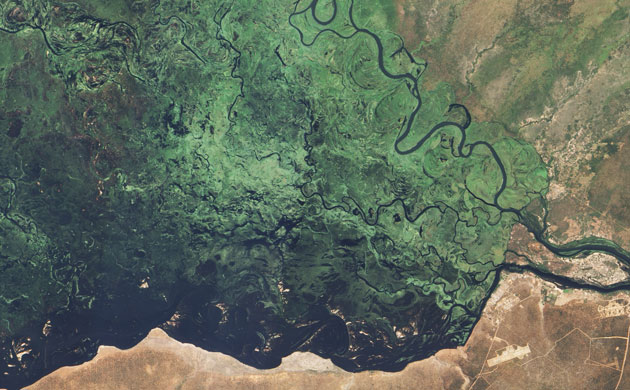
Satellite Eye on Earth:  Zambezi River floodplain
The Zambezi river is one of the great rivers of Africa. Originating in swampy wetlands in Angola in south-western Africa, the river flows 1,700 miles across the continent to the Indian Ocean. Along the way, the Zambezi tumbles over one of the world’s largest waterfalls, flows through deep gorges, and spreads across broad floodplains. This highly detailed true-colour image shows the stark eastern edge of the Zambezi floodplain during the river's annual flood. To the left of the edge, water covers everything. Deep blue channels wind among green, shallowly flooded plains. To the right of the edge, the land is dry. The city of Kasane is perched along the edge of the flood plain. The eastern edge of the flood plain is defined by the Mambova fault, which elevated the land on its eastern side. The Zambezi and Chobe rivers cut channels across the fault, but the shallow flood plain has not surmounted the elevated ground
Photograph: ALI/EO-1/NASA
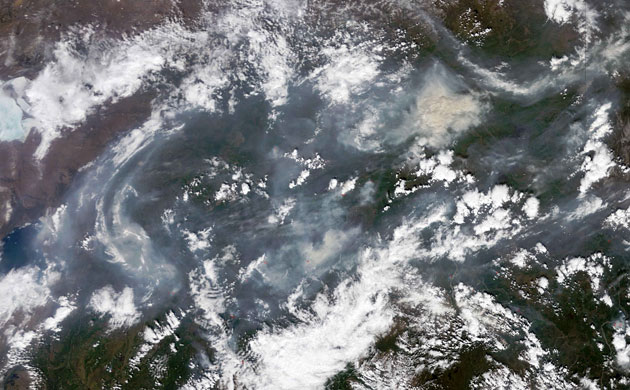
Satellite Eye on Earth: fires in Alaska
The stark white cloud cover is mixed in with more diffuse grey smoke from fires in Alaska on 30 May 2010. Each active fire is marked by a red dot. According to the Alaska Interagency Coordination Centre in Fairbanks, an unusually dry winter and spring have already resulted in 293 wildfires burning 463,000 acres this year. In fact, the fire activity in May was unprecedented and more typical of extreme July conditions. Most of the fires are caused by lightning
Photograph: MODIS/Terra/NASA
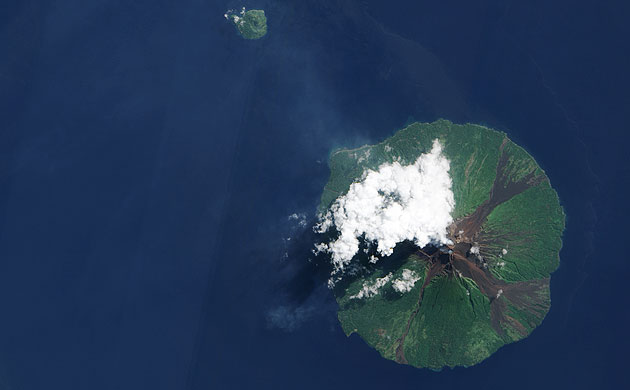
Satellite Eye on Earth: Papua New Guinea's Manam Volcano
Papua New Guinea's Manam Volcano released a thin, faint plume on 16 June, 2010, as clouds clustered at the volcano's summit. Brown valleys, bare of vegetation, extend downwards from the summit craters. The valley floors are filled with recent lava flows and scoured by hot volcanic avalanches (called pyroclastic flows). The remaining slopes are carpeted in lush tropical vegetation
Photograph: ALI/EO-1/NASA
Satellite Eye on Earth: A smoke-free Iceland : The Eyjafjallajokull volcano
A smoke-free Iceland: The Eyjafjallajökull volcano, which had a series of eruptions in April and May, is visible in the dark area on the southern coast. The Vatnajökull glacier (visible in white north-east of Eyjafjallajökull) is the largest in Iceland and in Europe. The white circular patch in the centre of the country is Hofsjökull, the country's third largest glacier and its largest active volcano. The elongated white area west of Hofsjökull is Langjökull, Iceland's second largest glacier
Photograph: MERIS/Envisat/ESA
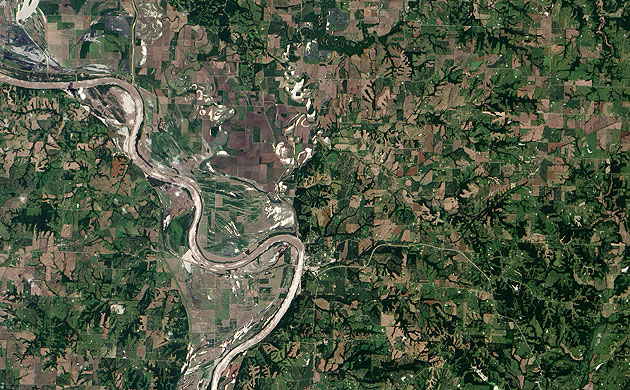
Satellite Eye on Earth: The Missouri River spilled over its banks around Glasgow, Missouri
The Missouri river burst its banks around Glasgow, Missouri, on 19 June. West of the town of Glasgow, the river curves toward the south-west and then toward the north-east. Immediately west of town, the river takes a sharp turn toward the south. In the bend in the river before its north-eastern turn, flooding is apparent. Muddy brown water has collected north of the river, along Epperson island. More flood water appears south and west of the river. Patches of off-white on the water surface result from sunglint. Away from the river and the town, the land in this area appears primarily as a patchwork of brown and green crop lands interspersed with patches of trees
Photograph: ALI/EO-1/NASA
Satellite Eye on Earth: Saharan dust ferried across the Atlantic on easterly winds
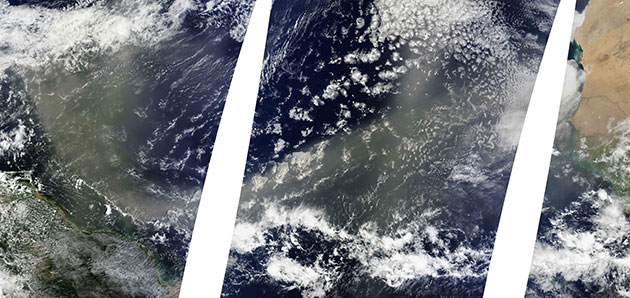
These photo-like satellite images stitched together from 1 June shows Saharan dust being ferried across the Atlantic on easterly winds. Terra satellite orbits from pole to pole. It returns to the same latitude roughly every 90 minutes, progressing westward with each orbit. Thus, the right side of this image was captured before the left side; grey areas show gaps between satellite overpasses. Each year, mostly in the Northern hemisphere winter, storms like the one pictured here deliver about 40m tonnes of dust from the Sahara to the Amazon river basin. The minerals in the dust replenish nutrients in rainforest soils, which are continually depleted by drenching, tropical rains. From more than 8,000km away, the barren Sahara nourishes the lush vegetation of the Amazon
Photograph: MODIS/Terra/NASA
Satellite Eye on Earth: nighttime appearance of the France-Italy border
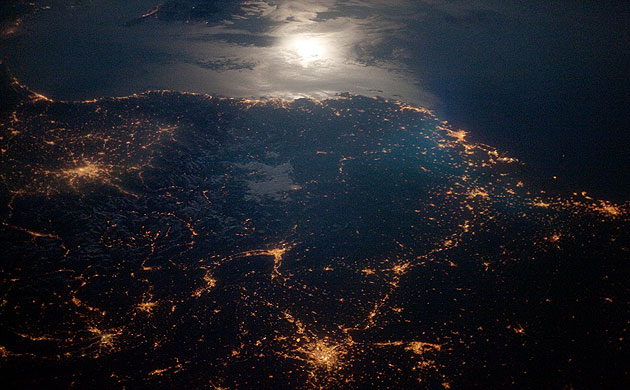
The brightly lit metropolitan areas of Turin (Italy), Lyon, and Marseille (both in France) stand out amid numerous smaller urban areas in this dramatic astronaut photograph. The image captures the night-time appearance of the France-Italy border. The south-western end of the Alps separates the two countries. The island of Corsica is visible in the Ligurian Sea to the south (image top). The full moon reflects brightly on the water surface and also illuminates the tops of low patchy clouds over the border (image centre)
Photograph: ISS/NASA

Satellite Eye on Earth: Ash, volcanic debris, and snow mingled at the summit of Mount Cleveland
Ash, volcanic debris, and snow mingled at the summit of Mount Cleveland, Alaska on 4 June. Clouds nearly surround the snow-capped volcano, which is striped with dark ash. A small, faint plume rises from the summit. Cleveland is a symmetrical stratovolcano at the western end of Chuginadak island in the Aleutian islands. At the bottom of the image, Herbert island can be seen peeping through the clouds and Carlisle island on top left
Photograph: ALI/EO-1/NASA
Satellite Eye on Earth: Canary Island archipelago
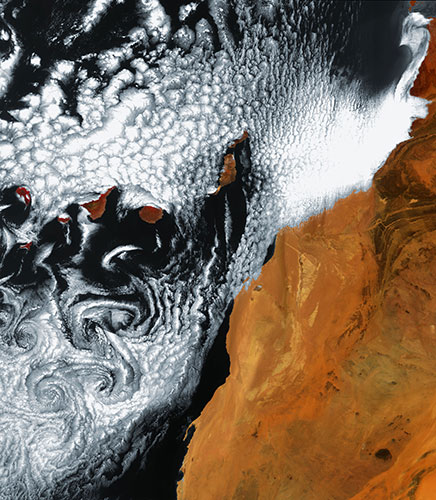
This satellite view highlights a unique cloud formation south of the Canary islands, some 95 km from the north-west coast of Africa (right) in the Atlantic Ocean. Seven larger islands and a few smaller ones make up the Canaries; the larger islands are (left to right): El Hierro, La Palma, La Gomera, Tenerife, Gran Canaria, Fuerteventura and Lanzarote
Photograph: Envisat/ESA
Satellite Eye on Earth: Petit Bois Island and  Horn Island, Deepwater Horizon BP oil spill
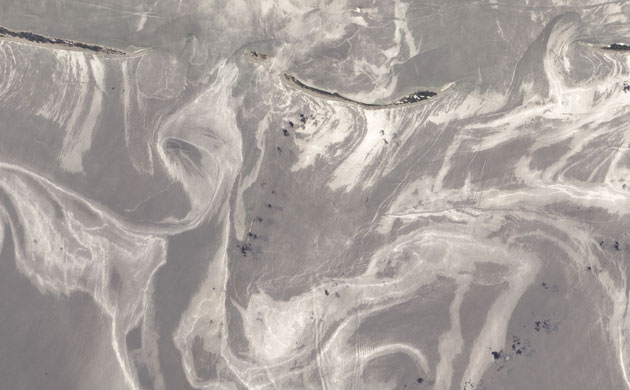
As of 27 June, the entire gulf-facing beachfront of several barrier islands in eastern Mississippi (offshore of Pascagoula) were listed as at least 'lightly oiled' by the interagency Shoreline Cleanup Assessment Team. This high-resolution image shows Petit Bois island (right) and the eastern end of Horn island (left). In general, oil-covered waters are silvery and cleaner waters are blue-gray. This pattern is especially consistent farther from the islands. The intensely bright patches of water directly offshore of the barrier islands, however, may be from a combination of factors, including sediment and organic material, coastal currents and surf, and oil
Photograph: ALI/EO-1/NASA
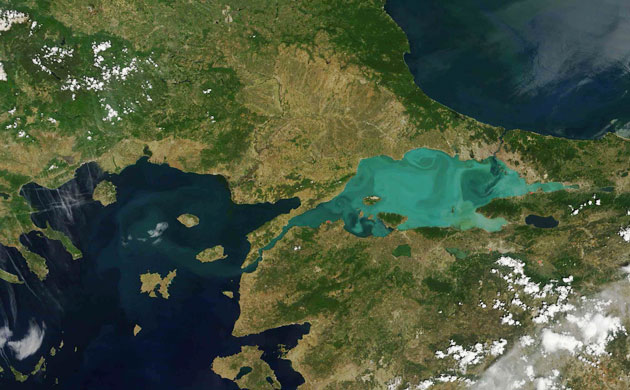
Satellite Eye on Earth: Sea of Marmara, located in Turkey
The region around the Aegean Sea. The large, bright coloured body of water near the centre of the image is the Sea of Marmara, located in Turkey. An inland sea, it is connected to the Aegean in the west by the Dardanelles strait, and to the Black Sea in the east by the Bosporus strait. The Sea of Marmara isn't always this brightly coloured; this is caused here by a bloom of the Emiliania huxleyi species of phytoplankton - tiny marine plants
Photograph: MODIS/Terra/NASA
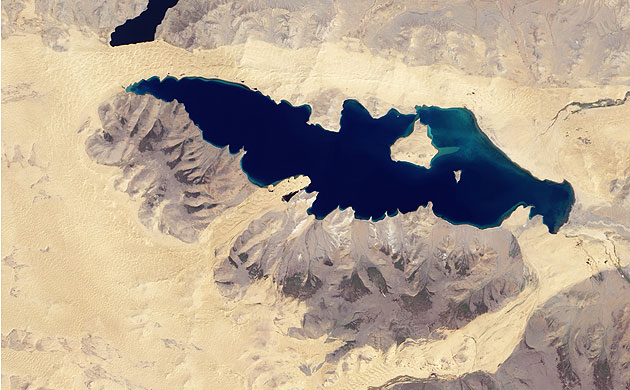
Satellite Eye on Earth: Telmen Nuur lake, Mongolia
In western Mongolia, braided streams of sand dunes stretch east-west across the arid landscape. One ribbon of sand, spanning roughly 200km, extends from an area south of Khyargas lake in the west to a smaller lake, Telmen Nuur, in the east. In between, sand dunes march past Har Nuur, or Black lake. Camel-coloured sand dunes ripple along the lake's northern shore. Along the southern shore, sand dunes approach the lake in just two locations. A triangle-shaped expanse of sand borders Har Nuur in the east, and a tongue of sand intrudes into the lake in the west, pushing through a gap in the nearby mountains
Photograph: ALI/EO-1/NASA
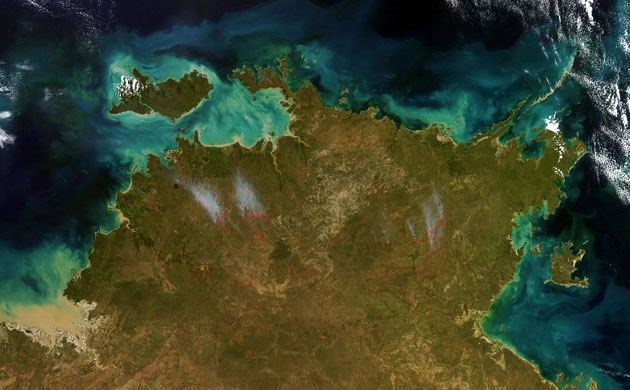
Satellite Eye on Earth: Wildfires burned along Australia's northern coast
Wildfires burned along Australia's northern coast on 2 June. The red outlines are hotspots associated with wildfires, and many of the fires appear in large clusters spanning tens of kilometres. The thickest smoke appears south-east of the coastal city of Darwin
Photograph: MODIS/Aqua/NASA
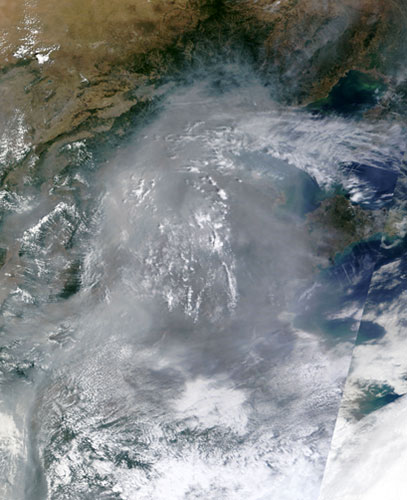
Satellite Eye on Earth: smooth gray haze over Northern China
Thick haze hung over eastern China on 25 June. The smooth grey haze lies low over the land, seeping into the valleys of the Luliang mountains on the west and north sides of the plain. The path of the Yellow River between the Luliang and Qin Ling mountains to the south is a channel for haze flowing between the north China plain and locations south and west. The river itself is hidden beneath the opaque air. Scattered white clouds hang over the haze
Photograph: MODIS/Terra/NASA
Satellite Eye on Earth: the southern Mingachevir Reservoir in north-central Azerbaijan
This photograph shows the southern Mingachevir reservoir in north-central Azerbaijan. The reservoir occupies part of the Kura basin, a topographic depression located between the Greater Caucasus mountains to the north-east and the Lesser caucasus mountains to the south-west. Folded layers of relatively young sedimentary rock, explosive volcanic products, and other sediments form the grey hills along the northern and southern shorelines of the reservoir (image centre and right). The nearby city of Mingachevir (left) is split by the Kur River after it passes through the dam and hydroelectric power station complex (image top). The current city was built to support the hydroelectric power station constructed as part of the then-Soviet Union's energy infrastructure for the region
Photograph: ISS/NASA
Satellite Eye on Earth: Sunset on the Indian Ocean
This spectacular image of sunset over the Indian Ocean was taken by astronauts aboard the International Space Station. It presents an edge-on, or limb view, of the Earth's atmosphere as seen from orbit. The Earth's curvature is visible along the horizon line, or limb, that extends across the image from centre left to lower right. Above the darkened surface of the Earth, a brilliant sequence of colours roughly denotes several layers of the atmosphere. Deep oranges and yellows appear in the troposphere, which extends from the Earth's surface to 6-20km high. The pink to white region above the clouds appears to be the stratosphere and it extends up to approximately 50km above the Earth's surface. Above the stratosphere, blue layers likely mark the transition between the middle and upper atmosphere as it gradually fades into the blackness of outer space
Photograph: ISS/NASA
Sign up to read this article
Read news from 100’s of titles, curated specifically for you.
Already a member? Sign in here
Related Stories
Top stories on inkl right now
One subscription that gives you access to news from hundreds of sites
Already a member? Sign in here
Our Picks
Fourteen days free
Download the app
One app. One membership.
100+ trusted global sources.