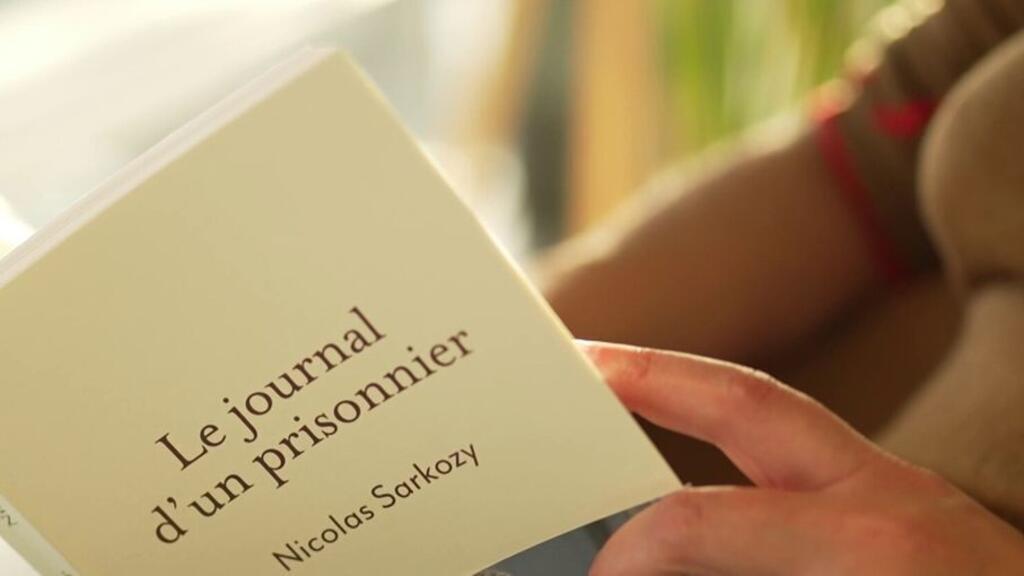
One month after Nicolas Sarkozy walked out of prison, the former French president's new book Diary of a Prisoner, recounting his 20 days behind bars, was released this week. Philippe Moreau-Chevrolet, a political communication specialist at Sciences Po Paris, tells RFI this is no simple memoir, but rather a calculated move to regain control of the narrative and reopen the door to political influence.
RFI: What is your impression of Diary of a Prisoner?
Philippe Moreau-Chevrolet: Nicolas Sarkozy leans heavily on emotion and this fits with his wider media defence strategy, which aims to strengthen his legal defence. He starts talking about his conviction almost straight away, so there is clearly a wish to protect his image for the future – since this is the first time in the history of the Fifth Republic that a president has been sent to prison.
The book focuses on injustice, but it is not a self-pitying story. By bringing in The Count of Monte Cristo – the Alexandre Dumas novel about a man seeking revenge after an unjust conviction, one of the two books he took to La Santé prison in Paris – he shapes the story as one of vengeance.
Former French president Sarkozy released from prison, pending appeal
He places himself in a future where he has won his legal battles and taken revenge for this humiliation.
From the start he also repeatedly invokes a comparison with Christ. Firstly, that speaks to right-wing voters. But it is also a way of saying he has sacrificed himself. It is a story of trial, suffering, sacrifice and revenge. It is not about redemption. This matches his legal defence, because he cannot say anything else without incriminating himself.
At the end, he even writes: "I started my life again." The idea is he has been reborn stronger, more mature, more serious. This also has a therapeutic role for him – letting go of this episode and showing where he stands today. It is a story of rebirth.
He also says he already knew he would be released at his appeal hearing, so he went jogging and stayed active straight away. For him, the key is to show he is still in fighting mode.
RFI: Can the release of the book be seen as a well-orchestrated communication exercise?
PMC: For him, this is a long-term fight. The aim is to make himself heard as much as possible, with every tool available. He appeals to public opinion through dramatic moments – the people who accompanied him to prison, the gathering of his supporters, his many statements in the press.
It creates an emotional build-up around him to maximise attention and cast the accused in a favourable light. In the end this is a frontal attack on the judiciary and on those who accuse Nicolas Sarkozy, using the most forceful approach possible because of how serious the situation is.
RFI: The book was published by Fayard, a publishing house owned by conservative billionaire Vincent Bolloré…
PMC: Yes, there are opportunistic strategies at work. On the far-right side there is clearly an attempt to capture this Sarkozy moment and his electorate. That is what is at stake for 2027. The strategy for Marine Le Pen and for Bolloré’s media is to take up the defence of the former head of state and pull those voters towards them.
The National Rally is increasingly aligned, under Jordan Bardella, with the communication and campaign methods of the American far right – judges are enemies, adversaries, elites to bring down, and a conviction can make you look like a hero.
For the far-right electorate, Nicolas Sarkozy’s conviction is not a negative thing. It can even attract support.
Sarkozy is also trying to win over that electorate for future elections. In his book he even calls for a “rally” with the National Rally. This could become a point of convergence between the two forces, assuming Nicolas Sarkozy still carries real weight, which is hard to judge today.
The fall of France's Nicolas Sarkozy, from palace to prison
RFI: Could the memoir's release influence Sarkozy’s political agenda and his return to public life?
PMC: The book gives him a platform to communicate, appear in the media and get people talking again. It should give him some room to manoeuvre and a bit of airtime to influence the 2027 election. It puts him back in the political debate, because when he talks about the National Rally he pushes an agenda about recovering far-right voters and uniting the right.
He cannot do anything other than step back into his role as a political figure. Stopping now would look like admitting defeat. He is not ready for that. He does not want to lose his reputation or his influence. This is also typical of Sarkozy-style communication.
I am thinking of Rachida Dati, who gave a speech on the steps of the Élysée in heels five days after giving birth. It is a staged image of resilience, comeback and invincibility that is part of their communication code.
RFI: The book was published in record time, and Sarkozy posted on social media: "The end of the story remains to be written." Is this an attempt to divert attention from his conviction?
PMC: It is mostly a way to frame the debate and shape how the public sees this episode. That is his whole aim.
He is releasing the book quickly to try to control the story before others define it. Speed matters – not letting others talk first and taking part in building the narrative rather than suffering it.
As with all media defence strategies in legal cases, the goal is to make sure the public hears the accused’s version first and identifies with it as much as possible. The reasons for the charges and the trial fade into the background.
This is a classic defence strategy: victimisation, challenging the media and the judges, and presenting his own truth. Repetition is key. He will repeat the same message in the media, in the book, everywhere, so that his version becomes dominant.
The reasons for the conviction are very complex – the investigation file is 400 pages long. Faced with a very simple and emotional message – the book – the competition [between the two narratives] is inevitably unequal.
This interview was adpated from the original version in French by Caroline Renaux.